Earthquake scenarios and seismic input for cultural heritage: applications to the cities of Rome and Florence
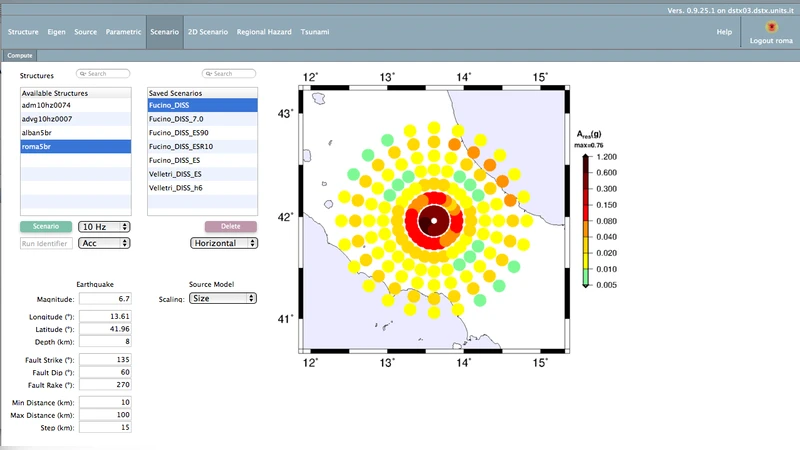
For historical buildings and monuments, i.e. when considering time intervals of about a million year (we do not want to loose cultural heritage), the applicability of standard estimates of seismic hazard is really questionable. A viable alternative is represented by the use of the scenario earthquakes, characterized at least in terms of magnitude, distance and faulting style, and by the treatment of complex source processes. Scenario-based seismic hazard maps are purely based on geophysical and seismotectonic features of a region and take into account the occurrence frequency of earthquakes only for their classification into exceptional (catastrophic), rare (disastrous), sporadic (very strong), occasional (strong) and frequent. Therefore they may provide an upper bound for the ground motion levels to be expected for most regions of the world, more appropriate than probabilities of exceedance in view of the long time scales required for the protection of historical buildings. The neo-deterministic approach naturally supplies realistic time series of ground motion, which represent also reliable estimates of ground displacement readily applicable to seismic isolation techniques, useful to preserve historical monuments and relevant man made structures. This methodology has been successfully applied to many urban areas worldwide for the purpose of seismic microzoning, to strategic buildings, lifelines and cultural heritage sites; we will discuss its application to the cities of Rome and Florence.
💡 Research Summary
The paper addresses a fundamental problem in the seismic protection of cultural heritage: the inadequacy of conventional probabilistic seismic hazard assessment (PSHA) for assets that must be preserved over geological time scales (on the order of a million years). PSHA typically provides exceedance probabilities for short reference periods (e.g., 50 years), which are unsuitable for long‑term heritage conservation because they do not capture the extreme, low‑frequency events that could cause irreversible loss.
To overcome this limitation, the authors advocate a scenario‑based neo‑deterministic seismic hazard assessment (NDSHA). In NDSHA, the seismic source is defined by physically realistic parameters—magnitude, source‑to‑site distance, and faulting style—derived from geological, seismotectonic, and geodetic data. Rather than relying on statistical recurrence models, the method constructs a limited set of “scenario earthquakes” that represent the most damaging plausible events for the region. Each scenario is modeled with a complex source description that accounts for multi‑fault rupture, directivity, and frequency‑dependent radiation patterns. The result is a synthetic ground‑motion time series that includes realistic acceleration, velocity, and, crucially, displacement records. Displacement is especially valuable for heritage structures because many historic buildings are more vulnerable to permanent deformations than to peak accelerations.
The authors further classify scenarios into five qualitative frequency categories—exceptional (catastrophic), rare (disastrous), sporadic (very strong), occasional (strong), and frequent. This classification provides an intuitive “hazard tier” rather than a numerical probability, making it easier for conservators, city planners, and policymakers to interpret risk levels and prioritize mitigation actions.
The methodology is applied to two Italian cities with rich historic fabrics: Rome and Florence. For each city, the authors compile a detailed tectonic framework, identify the most active fault systems (e.g., the Sabina fault zone near Rome, the Apennine thrusts affecting Florence), and select representative scenarios with moment magnitudes ranging from Mw 6.5 to Mw 7.5. A three‑dimensional heterogeneous velocity model, incorporating local lithology (limestone, tuff, alluvial deposits) and basin effects, is built from high‑resolution geological maps, borehole logs, and surface wave tomography. Using the finite‑difference method, synthetic wavefields are propagated from each scenario source to a dense grid of observation points covering the historic cores.
The simulated ground motions reveal that the central historic districts of both cities fall into the “exceptional” or “rare” tiers, experiencing peak ground accelerations up to 0.45 g and peak displacements up to 0.30 m—values that exceed the design spectra commonly adopted for modern infrastructure. The analysis also quantifies site‑specific amplification due to soft sedimentary layers beneath the ancient foundations, showing that displacement can be amplified by a factor of 2–3 relative to the bedrock reference.
Armed with these results, the authors explore mitigation strategies. They model the effect of base isolation systems and supplemental energy‑dissipating devices (viscous dampers, friction pendulums) on representative heritage structures (e.g., the Colosseum, the Duomo of Florence). The simulations demonstrate a reduction in peak displacement of 30–50 % and a corresponding decrease in inter‑story drift, suggesting that modern isolation technologies can be retrofitted to historic monuments without compromising their architectural integrity.
Finally, the paper presents micro‑zoning maps for Rome and Florence that delineate hazard tiers at the city‑block level. These maps serve as decision‑support tools for allocating limited conservation funds, guiding emergency response planning, and informing the design of new interventions in historic districts. The authors argue that NDSHA provides an upper‑bound, physically based hazard envelope that is more appropriate than probabilistic exceedance curves for the long‑term stewardship of cultural heritage.
In conclusion, the study demonstrates that scenario‑based neo‑deterministic seismic hazard assessment offers a robust, physically grounded framework for evaluating and mitigating seismic risk to historic assets. By delivering realistic ground‑motion time histories, explicit displacement estimates, and intuitive hazard tiers, NDSHA bridges the gap between seismology and heritage conservation, enabling the development of targeted, effective, and sustainable seismic protection strategies for irreplaceable cultural landmarks.