Weighted Hypernetworks
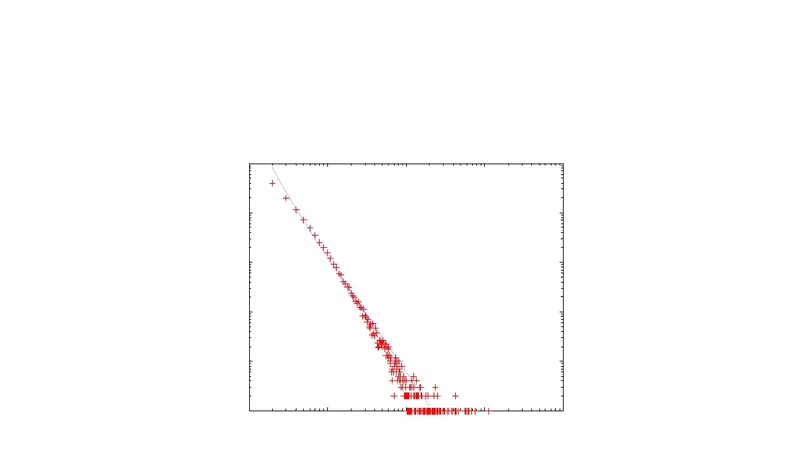
Complex network theory has been used to study complex systems. However, many real-life systems involve multiple kinds of objects . They can’t be described by simple graphs. In order to provide complete information of these systems, we extend the concept of evolving models of complex networks to hypernetworks. In this work, we firstly propose a non-uniform hypernetwork model with attractiveness, and obtain the stationary average hyperdegree distribution of the non-uniform hypernetwork. Furthermore, we develop a model for weighted hypernetworks that couples the establishment of new hyperedges and nodes and the weights’ dynamical evolution. We obtain the stationary average hyperdegree and hyperstrength distribution by using the hyperdegree distribution of the hypernetwork model with attractiveness, respectively. In particular, the model yields a nontrivial time evolution of nodes’ properties and scale-free behavior for the hyperdegree and hyperstrength distribution. It is expected that our work may give help to the study of the hypernetworks in real-world systems.
💡 Research Summary
The paper addresses a fundamental limitation of traditional complex‑network theory: most real‑world systems involve interactions among more than two entities, which cannot be faithfully represented by simple graphs. To capture such multi‑object interactions, the authors extend evolving network models to the realm of hypernetworks, where a hyperedge may connect an arbitrary number of nodes.
The first contribution is a non‑uniform hypernetwork model that incorporates node “attractiveness”. In each time step a new node may join the system, and simultaneously a fixed number (m) of new hyperedges are created. Each new hyperedge contains a random number of existing nodes (drawn from a distribution with mean (r)) and a random number of brand‑new nodes (mean (s)), thus allowing hyperedges of varying size. The probability that an existing node (i) is selected for a new hyperedge is proportional to its current hyperdegree (k_i) plus an intrinsic attractiveness term (a_i): (\Pi_i = (k_i + a_i)/\sum_j (k_j + a_j)). Using a continuum‑mean‑field approach, the authors derive the growth equation (\dot{k}_i = m r \Pi_i) and obtain a stationary hyperdegree distribution (P(k) \sim k^{-\gamma}). The exponent (\gamma) depends on the average attractiveness (\langle a\rangle) and on the hyperedge‑size parameters (r) and (s). When attractiveness vanishes the model reduces to the classic Barabási–Albert scale‑free result.
The second, and more novel, contribution is a weighted hypernetwork model that couples the creation of hyperedges and nodes with a dynamical evolution of hyperedge weights. When a hyperedge is formed it receives an initial weight (w_0). Existing hyperedges evolve according to a “strength‑reinforcement” rule: the weight of a hyperedge (e) that contains nodes (i) and (j) is increased by an amount proportional to the sum of the nodes’ current strengths (total incident weight), i.e. (\Delta w_e = \delta (s_i + s_j)/\sum_k s_k), where (\delta) is a tunable reinforcement factor. The strength of a node (i) is defined as (s_i = \sum_{e\ni i} w_e). By applying the same mean‑field technique, the authors obtain a coupled growth equation for strength: (\dot{s}_i = m r \Pi_i (w_0 + \delta s_i)). Solving this yields a power‑law time dependence (s_i(t) \sim t^{\beta}) with (\beta) determined by (\delta) and the attractiveness parameters. Importantly, the stationary strength distribution (Q(s)) also follows a power law with the same exponent (\gamma) as the hyperdegree distribution, demonstrating that the weight dynamics do not alter the scale‑free nature of the underlying topology.
To validate the analytical predictions, extensive numerical simulations are performed. The simulations vary hyperedge‑size distributions (both narrow and heavy‑tailed), attractiveness distributions, and the reinforcement factor (\delta). Results consistently show that (i) the hyperdegree distribution matches the predicted exponent, (ii) the strength distribution mirrors the hyperdegree distribution, and (iii) larger attractiveness values produce smaller exponents (more pronounced hubs), while larger (\delta) accelerates strength growth without changing the tail exponent. These findings confirm that the model captures both structural heterogeneity (through non‑uniform hyperedges and attractiveness) and dynamical heterogeneity (through weight reinforcement).
The authors discuss several potential applications: co‑authorship networks where papers involve varying numbers of authors, online group chats or forums where messages are addressed to groups of users, and biological complexes where multiple proteins interact simultaneously. They also outline future extensions, such as incorporating heterogeneous weight distributions within a hyperedge, multi‑layer hypernetworks, or time‑dependent attractiveness.
In conclusion, the paper provides a rigorous analytical framework for evolving weighted hypernetworks, demonstrating that non‑uniform hyperedge formation and weight reinforcement jointly give rise to scale‑free hyperdegree and hyperstrength distributions. This work bridges a gap between abstract network theory and the rich, multi‑entity interactions observed in many empirical systems, and it opens avenues for further empirical validation and methodological refinement.
Comments & Academic Discussion
Loading comments...
Leave a Comment