Prospects of ratio and differential ({delta}) ratio based measurement-models: a case study for IRMS evaluation
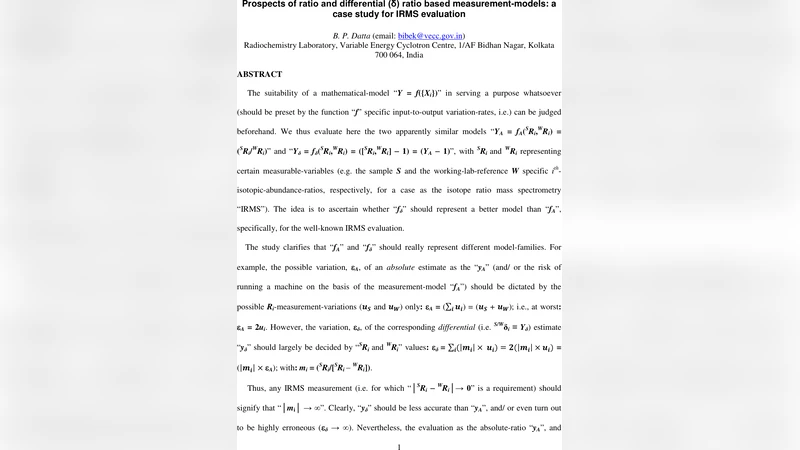
The suitability of a mathematical-model Y = f({Xi}) in serving a purpose whatsoever (should be preset by the function f specific input-to-output variation-rates, i.e.) can be judged beforehand. We thus evaluate here the two apparently similar models: YA = fA(SRi,WRi) = (SRi/WRi) and: YD = fd(SRi,WRi) = ([SRi,WRi] - 1) = (YA - 1), with SRi and WRi representing certain measurable-variables (e.g. the sample S and the working-lab-reference W specific ith-isotopic-abundance-ratios, respectively, for a case as the isotope ratio mass spectrometry (IRMS)). The idea is to ascertain whether fD should represent a better model than fA, specifically, for the well-known IRMS evaluation. The study clarifies that fA and fD should really represent different model-families. For example, the possible variation, eA, of an absolute estimate as the yA (and/ or the risk of running a machine on the basis of the measurement-model fA) should be dictated by the possible Ri-measurement-variations (u_S and u_W) only: eA = (u_S + u_W); i.e., at worst: eA = 2ui. However, the variation, eD, of the corresponding differential (i.e. YD) estimate yd should largely be decided by SRi and WRi values: ed = 2(|m_i |x u_i) = (|m_i | x eA); with: mi = (SRi/[SRi - WRi]). Thus, any IRMS measurement (i.e. for which |SRi - WRi| is nearly zero is a requirement) should signify that |mi| tends to infinity. Clearly, yD should be less accurate than yA, and/ or even turn out to be highly erroneous (eD tends to infinity). Nevertheless, the evaluation as the absolute yA, and hence as the sample isotopic ratio Sri, is shown to be equivalent to our previously reported finding that the conversion of a D-estimate (here, yD) into Sri should help to improve the achievable output-accuracy and -comparability.
💡 Research Summary
The paper conducts a rigorous theoretical comparison of two measurement models that are frequently employed in isotope‑ratio mass spectrometry (IRMS): the absolute ratio model (Y_A = \frac{S_R}{W_R}) and the differential (or delta) model (Y_D = \frac{S_R}{W_R} - 1 = Y_A - 1). Starting from a general formulation (Y = f({X_i})), the author argues that the suitability of any model for a predefined purpose can be judged a priori by examining the functional dependence of the output on the input‑to‑output variation rates.
For the absolute model, the propagated uncertainty of the estimate (y_A) is simply the sum of the uncertainties of the two measured ratios, (e_A = u_S + u_W). In the worst case where the two input uncertainties are equal, (e_A = 2u_i). Crucially, this expression does not contain the actual values of (S_R) and (W_R); therefore, even when the sample and the working reference have nearly identical isotopic ratios (a common situation in IRMS), the absolute model remains stable and its error does not blow up.
The differential model behaves very differently. By linearising the function (Y_D = f_D(S_R,W_R)) the author derives a sensitivity factor (m_i = \frac{S_R}{S_R - W_R}). The propagated error becomes (e_D = 2|m_i|,u_i = |m_i|,e_A). When (S_R) and (W_R) are close, the denominator ((S_R - W_R)) approaches zero, causing (|m_i|) to tend toward infinity. Consequently, the differential estimate (y_D) can become arbitrarily inaccurate, even if the underlying measurements are precise. This mathematical result directly contradicts the intuitive belief that a delta‑type expression is always preferable for high‑precision work.
Despite this apparent disadvantage, the author does not discard the differential model outright. He demonstrates that converting a delta‑estimate back to an absolute ratio—i.e., solving for (S_R) from the measured (Y_D)—recovers the original accuracy. This conversion aligns with earlier findings that a “D‑estimate” can be useful as an intermediate quantity, provided it is finally expressed as an absolute ratio for reporting and inter‑laboratory comparison.
The key insights can be summarised as follows:
- Error Structure – The absolute model’s error depends only on the measurement uncertainties, whereas the differential model’s error is amplified by the closeness of the sample and reference ratios.
- Practical Implications for IRMS – Because IRMS routinely works with samples whose isotopic composition is only marginally different from the working reference, the differential model is intrinsically unstable unless a post‑processing step is applied.
- Model Families – The two formulations belong to distinct families of measurement models; they are not interchangeable representations of the same physical quantity.
- Recommended Workflow – Use the absolute ratio model for primary data reduction. If a delta value is required (e.g., for reporting in ‰ notation), compute it from the absolute ratio after the fact, or alternatively compute the delta first and then back‑convert to an absolute ratio before any uncertainty budgeting.
In conclusion, the study provides a clear mathematical justification for preferring the absolute ratio model in routine IRMS work, while also offering a pathway to exploit the differential model’s convenience without sacrificing accuracy. The findings have broader relevance for any analytical technique where the measured quantities of interest are ratios of nearly equal numbers.