Twisted K-theory, K-homology and bivariant Chern-Connes type character of some infinite dimensional spaces
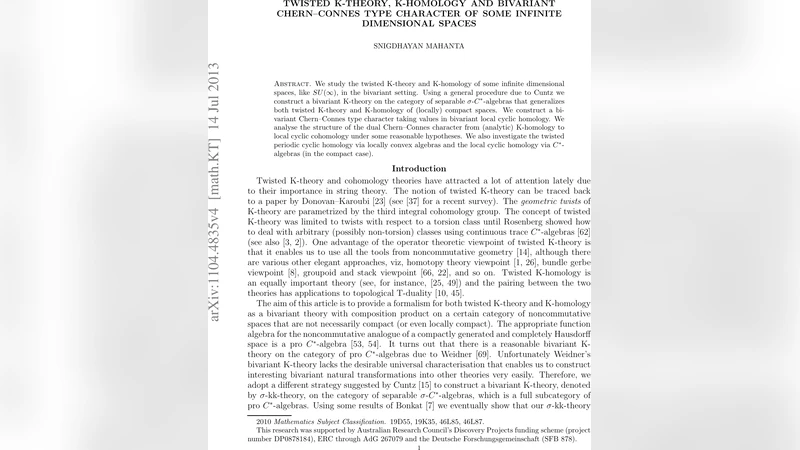
We study the twisted K-theory and K-homology of some infinite dimensional spaces, like SU(\infty), in the bivariant setting. Using a general procedure due to Cuntz we construct a bivariant K-theory on the category of separable \sigma-C^-algebras that generalizes both twisted K-theory and K-homology of (locally) compact spaces. We construct a bivariant Chern–Connes type character taking values in bivariant local cyclic homology. We analyse the structure of the dual Chern–Connes character from (analytic) K-homology to local cyclic cohomology under some reasonable hypotheses. We also investigate the twisted periodic cyclic homology via locally convex algebras and the local cyclic homology via C^-algebras (in the compact case).
💡 Research Summary
The paper develops a comprehensive framework for twisted K‑theory, twisted K‑homology and an associated bivariant Chern–Connes type character on a class of infinite‑dimensional spaces, most notably the direct limit unitary groups such as SU(∞). The authors begin by recalling the theory of pro‑C* algebras and, in particular, σ‑C* algebras, which are inverse limits of countable systems of C* algebras with surjective connecting maps. Such algebras provide the natural non‑commutative function algebras for countably compactly generated Hausdorff spaces, including direct limits of compact manifolds.
To obtain a bivariant K‑theory that works on this category, the authors adopt Cuntz’s construction of a universal bivariant theory. They define σ‑kk, a bivariant K‑theory on separable σ‑C* algebras, and prove that σ‑kk coincides with Kasparov’s KK when restricted to ordinary separable C* algebras and with Weydner’s bivariant K‑theory on the subcategory of nuclear σ‑C* algebras. The universal property of σ‑kk guarantees the existence of natural transformations to other bivariant theories.
Twisted K‑theory is then introduced via a principal PU(H) bundle representing a class in H³(X,ℤ). For a σ‑C* algebra A = C(X,𝔈) encoding the twist, the twisted K‑groups are defined as σ‑kk∗(ℂ, A). The authors compute these groups for several examples. In particular, they show that for the non‑trivial twist on SU(∞) all twisted K‑groups vanish, while other spaces admit non‑trivial twisted K‑theory.
The second major component is the treatment of cyclic homology. Using locally convex algebras and the X‑complex formalism, the authors construct the local cyclic homology HL∗, a version of cyclic (co)homology well suited to ind‑Banach algebras. They prove a Karoubi density theorem for HL∗, showing that a dense smooth subalgebra of a σ‑C* algebra has the same local cyclic homology. This allows the passage from twisted K‑theory to local cyclic homology via a Chern–Connes character.
The central result, Theorem 52, provides a natural multiplicative bivariant Chern–Connes character
ch∗ : σ‑kk∗(A,B) → HL∗(𝕂̂⊗A, 𝕂̂⊗B),
where 𝕂̂ denotes the compact operators. This map respects the product structure and, in the compact case, becomes an isomorphism after tensoring with ℂ (Theorem 20). Consequently, the dual Chern–Connes character from analytic K‑homology to local cyclic cohomology is obtained, and under mild hypotheses it factors through the periodic cyclic homology character.
The paper also discusses Poincaré‑duality type isomorphisms in this setting and illustrates how the bivariant character simplifies in such cases. Throughout, the authors emphasize the relevance of their constructions to physics, especially to large‑N limits, matrix models, and M‑theory, where infinite‑dimensional gauge groups like SU(∞) naturally appear.
In summary, the work extends twisted K‑theory and K‑homology to a broad class of non‑compact, infinite‑dimensional spaces by introducing σ‑kk, establishes a robust bivariant Chern–Connes character valued in local cyclic homology, and demonstrates that, at least in the compact setting, this character recovers the classical Connes–Karoubi isomorphism after complexification. The framework opens the door to systematic computations of twisted invariants on spaces that were previously inaccessible to operator‑algebraic techniques.
Comments & Academic Discussion
Loading comments...
Leave a Comment