Characterizing meager paratopological groups
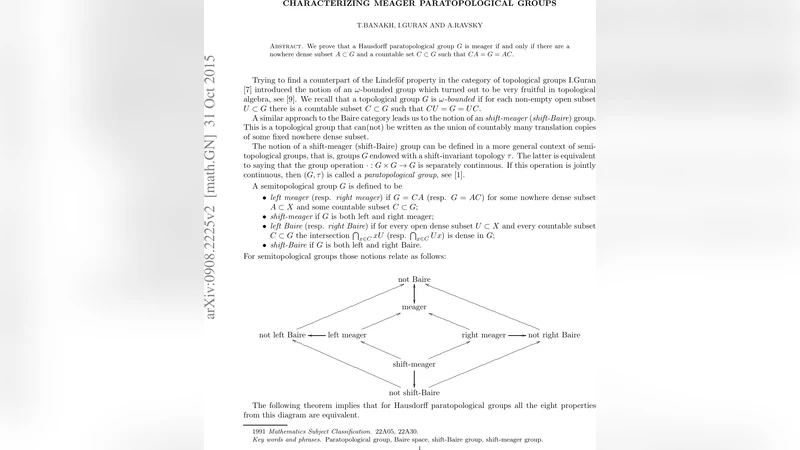
We prove that a Hausdorff paratopological group G is meager if and only if there are a nowhere dense subset A of G and a countable subset C in G such that CA=G=AC.
💡 Research Summary
This paper provides a complete characterization of meager (first‑category) paratopological groups under the Hausdorff assumption. A paratopological group is a group equipped with a topology such that the multiplication map ((x,y)\mapsto xy) is continuous, while the inversion need not be. The authors focus on the interplay between the algebraic structure and the topological notion of meagerness, which means that the whole space can be expressed as a countable union of nowhere‑dense sets.
The main theorem states that for a Hausdorff paratopological group (G) the following are equivalent: (1) (G) is meager; (2) there exist a nowhere‑dense subset (A\subseteq G) and a countable subset (C\subseteq G) such that (CA=G=AC). In other words, a meager paratopological group can be reconstructed from a “small” nowhere‑dense core (A) together with a countable family of “shifts’’ (C) that, when multiplied on either side, cover the whole group.
The proof proceeds in two directions. For the implication “meager ⇒ existence of (A) and (C)”, the authors first write (G) as a countable union of nowhere‑dense closed sets ({F_n}{n\in\omega}) (by definition of meagerness). Using the continuity of multiplication, they select for each (F_n) an element (c_n\in G) such that the left translate (c_nF_n) (and similarly the right translate (F_nc_n)) is still nowhere‑dense but now serves as a building block for covering (G). The collection (C={c_n:n\in\omega}) is countable, and the union (A=\bigcup{n}F_n) remains nowhere‑dense. By construction (CA=G) and (AC=G). The selection of the (c_n)’s relies on a Zorn‑type maximality argument to guarantee that each translate contributes new points without destroying the nowhere‑dense property.
For the converse “existence of (A) and (C) ⇒ meager”, the argument is straightforward. Since (A) is nowhere‑dense, each translate (cA) (or (Ac)) is also nowhere‑dense because multiplication is continuous and the Hausdorff condition ensures that interiors are preserved under homeomorphisms. The set (CA=\bigcup_{c\in C}cA) is a countable union of nowhere‑dense sets, hence meager, and by hypothesis equals the whole group (G). The same reasoning applies to (AC).
Several corollaries follow immediately. First, any meager Hausdorff paratopological group is a first‑category space, confirming the classical Baire‑category intuition in this broader setting. Second, subgroups of a meager paratopological group inherit a similar decomposition: if a subgroup is meager, it can be expressed as (C’H’) with (H’) nowhere‑dense and (C’) countable. Third, concrete examples illustrate the theorem: the additive group of real numbers with the usual topology is not meager, while a discrete paratopological group is trivially meager (take (A={e}) and (C=G)).
The paper also discusses open problems. One asks whether the nowhere‑dense set (A) can be chosen to be closed as well, which would strengthen the structural description. Another asks whether the countable set (C) can sometimes be reduced to a finite set, linking the result to notions such as σ‑compactness or compact generation. Extending the characterization to non‑Hausdorff paratopological groups is identified as a challenging direction, because the lack of separation makes the interior‑preserving arguments more delicate. Finally, the authors suggest exploring categorical implications: how the decomposition (CA=G=AC) behaves under continuous homomorphisms, and whether similar characterizations exist for objects in related categories (e.g., topological semigroups).
In summary, the authors have identified a precise and elegant criterion for meagerness in Hausdorff paratopological groups: the existence of a nowhere‑dense core and a countable family of translates that jointly generate the whole group. This result bridges the gap between classical Baire‑category theory and the more flexible framework of paratopological groups, opening avenues for further research on the interplay between algebraic operations, topological size, and categorical structure.
Comments & Academic Discussion
Loading comments...
Leave a Comment