A generalization of Gabriels Galois covering functors II: 2-categorical Cohen-Montgomery duality
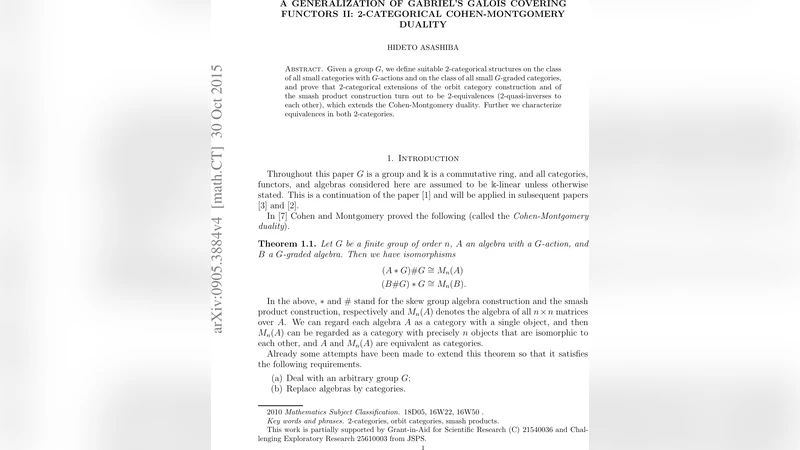
Given a group $G$, we define suitable 2-categorical structures on the class of all small categories with $G$-actions and on the class of all small $G$-graded categories, and prove that 2-categorical extensions of the orbit category construction and of the smash product construction turn out to be 2-equivalences (2-quasi-inverses to each other), which extends the Cohen-Montgomery duality.
💡 Research Summary
The paper continues the series on Gabriel’s Galois covering functors by lifting the classical Cohen‑Montgomery duality from the level of ordinary categories to the realm of 2‑categories. The authors first introduce two 2‑categories that serve as the ambient settings for the duality. The first, denoted 𝒞_G, consists of all small categories equipped with a left action of a fixed group G; its 1‑morphisms are G‑equivariant functors and its 2‑morphisms are natural transformations that are compatible with the G‑action. The second, 𝒟_G, consists of all small G‑graded categories; here 1‑morphisms are functors preserving the grading and 2‑morphisms are grading‑respecting natural transformations. By spelling out the composition laws and identity data, the authors verify that both structures satisfy the axioms of a strict 2‑category (or a bicategory, depending on the chosen level of strictness), thereby providing a precise higher‑categorical framework for objects that classically appear only at the 1‑categorical level.
Having set up the ambient 2‑categories, the authors then “2‑categorify’’ the two classical constructions that underlie the Cohen‑Montgomery duality: the orbit‑category construction and the smash‑product construction. The orbit 2‑functor O : 𝒞_G → 𝒟_G sends a G‑category C to its orbit category C/G, a G‑equivariant functor F to the induced functor between orbit categories, and a G‑compatible natural transformation η to the corresponding natural transformation on orbits. Dually, the smash‑product 2‑functor S : 𝒟_G → 𝒞_G sends a G‑graded category D to the smash‑product category D♯G, a grading‑preserving functor φ to the induced G‑equivariant functor, and a grading‑compatible natural transformation θ to its image under S. In both cases the authors check that the assignments respect identities and compositions up to the required 2‑cell equalities, thus establishing genuine 2‑functors rather than merely lax or oplax constructions.
The central theorem, called the “2‑categorical Cohen‑Montgomery duality,” asserts that O and S are mutually 2‑equivalences. Concretely, the composite O∘S is 2‑naturally isomorphic to the identity 2‑functor on 𝒟_G, and the composite S∘O is 2‑naturally isomorphic to the identity on 𝒞_G. The proof constructs explicit 2‑natural transformations ε : Id_{𝒟_G} ⇒ O∘S and η : Id_{𝒞_G} ⇒ S∘O, verifies the triangle identities, and shows that these transformations are invertible at the level of 2‑cells. Consequently, O and S form a pair of 2‑quasi‑inverse 2‑functors, extending the classical equivalence between orbit categories and smash‑product algebras to a full 2‑categorical equivalence.
Beyond the main equivalence, the paper explores several consequences and potential applications. First, the authors discuss how the duality behaves on the level of module 2‑categories: for a G‑graded algebra A, the category of graded A‑modules is 2‑equivalent to the category of modules over the smash‑product algebra A♯G, and the orbit construction recovers the usual module category over the skew group algebra. This provides a higher‑categorical explanation of the well‑known Morita‑type results in representation theory. Second, the authors indicate that the duality interacts nicely with monoidal 2‑categories; when the underlying categories carry a tensor product compatible with the G‑action or grading, the orbit and smash‑product 2‑functors become monoidal 2‑functors, preserving the higher‑tensor structure. Third, they sketch how the duality can be employed in homological contexts: chain complexes equipped with a G‑action can be passed to graded complexes via the smash product, and the resulting derived categories are linked by the same 2‑equivalence, suggesting new spectral‑sequence arguments that respect the group symmetry at the 2‑categorical level.
Finally, the authors outline future directions. Extending the framework to infinite or topological groups would require a careful treatment of size issues and possibly a passage to (∞,2)‑categories. Another promising line is to replace ordinary categories by higher algebraic structures such as 2‑rings or 2‑algebras, thereby obtaining a “higher‑Cohen‑Montgomery duality” that could impact derived algebraic geometry and higher representation theory. In summary, the paper delivers a thorough and technically robust lift of the Cohen‑Montgomery duality to 2‑categories, opening the door to a wealth of higher‑categorical applications in algebra, topology, and beyond.
Comments & Academic Discussion
Loading comments...
Leave a Comment