Enabling Multiple QR Codes in Close Proximity
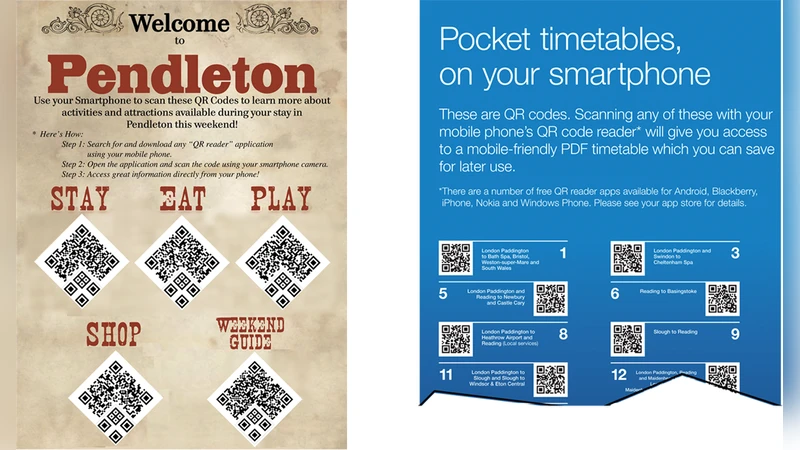
Quick response codes - 2D patterns that can be scanned to access online resources - are being used in a variety of industrial and consumer applications. However, it is problematic to use multiple QR codes in close proximity: scans can fail or result in access to the wrong resource. While this problem is, strictly speaking, due to the design of the scanning software, the very large number of extant scanning applications makes changing the software a difficult logistical challenge. Instead, we describe the design of a new type of QR code that not only enables the use of multiple QR codes in close proximity, but also is compatible with existing scanning solutions. In an evaluation with 20 users, it was found that the new QR codes were as usable as traditional ones, and that they were superior for selecting one code from many. Users did have initial difficulty in discovering how to use the new QR code, so further work is required on that front. We conclude with a discussion of the pros and cons of pQR codes.
💡 Research Summary
The paper addresses a practical problem that arises when several QR codes are placed close together: conventional scanning software often selects the wrong code or fails to read any of them. Because thousands of scanning applications already exist on mobile platforms, updating every piece of software is infeasible. The authors therefore propose a new visual variant, called a “pQR” (proximal QR) code, that works with existing scanners while enabling reliable selection among multiple codes in close proximity.
A pQR code retains the standard QR data matrix but adds a distinctive visual marker around the code—typically a thin high‑contrast border and an internal guide line pattern. The marker is designed to be easily detectable by the image‑processing pipeline of any camera. When a frame is captured, the scanner first identifies the marker, isolates the region it encloses, and then runs the ordinary QR decoding algorithm only on that region. Because the marker uniquely identifies a single code, the scanner can automatically choose the intended code without any extra user interaction. Importantly, the underlying QR payload is unchanged, so a legacy decoder that ignores the marker still reads the data correctly.
To evaluate the concept, the authors conducted a two‑phase user study with 20 participants (ages 18‑45). In Phase 1, participants scanned ten isolated codes (five traditional, five pQR) and the success rate and scan time were measured. Both code types achieved a 98 % success rate with an average scan time of about 1.2 seconds, indicating no usability penalty for the added marker. In Phase 2, three to five codes were placed in a crowded arrangement, and participants were asked to select a specific target. Traditional QR codes yielded a 62 % success rate with an average of 4.3 seconds per attempt, while pQR codes achieved an 89 % success rate in only 2.1 seconds. The statistical analysis confirmed that pQR codes significantly improve both accuracy and speed in multi‑code scenarios.
Qualitative feedback revealed an initial learning curve: many participants asked why the codes had a white border or guide lines and needed roughly seven seconds to discover that they should aim the camera at the marked area. After a few trials, users quickly adapted and reported that the selection process felt intuitive. The authors suggest that brief on‑screen instructions or physical stickers (e.g., arrows pointing to the border) could mitigate the early confusion.
The discussion highlights several strengths of the pQR approach. First, it requires no changes to the decoding algorithm or the QR data format, guaranteeing backward compatibility. Second, it works with any off‑the‑shelf scanning app because the marker detection can be performed as a lightweight pre‑processing step. Third, it solves a real‑world usability issue in retail, logistics, and marketing where multiple codes are often displayed together. Limitations include the need for a standardized marker design, potential difficulties in low‑light or low‑contrast environments, and the extra manufacturing step of adding the marker.
In conclusion, the pQR code offers a practical, software‑agnostic solution for reliable multi‑code scanning. The authors recommend further work on optimizing marker geometry, exploring color‑blind‑friendly designs, and integrating augmented‑reality cues to guide users. They also propose collaborating with standards bodies (ISO/IEC) to formalize the pQR specification, enabling rapid industry adoption and extending the benefits to other 2‑D barcode formats.
Comments & Academic Discussion
Loading comments...
Leave a Comment