Conspiratorial beliefs observed through entropy principles
We propose a novel approach framed in terms of information theory and entropy to tackle the issue of conspiracy theories propagation. We start with the report of an event (such as 9/11 terroristic attack) represented as a series of individual strings of information denoted respectively by two-state variable Ei=+/-1, i=1,…, N. Assigning Ei value to all strings, the initial order parameter and entropy are determined. Conspiracy theorists comment on the report, focusing repeatedly on several strings Ek and changing their meaning (from -1 to +1). The reading of the event is turned fuzzy with an increased entropy value. Beyond some threshold value of entropy, chosen by simplicity to its maximum value, meaning N/2 variables with Ei=1, doubt prevails in the reading of the event and the chance is created that an alternative theory might prevail. Therefore, the evolution of the associated entropy is a way to measure the degree of penetration of a conspiracy theory. Our general framework relies on online content made voluntarily available by crowds of people, in response to some news or blog articles published by official news agencies. We apply different aggregation levels (comment, person, discussion thread) and discuss the associated patterns of entropy change.
💡 Research Summary
The paper proposes a novel framework that applies information theory and Shannon entropy to quantify the spread of conspiracy theories, using the September 11 attacks as a case study. The authors model the official report of an event as a set of N binary variables Ei ∈ {−1,+1}, where each variable represents a distinct “information string” (e.g., a factual claim). In the baseline scenario all Ei = −1, yielding a perfectly ordered state with minimal entropy. Conspiracy theorists, through comments and alternative narratives, flip selected variables from −1 to +1, thereby increasing the system’s entropy. The authors define a critical entropy threshold at E = 0, which corresponds to exactly half of the variables being +1 (i.e., maximal uncertainty). When this threshold is crossed, the authors argue that collective doubt becomes dominant and an alternative interpretation of the event can take hold.
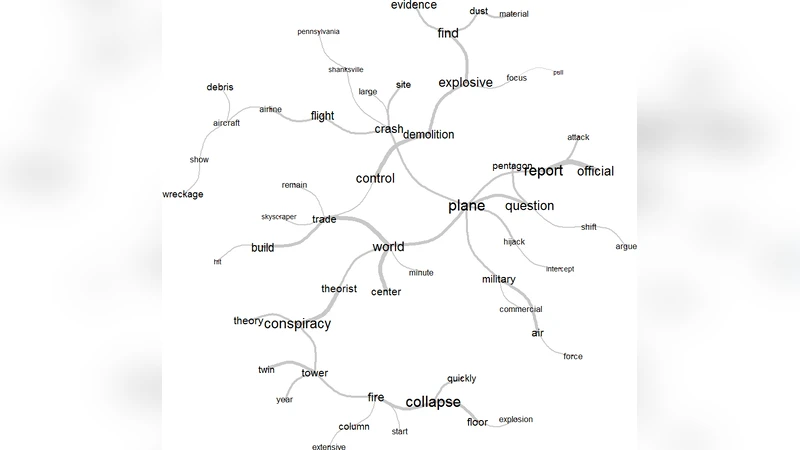
To operationalize the model, the authors collect online comment data from a BBC article discussing 9/11 conspiracy theories. The dataset contains 755 comments posted by 341 distinct pseudonyms. Textual content is visualized using semantic clouds and co‑occurrence networks, revealing two dominant clusters: one centered on “collapse” (structural anomalies) and another on “person” (human motives and political incentives). Network analysis shows a small‑world topology with a degree distribution following a power law (exponent ≈ −1), indicating that a few highly connected users drive much of the discourse.
The study also examines the relationship between comment “likes” (a proxy for rating) and thread length. Longer threads tend to accumulate higher total ratings, suggesting that sustained interaction reinforces positive feedback loops. However, extreme ratings (both high and low) are associated with short, isolated comments, implying limited diffusion potential.
Conceptually, the model diverges from classic epidemiological contagion models (SIS, SIR) by treating opinion change as a transition of information states rather than simple infection. The probability that a given Ek flips depends on multiple factors: the individual’s reliability, the logical strength of arguments, emotional appeal, and possibly external cues. While the current dataset is insufficient for precise parameter estimation, the authors argue that, with larger crowdsourced corpora, the entropy measure could serve as a real‑time indicator of conspiracy theory penetration, guiding timely interventions by policymakers or media outlets.
The paper acknowledges several limitations. First, binary encoding of opinions oversimplifies the nuanced spectrum of belief. Second, the choice of the critical point (E = 0) is arbitrary and lacks empirical validation. Third, the analysis is confined to a single platform (BBC) and language, raising concerns about sampling bias. Fourth, the “like” algorithm is opaque, so the rating may not faithfully reflect sentiment strength.
Future work is suggested in three directions. (1) Extend the state space to multi‑valued variables (e.g., −1, 0, +1) and incorporate Bayesian updating to capture gradual belief revisions. (2) Integrate data from multiple social media platforms (Twitter, Reddit, Facebook) and across different cultural contexts to test the universality of the entropy dynamics. (3) Develop an operational early‑warning system that monitors entropy trajectories and triggers alerts when the system approaches the critical threshold, enabling pre‑emptive counter‑messaging or fact‑checking campaigns.
In summary, the study offers an innovative, albeit preliminary, quantitative lens for examining how conspiracy narratives alter the informational entropy of public discourse. By linking entropy growth to the degree of doubt and potential for alternative narratives, it opens a pathway toward systematic monitoring and mitigation of misinformation in the digital age.
Comments & Academic Discussion
Loading comments...
Leave a Comment