A Matter of Principle: The Principles of Quantum Theory, Diracs Equation, and Quantum Information
This article is concerned with the role of fundamental principles in theoretical physics, especially quantum theory. The fundamental principles of relativity will be be addressed as well in view of th
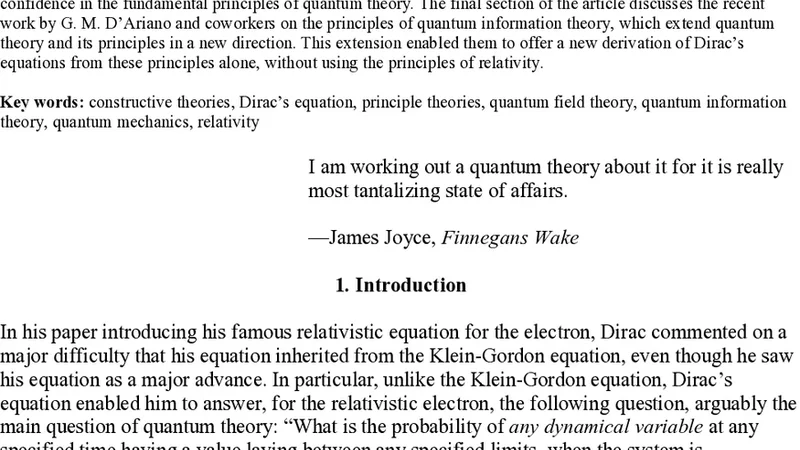
This article is concerned with the role of fundamental principles in theoretical physics, especially quantum theory. The fundamental principles of relativity will be be addressed as well in view of their role in quantum electrodynamics and quantum field theory, specifically Dirac’s work, which, in particular Dirac’s derivation of his relativistic equation for the electron from the principles of relativity and quantum theory, is the main focus of this article. I shall, however, also consider Heisenberg’s derivation of quantum mechanics, which inspired Dirac. I argue that Heisenberg’s and Dirac’s work alike was guided by their adherence to and confidence in the fundamental principles of quantum theory. The final section of the article discusses the recent work by G. M. D’ Ariano and his coworkers on the principles of quantum information theory, which extends quantum theory and its principles in a new direction. This extension enabled them to offer a new derivation of Dirac’s equation from these principles alone, without using the principles of relativity.
💡 Research Summary
The paper investigates the central role that fundamental principles play in the development of theoretical physics, focusing on quantum theory, relativity, and the Dirac equation. It begins by outlining what is meant by a “principle” in physics and how the early twentieth‑century revolutions in quantum mechanics and special relativity each emerged from a compact set of guiding postulates—Heisenberg’s uncertainty and non‑commutativity on the quantum side, and Lorentz invariance on the relativistic side.
In the first substantive section the author revisits Heisenberg’s 1925 derivation of matrix mechanics. Heisenberg’s guiding idea was that observable quantities must obey specific commutation relations, a principle that forces the replacement of classical phase‑space variables by operators whose order matters. This principle liberated the theory from the classical trajectory picture and forced a focus on transition amplitudes between quantized energy levels.
The next section turns to Dirac’s 1928 work. Dirac sought a relativistically covariant wave equation for the electron that would also respect the quantum‑mechanical operator framework. By demanding that the energy‑momentum relation (E^{2}=p^{2}c^{2}+m^{2}c^{4}) be linear in both (E) and (\mathbf{p}), he introduced a set of four (4\times4) gamma matrices that furnish a spin‑½ representation of the Lorentz group. The resulting Dirac equation, \
📜 Original Paper Content
🚀 Synchronizing high-quality layout from 1TB storage...