Efficient Computation of Instantons for Multi-Dimensional Turbulent Flows with Large Scale Forcing
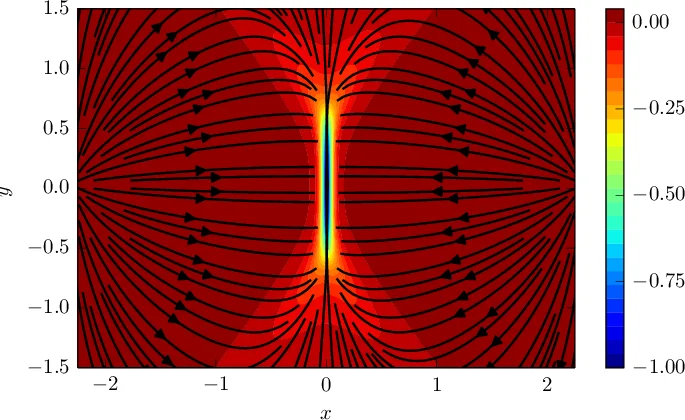
Extreme events play a crucial role in fluid turbulence. Inspired by methods from field theory, these extreme events, their evolution and probability can be computed with help of the instanton formalism as minimizers of a suitable action functional. Due to the high number of degrees of freedom in multi-dimensional fluid flows, traditional global minimization techniques quickly become prohibitive in their memory requirements. We outline a novel method for finding the minimizing trajectory in a wide class of problems that typically occurs in turbulence setups, where the underlying dynamical system is a non-gradient, non-linear partial differential equation, and the forcing is restricted to a limited length scale. We demonstrate the efficiency of the algorithm in terms of performance and memory by computing high resolution instanton field configurations corresponding to viscous shocks for 1D and 2D compressible flows.
💡 Research Summary
The paper addresses the formidable challenge of computing instanton configurations—most probable trajectories associated with rare, extreme events—in multi‑dimensional turbulent flows that are driven by large‑scale forcing. In the small‑noise limit, the probability of such events is governed by a Freidlin‑Wentzell large‑deviation principle, where the action functional must be minimized. Traditional global minimization techniques (e.g., the Minimum Action Method, string method) require storing the full space‑time field for every time step, leading to memory consumption that scales linearly with the number of temporal discretization points, (O(N_t)). This quickly becomes prohibitive for the high‑dimensional partial differential equations (PDEs) that describe turbulence.
The authors propose a suite of algorithmic innovations that together reduce the memory footprint to (O(\log N_t)) while preserving—or even improving—numerical accuracy and convergence speed. The key ideas are:
- Arc‑length (geometric) re‑parametrization – By switching from physical time to an arc‑length parameter (s\in
Comments & Academic Discussion
Loading comments...
Leave a Comment