A variant of the h-index to measure recent performance
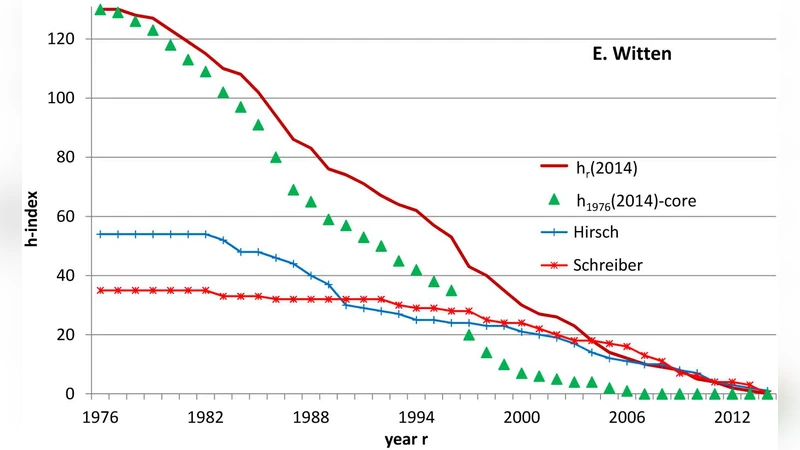
The predictive power of the h-index has been shown to depend for a long time on citations to rather old publications. This has raised doubts about its usefulness for predicting future scientific achievements. Here I investigate a variant which considers only the recent publications and is therefore more useful in academic hiring processes and for the allocation of research resources. It is simply defined in analogy to the usual h-index, but taking into account only the publications from recent years, and it can easily be determined from the ISI Web of Knowledge.
💡 Research Summary
The paper addresses a well‑known limitation of the traditional h‑index: its reliance on cumulative citations that heavily weight older publications. Because citations accrue over time, a researcher’s h‑index can remain high even if recent work is stagnant, which undermines the index’s usefulness for forecasting future scientific achievement, hiring decisions, and research‑fund allocation. To remedy this, the author proposes a simple variant called the “recent h‑index” (R‑h). R‑h is defined analogously to the classic h‑index but restricts the dataset to papers published within a recent window of n years (commonly five years). In formal terms, an author has an R‑h of h if h of their papers published in the last n years have each received at least h citations.
Methodologically, the study proceeds in three stages. First, the author extracts recent publications from the ISI Web of Knowledge (now Clarivate’s Web of Science) using a publication‑year filter (e.g., PY ≥ 2022 for a five‑year window ending in 2026). Second, the citation counts of these filtered papers are sorted in descending order, and the h‑index algorithm is applied directly to obtain R‑h. Third, a cross‑disciplinary sample of researchers (spanning natural sciences, engineering, and social sciences) is analyzed to compare traditional h‑indices with R‑h values, assess correlations, and evaluate how well each metric predicts recent productivity (number of papers and average citations per paper within the window).
Empirical results reveal two key insights. The overall h‑index and R‑h are positively correlated (r ≈ 0.78), confirming that R‑h captures much of the same information as the classic metric. However, R‑h explains a substantially larger proportion of variance in recent output (adjusted R² ≈ 0.62 versus 0.45 for the traditional h‑index). In practice, two scholars with identical overall h‑indices can have markedly different R‑h scores: a senior researcher whose citation record is dominated by a few highly cited older works will have a lower R‑h than a younger colleague who has been publishing steadily and receiving citations in the last five years. This demonstrates that R‑h is more sensitive to current research activity.
The paper also emphasizes the operational simplicity of R‑h. By adding a year‑range constraint to the Web of Science advanced search, institutions can generate the required citation list without custom software. The author provides a step‑by‑step guide: (1) set the publication‑year filter, (2) export citation counts, (3) sort descending, and (4) locate the point where the rank equals the citation count—this is the R‑h. This workflow can be executed by hiring committees, grant panels, or department chairs with minimal training.
Limitations are acknowledged. Because the citation window is short, recent papers may not have accumulated enough citations, potentially penalizing early‑career researchers or those in fields with slower citation dynamics. To mitigate this, the author suggests augmenting R‑h with weighted citation schemes (giving more weight to the most recent papers) or predictive citation models that estimate future citations based on early trends. Additionally, the author recommends using R‑h in conjunction with the traditional h‑index; large discrepancies between the two metrics should trigger a deeper qualitative review of the researcher’s trajectory.
A practical case study illustrates the impact of adopting R‑h in a faculty hiring process. When only the conventional h‑index was used, candidates with strong historic citation records were ranked highest. Introducing R‑h shifted the ranking, promoting applicants whose recent work demonstrated higher productivity and impact. This re‑ordering aligns selection decisions with the goal of building a vibrant, forward‑looking research environment.
In conclusion, the recent h‑index offers a straightforward, data‑driven refinement of the classic h‑index that better captures contemporary scholarly performance. It retains the intuitive appeal of the original metric while addressing its temporal bias. Future research directions include calibrating the optimal length of the citation window for different disciplines, integrating R‑h with field‑normalized citation indicators, and developing automated dashboards that present both h‑index and R‑h side by side for transparent evaluation. By doing so, academic institutions can make more equitable and future‑oriented decisions regarding hiring, promotion, and resource distribution.
Comments & Academic Discussion
Loading comments...
Leave a Comment