E-Theory for C*-algebras over topological spaces
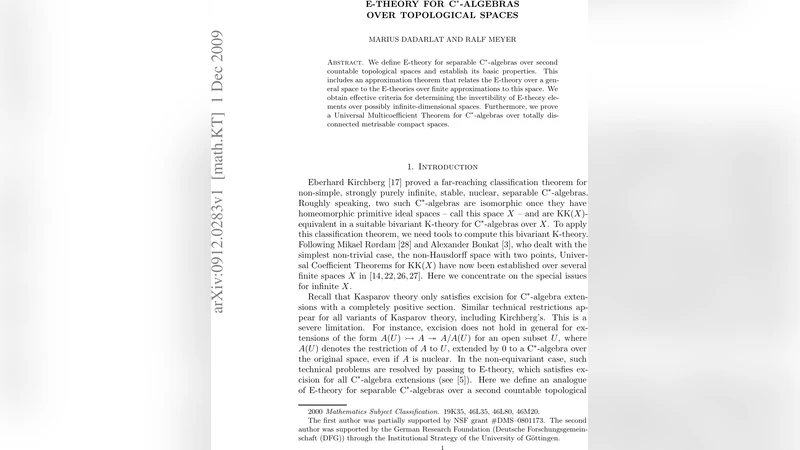
We define E-theory for separable C*-algebras over second countable topological spaces and establish its basic properties. This includes an approximation theorem that relates the E-theory over a general space to the E-theories over finite approximations to this space. We obtain effective criteria for determining the invertibility of E-theory elements over possibly infinite-dimensional spaces. Furthermore, we prove a Universal Multicoefficient Theorem for C*-algebras over totally disconnected metrisable compact spaces.
💡 Research Summary
The paper introduces a systematic extension of Connes–Higson E‑theory to separable C‑algebras equipped with a continuous ideal structure over second‑countable topological spaces. After defining the category 𝔈_X of “C‑algebras over X”, where each open set U⊂X is assigned a closed ideal I_U satisfying the natural monotonicity and continuity conditions, the authors construct asymptotic morphisms that respect this X‑continuity. This yields the bivariant groups E_X(A,B), which reduce to ordinary E‑theory when X is a point.
A central result is the Approximation Theorem. For any second‑countable space X, one can choose a directed system of finite open covers {𝒰_n} and the associated finite approximation spaces X_n. The restriction functors r_n:𝔈_X→𝔈_{X_n} induce isomorphisms
E_X(A,B) ≅ lim← E_{X_n}(r_nA, r_nB).
Thus calculations on a possibly infinite‑dimensional space can be carried out on finite models, preserving all homotopy‑invariant information.
Using this approximation, the authors give an effective criterion for invertibility in E_X. An element α∈E_X(A,B) is invertible if and only if its images α_n∈E_{X_n}(r_nA, r_nB) are invertible for every n. Consequently, one can test invertibility by checking finitely many K‑theoretic conditions on the approximating spaces, a substantial simplification over direct KK‑theoretic methods.
The second major contribution is a Universal Multicoefficient Theorem (UMCT) for C‑algebras over totally disconnected metrizable compact spaces Y. The theorem establishes a natural short exact sequence
0 → Ext^1_ℤ(K_{+1}(A),K_(B)) → E_Y(A,B) → Hom_ℤ(K_(A),K_(B)) → 0,
where the Ext and Hom groups are taken in the category of modules equipped with the full Bockstein operations coming from the clopen structure of Y. This result generalizes the classical UCT from ordinary K‑theory to the bivariant E‑theory context, incorporating the additional topological data encoded by Y.
The paper concludes with several applications. First, the approximation theorem enables explicit E‑theory computations for C‑algebras over non‑compact or infinite‑dimensional spaces, which appear in dynamical systems and crossed‑product constructions. Second, the invertibility criterion provides a practical tool for establishing E‑equivalences, facilitating classification results that go beyond the reach of KK‑theory. Third, the UMCT shows that, for totally disconnected compact bases, the entire E‑theory class of a pair (A,B) is determined by their K‑theory groups together with the multicoefficient structure, offering a new invariant for classification problems.
Overall, the work furnishes a robust framework for E‑theory on C‑algebras over general topological spaces, supplies computational techniques via finite approximations, and extends universal coefficient technology to a broader, multicoefficient setting. This opens the door to new classification results and deeper understanding of the interplay between topology and operator‑algebraic invariants.
Comments & Academic Discussion
Loading comments...
Leave a Comment