Equivariant representable K-theory
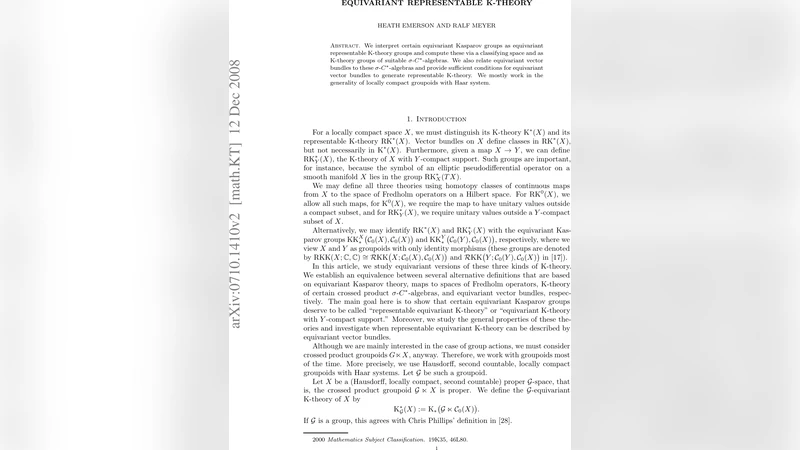
We interpret certain equivariant Kasparov groups as equivariant representable K-theory groups. We compute these groups via a classifying space and as K-theory groups of suitable sigma-C*-algebras. We also relate equivariant vector bundles to these sigma-C*-algebras and provide sufficient conditions for equivariant vector bundles to generate representable K-theory. Mostly we work in the generality of locally compact groupoids with Haar system.
💡 Research Summary
The paper investigates the relationship between equivariant Kasparov groups and equivariant representable K‑theory, working in the broad setting of locally compact Hausdorff groupoids equipped with a Haar system. The authors begin by focusing on Kasparov groups of the form (KK^{\mathcal G}(C_0(X),\mathbb C)), where (X) is a (\mathcal G)‑space. They define the equivariant representable K‑theory group (\mathcal R K_{\mathcal G}^0(X)) to be exactly this Kasparov group, thereby providing a concrete K‑theoretic interpretation of a class of equivariant KK‑elements.
A central construction is a classifying space (E_{\mathcal G}X) for the action of (\mathcal G) on (X). The space is built as a (\mathcal G)‑free, proper, (\mathcal G)‑CW complex that captures the homotopy‑theoretic data of the action. By forming the crossed‑product C*‑algebra (C_0(E_{\mathcal G}X)\rtimes \mathcal G) and applying standard K‑theory, the authors prove a natural isomorphism
\
Comments & Academic Discussion
Loading comments...
Leave a Comment