Three Hours a Day: Understanding Current Teen Practices of Smartphone Application Use
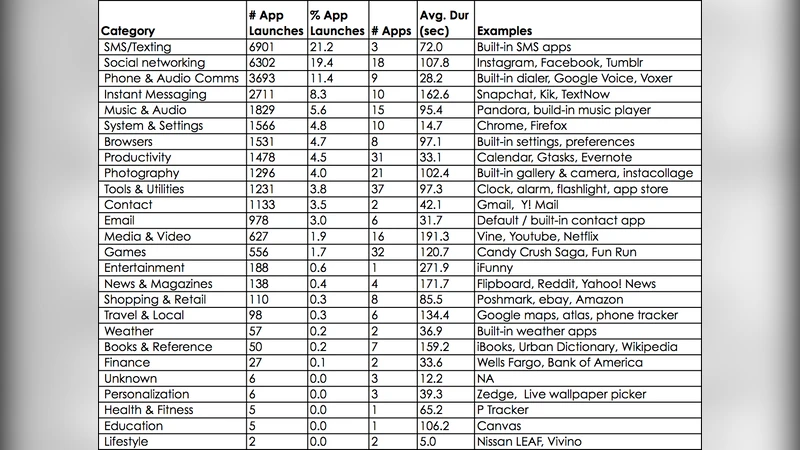
Teens are using mobile devices for an increasing number of activities. Smartphones and a variety of mobile apps for communication, entertainment, and productivity have become an integral part of their lives. This mobile phone use has evolved rapidly as technology has changed and thus studies from even 2 or 3 years ago may not reflect new patterns and practices as smartphones have become more sophisticated. In order to understand current teen’s practices around smartphone use, we conducted a two week, mixed-methods study with 14 diverse teens. Through voicemail diaries, interviews, and real world usage data from a logging application installed on their smartphones, we developed an understanding of the types of apps used by teens, when they use these apps, and their reasons for using specific apps in particular situations. We found that the teens in our study used their smartphones for an average of almost 3 hours per day and that two-thirds of all app use involved interacting with an average of almost 10 distinct communications applications. From our study data, we highlight key implications for the design of future mobile apps or services, specifically new social and communications-related applications that allow teens to maintain desired levels of privacy and permanence on the content that they share.
💡 Research Summary
This paper investigates contemporary teenage smartphone application usage by conducting a two‑week mixed‑methods study with fourteen diverse adolescents. Recognizing that prior research quickly becomes outdated as mobile hardware and app ecosystems evolve, the authors combined quantitative logging, daily voicemail diaries, and post‑study semi‑structured interviews to capture both objective usage metrics and the subjective context surrounding each interaction.
Participants (seven male, seven female, ages 13‑17, representing varied socioeconomic and ethnic backgrounds) installed a custom logging application on their personal devices. The logger recorded app launches, foreground/background transitions, and session durations at a fine‑grained temporal resolution. Each evening, participants submitted a short voice diary describing which apps they used, why they chose them, and any associated feelings or social circumstances. After the two‑week observation period, researchers conducted in‑depth interviews to clarify ambiguous log entries, explore motivations, and probe attitudes toward privacy, permanence, and social norms.
Statistical analysis of the log data revealed an average daily smartphone usage of 2 hours 58 minutes (± 45 minutes). Remarkably, about two‑thirds (≈ 66 %) of this time was spent within communication‑oriented applications—messaging, social networking, and video‑calling services. On average, each teen interacted with roughly ten distinct communication apps, indicating a high degree of “app diversification” rather than reliance on a single platform. Non‑communication categories (entertainment, education, productivity) accounted for the remaining third, with usage patterns tightly linked to daily routines such as schoolwork, leisure, and transitional periods (e.g., commuting).
Qualitative findings complemented the quantitative picture. Teens consistently emphasized the importance of context: they chose apps based on perceived immediacy, audience size, and the type of content they wished to share. A recurring theme was heightened sensitivity to privacy and content permanence. Participants expressed discomfort with platforms that retain photos, videos, or messages indefinitely, preferring “ephemeral” services where content disappears after a set interval or after being viewed. Conversely, they valued platforms that allowed selective permanence for memories they wanted to preserve. This dual desire for fleeting and lasting communication suggests a nuanced expectation that current social media do not fully satisfy.
The authors discuss several design implications. First, future applications should enable users to toggle the permanence of each piece of content—offering both “disappear after view” and “store indefinitely” options within the same interface. Second, granular control over audience scope (e.g., temporary groups, time‑limited broadcasts) can help teens manage social risk. Third, because teens routinely juggle multiple messaging and social apps, integrating cross‑app conversation threads or providing a unified notification hub could reduce cognitive load and improve continuity. Fourth, privacy‑by‑design principles—minimal data retention, on‑device encryption, and transparent lifecycle policies—are essential to gain teenage trust.
Limitations include the modest sample size, potential regional bias, and the two‑week observation window, which may not capture seasonal or academic‑calendar variations. Additionally, background system processes could have caused under‑reporting of certain app usages. The authors recommend scaling the study to larger, more diverse populations and extending the observation period to examine longitudinal shifts in app preferences.
In conclusion, contemporary teens spend nearly three hours per day on smartphones, with the majority of that time devoted to a heterogeneous set of communication applications. Their pronounced concern for privacy and content permanence underscores a market opportunity for new social and communication services that balance ephemerality with selective durability, while offering seamless interaction across the fragmented app landscape they already navigate.
Comments & Academic Discussion
Loading comments...
Leave a Comment