Career Path Suggestion using String Matching and Decision Trees
High school and college graduates seemingly are often battling for the courses they should major in order to achieve their target career. In this paper, we worked on suggesting a career path to a graduate to reach his/her dream career given the current educational status. Firstly, we collected the career data of professionals and academicians from various career fields and compiled the data set by using the necessary information from the data. Further, this was used as the basis to suggest the most appropriate career path for the person given his/her current educational status. Decision trees and string matching algorithms were employed to suggest the appropriate career path for a person. Finally, an analysis of the result has been done directing to further improvements in the model.
💡 Research Summary
This paper presents a model designed to assist high school and college graduates in planning their academic trajectory towards a desired career. The core problem it addresses is the common uncertainty students face when choosing majors and advanced degrees to achieve their professional goals. The proposed solution is a data-driven suggestion system that leverages career path data from real-world professionals.
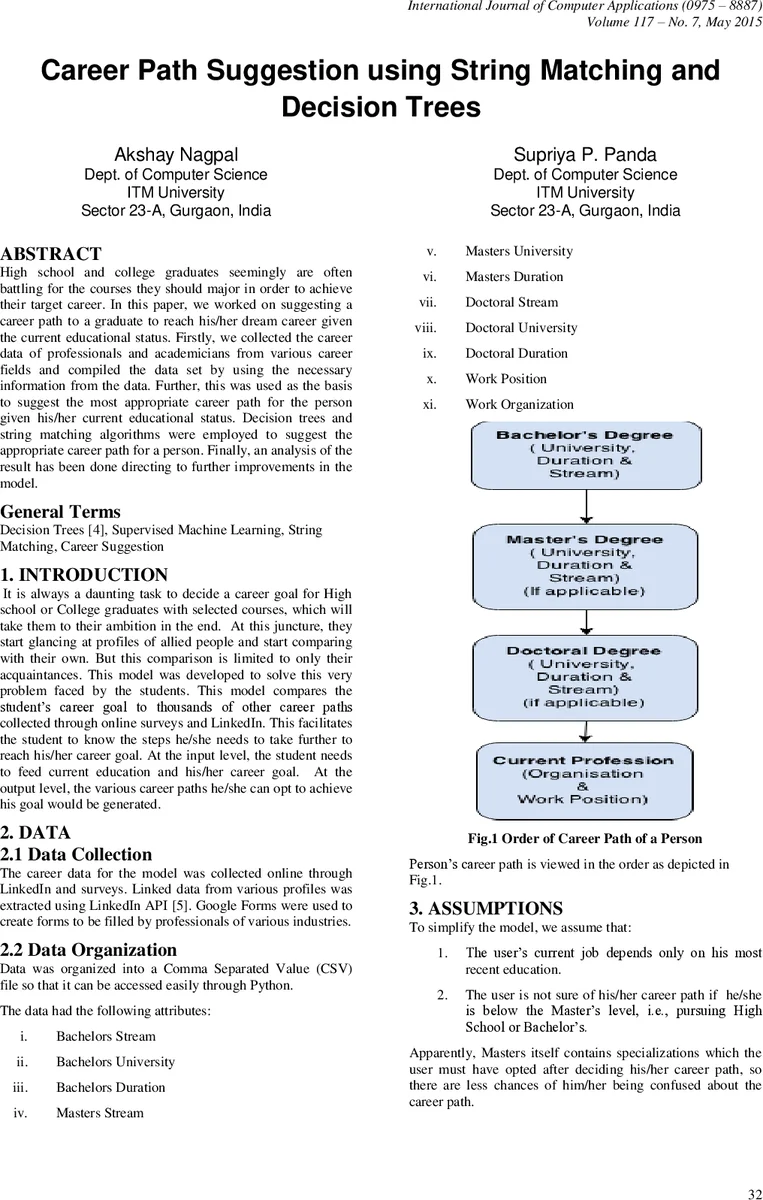
The foundation of the model is a dataset compiled from two primary sources: profiles extracted via the LinkedIn API and responses from online surveys conducted using Google Forms. This dataset captures the educational and professional journey of individuals across various fields, structured into attributes including undergraduate stream/university/duration, master’s stream/university/duration, doctoral stream/university/duration, current work position, and current organization.
The system’s operation involves a two-stage process. First, it performs string matching between the user’s inputted “Career Goal” (e.g., “Data Scientist”) and the “Work Position” values in the dataset. Instead of requiring exact matches, it employs fuzzy string matching techniques from the Python Fuzzywuzzy library. Specifically, it uses the simple_ratio method for strings of similar length and the partial_ratio method for strings of differing lengths, applying similarity thresholds of 60% and 80%, respectively, to filter relevant profiles.
Second, a rule-based suggestion algorithm (conceptually aligned with decision trees) generates the career path recommendations. This algorithm takes the user’s “Current Education” status as its key decision point. If the status is “High School,” the model suggests a full path comprising the Bachelor’s, Master’s, and Doctoral information from the matched profiles. If the status is “Bachelor’s,” it suggests only the subsequent Master’s and Doctoral information. This logic is based on the assumption that individuals at the Master’s level or above have already made definitive career choices. The final list of suggested academic paths is sorted in descending order of the string similarity score and presented to the user via a graphical interface.
The model was tested with various inputs, yielding logical and realistic suggestions. For instance, an input of (“Software Engineer”, “Bachelor’s”) produced recommendations like pursuing a Master’s in Computer Science or Software Engineering. Similarly, (“Fashion Designer”, “High School”) suggested Bachelor’s degrees in Fashion Designing or Fashion Merchandising. The authors conclude that while the model provides practical guidance for basic and intermediate career queries, its efficacy can be enhanced through several improvements. Future work should incorporate university rankings to prioritize suggestions and integrate internship data to analyze the correlation between internship roles and final career outcomes, offering students a more holistic view of the steps required to reach their ambitions.
Comments & Academic Discussion
Loading comments...
Leave a Comment