Timescales of Massive Human Entrainment
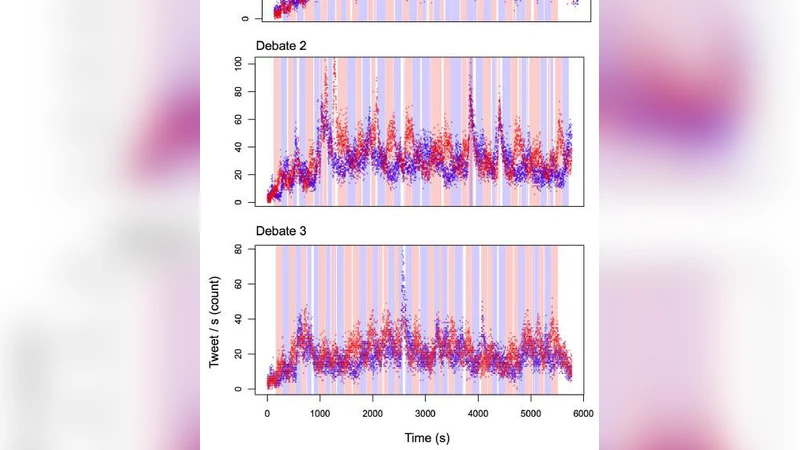
The past two decades have seen an upsurge of interest in the collective behaviors of complex systems composed of many agents entrained to each other and to external events. In this paper, we extend concepts of entrainment to the dynamics of human collective attention. We conducted a detailed investigation of the unfolding of human entrainment - as expressed by the content and patterns of hundreds of thousands of messages on Twitter - during the 2012 US presidential debates. By time locking these data sources, we quantify the impact of the unfolding debate on human attention. We show that collective social behavior covaries second-by-second to the interactional dynamics of the debates: A candidate speaking induces rapid increases in mentions of his name on social media and decreases in mentions of the other candidate. Moreover, interruptions by an interlocutor increase the attention received. We also highlight a distinct time scale for the impact of salient moments in the debate: Mentions in social media start within 5-10 seconds after the moment; peak at approximately one minute; and slowly decay in a consistent fashion across well-known events during the debates. Finally, we show that public attention after an initial burst slowly decays through the course of the debates. Thus we demonstrate that large-scale human entrainment may hold across a number of distinct scales, in an exquisitely time-locked fashion. The methods and results pave the way for careful study of the dynamics and mechanisms of large-scale human entrainment.
💡 Research Summary
The paper investigates how large‑scale human attention synchronizes, or “entrains,” to the unfolding dynamics of a real‑world event: the 2012 United States presidential debates. By aligning (time‑locking) two massive data streams—high‑resolution video of the debates and a corpus of several hundred thousand tweets posted in real time—the authors quantify the temporal relationship between specific debate moments and the collective response on social media.
Methodologically, the study first annotates the debate video at the frame level, marking every instance of a candidate speaking, the exact moment a candidate is interrupted, and the start and end of each speaking turn. Simultaneously, the Twitter API is used to collect all public tweets containing the candidates’ names, the word “debate,” and related keywords such as “interrupt.” Each tweet is timestamped in Coordinated Universal Time (UTC) and normalized to the same temporal grid as the video. The two streams are then merged on a second‑by‑second basis, creating a high‑frequency event‑response time series.
Statistical analysis proceeds in three stages. First, an event‑response model is fitted to the tweet count series surrounding each annotated moment, capturing the immediate rise, peak, and subsequent decay of mentions. Second, the rise‑to‑peak and decay phases are parameterized using log‑normal and exponential decay functions, respectively, allowing the extraction of characteristic time constants. Third, mixed‑effects regression models assess the contribution of multiple predictors—candidate speaking, interruption, and overall debate progression—to the magnitude and timing of the tweet response.
Key findings are strikingly consistent across the entire debate. When a candidate begins speaking, mentions of that candidate’s name surge within 5–10 seconds, typically doubling the baseline rate. The surge reaches its maximum roughly one minute after the speaking onset, after which the mention rate decays exponentially with a time constant that remains stable across different debate segments. Interruptions—moments when the opposing candidate cuts in—amplify the response: the peak magnitude is about 30 % higher, and the time to peak shortens by roughly eight seconds. Moreover, a gradual decline in the overall baseline level of mentions is observed as the debate proceeds, indicating a fatigue or saturation effect in audience attention.
These results support a multi‑scale entrainment model. The ultra‑fast (5–10 s) response reflects immediate sensory and cognitive processing of salient auditory‑visual cues, while the one‑minute peak aligns with social meaning construction and information diffusion within the network. The amplification effect of interruptions confirms classic attention‑capture theories: competing stimuli re‑orient collective focus, producing a larger and slightly faster response.
Beyond the substantive insights into political communication, the study contributes a methodological blueprint for investigating real‑time collective behavior. By leveraging massive, high‑frequency social media streams and precise event annotation, the authors move beyond daily or weekly aggregation typical of prior work, revealing that human groups can synchronize to external events at the scale of seconds. This opens avenues for predictive modeling in domains such as crisis management, marketing, and public health, where anticipating the timing and intensity of mass attention could inform rapid response strategies.
Future research directions suggested by the authors include extending the approach to other languages and platforms (e.g., Weibo, Reddit), integrating multimodal signals such as facial expression or prosody from the video, and testing whether the identified time constants hold across different cultural contexts or types of events (sports, natural disasters, entertainment). By establishing a robust, quantifiable framework for large‑scale human entrainment, the paper lays the groundwork for a deeper scientific understanding of how societies collectively process and react to the flow of information in the digital age.
Comments & Academic Discussion
Loading comments...
Leave a Comment