Connected tree-width
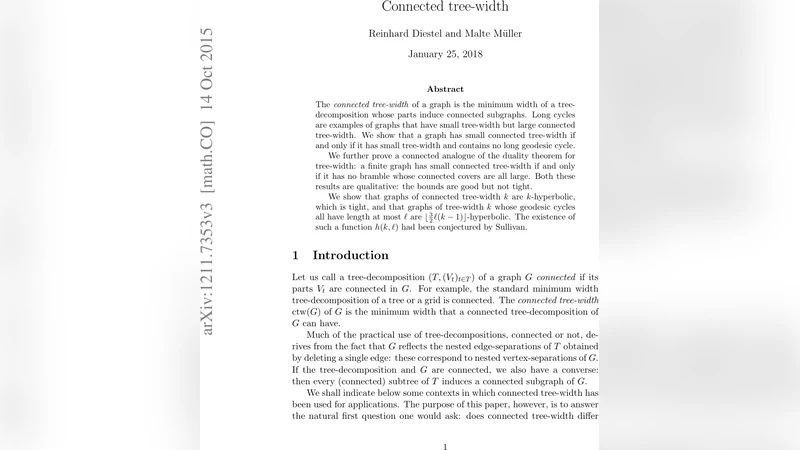
The connected tree-width of a graph is the minimum width of a tree-decomposition whose parts induce connected subgraphs. Long cycles are examples of graphs that have small tree-width but large connected tree-width. We show that a graph has small connected tree-width if and only if it has small tree-width and contains no long geodesic cycle. We further prove a connected analogue of the duality theorem for tree-width: a finite graph has small connected tree-width if and only if it has no bramble whose connected covers are all large. Both these results are qualitative: the bounds are good but not tight. We show that graphs of connected tree-width $k$ are $k$-hyperbolic, which is tight, and that graphs of tree-width $k$ whose geodesic cycles all have length at most $\ell$ are $\lfloor{3\over2}\ell(k-1)\rfloor$-hyperbolic. The existence of such a function $h(k,\ell)$ had been conjectured by Sullivan.
💡 Research Summary
The paper introduces and studies the notion of connected tree‑width, a refinement of the classical tree‑width that requires each bag of a tree‑decomposition to induce a connected subgraph. This additional connectivity constraint captures structural properties that ordinary tree‑width ignores, and it is motivated by applications where continuity of sub‑networks matters.
The authors first observe that long cycles dramatically increase connected tree‑width. In particular, a geodesic cycle—one that is a shortest‑path cycle—of length ℓ forces any connected tree‑decomposition to contain a bag of size at least proportional to ℓ, because the bag must contain the whole cycle while remaining connected. Consequently, graphs that contain arbitrarily long geodesic cycles can have arbitrarily large connected tree‑width even if their ordinary tree‑width stays bounded (e.g., long simple cycles).
The central structural theorem states that a graph has bounded connected tree‑width if and only if two conditions hold simultaneously: (1) its ordinary tree‑width is bounded, and (2) it contains no geodesic cycle longer than a fixed constant. The proof proceeds by constructing a connected tree‑decomposition from a standard one, carefully merging bags along short geodesic cycles, and showing that the resulting width depends only on the original tree‑width and the maximal length of geodesic cycles. This gives a clean qualitative characterisation: small connected tree‑width ⇔ small tree‑width + no long geodesic cycles.
Next, the paper extends the classic duality between tree‑width and brambles to the connected setting. A bramble is a collection of pairwise‑touching connected subgraphs; the traditional theorem says that a graph has tree‑width at least k iff it contains a bramble that cannot be hit by fewer than k vertices. The authors define a “connected bramble” and prove that a graph has small connected tree‑width exactly when every connected bramble admits a small connected cover. In other words, large connected tree‑width is equivalent to the existence of a connected bramble whose every connected hitting set is large. This result mirrors the original duality while respecting the added connectivity requirement, and it provides a powerful combinatorial tool for lower‑bounding connected tree‑width.
Finally, the authors investigate metric consequences. Hyperbolicity measures how tree‑like a metric space is; a graph is δ‑hyperbolic if all its geodesic triangles are δ‑thin. They prove two sharp hyperbolicity bounds. First, any finite graph with connected tree‑width k is k‑hyperbolic, and this bound is tight (examples achieve equality). Second, if a graph has ordinary tree‑width k and every geodesic cycle has length at most ℓ, then the graph is ⌊3ℓ(k−1)/2⌋‑hyperbolic. This settles a conjecture of Sullivan, who asked whether a function h(k,ℓ) exists with this property; the paper not only confirms existence but supplies an explicit (and essentially optimal) formula.
Overall, the work integrates three major themes—tree‑width, bramble duality, and hyperbolicity—under the unifying lens of connectivity. By showing that connected tree‑width is controlled precisely by ordinary tree‑width and the absence of long geodesic cycles, and by providing a connected‑bramble duality and tight hyperbolicity bounds, the authors deliver a comprehensive theory that both deepens our understanding of graph decomposition and opens avenues for algorithmic applications where connectivity of parts is essential.
Comments & Academic Discussion
Loading comments...
Leave a Comment