Orientation Dynamics of Asymmetric Rotors Using Random Phase Wave Functions
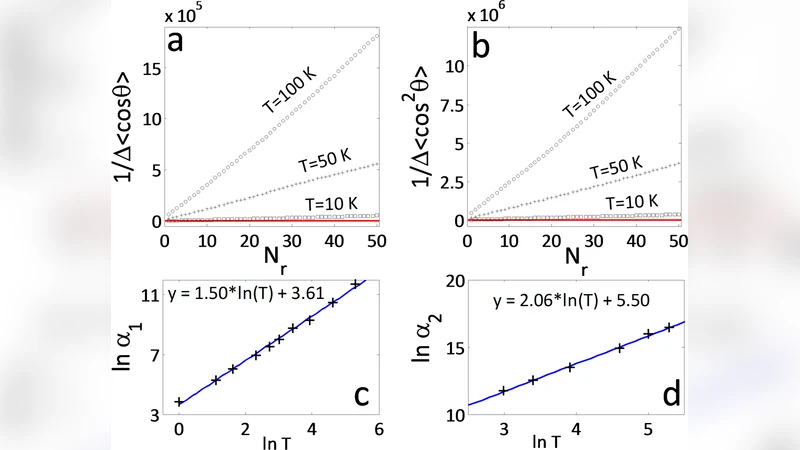
Intense terahertz-frequency pulses induce coherent rotational dynamics and orientation of polar molecular ensembles. Exact numerical methods for rotational dynamics are computationally not feasible for the vast majority of molecular rotors - the asymmetric top molecules at ambient temperatures. We exemplify the use of Random Phase Wave Functions (RPWF) by calculating the terahertz-induced rotational dynamics of sulfur dioxide (SO2) at ambient temperatures and high field strengths and show that the RPWF method gains efficiency with the increase in temperature and in the THz-field strengths. The presented method provides wide-ranging computational access to rotational dynamical responses of molecules at experimental conditions which are far beyond the reach of exact numerical methods.
💡 Research Summary
The paper addresses a long‑standing computational bottleneck in simulating the rotational dynamics of asymmetric‑top molecules subjected to intense terahertz (THz) pulses. Exact quantum‑mechanical propagation of the full rotational density matrix becomes infeasible at ambient temperatures because the number of thermally populated rotational states grows to tens of thousands, leading to prohibitive memory and CPU requirements. To overcome this, the authors adopt the Random Phase Wave Function (RPWF) approach, a statistical sampling technique that approximates a mixed thermal state by averaging over a modest ensemble of pure‑state wavefunctions each endowed with random phases. By virtue of phase averaging, off‑diagonal elements of the density matrix cancel statistically, allowing expectation values of observables to be recovered with far fewer basis vectors than required by a deterministic expansion.
The methodology is first laid out in detail. Starting from the Boltzmann distribution of rotational eigenstates (|J,K,M\rangle) of a rigid asymmetric top, each state is assigned a probability (p_{JKM}). An RPWF sample (|\psi_n\rangle) is constructed as (|\psi_n\rangle=\sum_{JKM}\sqrt{p_{JKM}},e^{i\phi_{n}^{JKM}}|J,K,M\rangle), where the phases (\phi_{n}^{JKM}) are independent random numbers uniformly drawn from (