Crossed product tensor categories
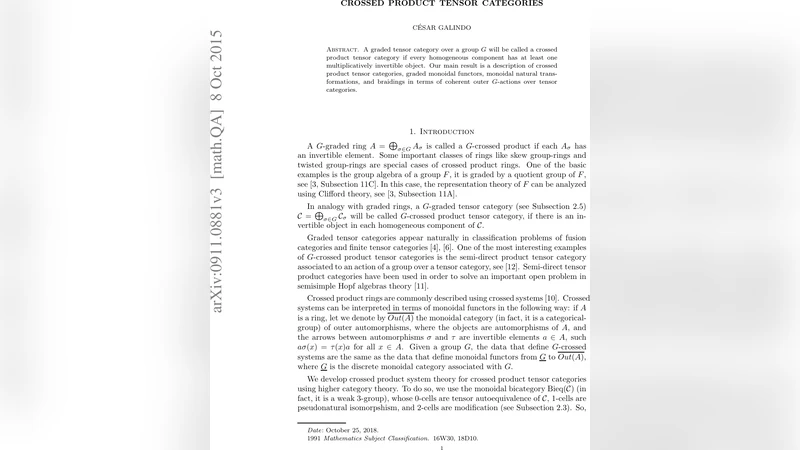
A graded tensor category over a group $G$ will be called a crossed product tensor category if every homogeneous component has at least one multiplicatively invertible object. Our main result is a description of the crossed product tensor categories, graded monoidal functors, monoidal natural transformations, and braiding in terms of coherent outer $G$-actions over tensor categories.
💡 Research Summary
The paper introduces and completely classifies a class of graded tensor categories called “crossed product tensor categories.” A $G$‑graded tensor category $\mathcal{C}=\bigoplus_{g\in G}\mathcal{C}_g$ is called a crossed product if every homogeneous component $\mathcal{C}g$ contains at least one multiplicatively invertible (i.e. tensor‑invertible) object. The existence of such objects allows one to pick a family ${U_g}{g\in G}$ with $U_g\in\mathcal{C}g$ and $U_g\otimes U_h\simeq U{gh}$, thereby providing a categorical analogue of a group extension.
The central insight is that the data of a crossed product category is equivalent to the data of a coherent outer action of $G$ on a tensor category. Concretely, for each $g\in G$ one constructs a tensor auto‑equivalence $F_g:\mathcal{C}\to\mathcal{C}$ together with natural isomorphisms $\mu_{g,h}:F_g\circ F_h\Rightarrow F_{gh}$ satisfying the usual 3‑cocycle (or “pentagon”) coherence condition. The family ${F_g,\mu_{g,h}}$ is called a coherent outer $G$‑action. Theorem A of the paper states that the assignment $\mathcal{C}\mapsto (F,\mu)$ yields a 2‑equivalence between the 2‑category of crossed product tensor categories and the 2‑category of coherent outer $G$‑actions. In other words, every crossed product can be reconstructed from a coherent outer action, and conversely any such action produces a crossed product by taking the graded pieces as the images of the invertible objects $U_g$.
Having fixed this correspondence, the authors turn to morphisms. A graded monoidal functor $T:\mathcal{C}\to\mathcal{D}$ between crossed products is required to preserve the grading ($T(\mathcal{C}_g)\subseteq\mathcal{D}_g$) and to be equipped with isomorphisms $\theta_g:T(U_g)\xrightarrow{\sim}V_g$ where $V_g$ are the chosen invertible objects in $\mathcal{D}_g$. The compatibility of $\theta_g$ with the coherence isomorphisms $\mu$ and $\nu$ (the latter belonging to $\mathcal{D}$) exactly encodes the notion of a monoidal natural transformation between the associated outer actions. Thus the 2‑morphisms in the crossed‑product world are identified with the 2‑cells of the outer‑action 2‑category.
The paper also treats braidings. If a crossed product tensor category carries a braiding, the outer action must be compatible with it: each $F_g$ must be a braided auto‑equivalence and the $\mu_{g,h}$ must intertwine the braiding in the sense of naturality. This additional structure mirrors the familiar compatibility conditions for crossed product Hopf algebras equipped with an $R$‑matrix, and it shows how the categorical braiding encodes a higher‑dimensional cohomological obstruction (a mixture of a 2‑cocycle governing the action and a 3‑cocycle governing the associator).
A substantial part of the paper is devoted to examples that illustrate the theory. The simplest case is the pointed fusion category $\operatorname{Vec}_G^\omega$, where $\omega\in H^3(G,\Bbbk^\times)$ is a 3‑cocycle; here the invertible objects are the one‑dimensional $g$‑graded vector spaces and the outer action is just the left translation on the grading. Another family of examples comes from representation categories $\operatorname{Rep}(G)$ twisted by a non‑trivial 2‑cocycle, producing “twisted crossed products’’ that generalize the usual equivariantization/de‑equivariantization procedures. The authors also discuss Drinfeld centers $Z(\mathcal{C})$ of crossed products, showing that the center inherits a natural $G$‑crossed braided structure, which is relevant for constructing new modular tensor categories and for applications in topological quantum field theory.
Overall, the work provides a clean, conceptual framework that unifies several previously disparate constructions—group extensions of tensor categories, $G$‑crossed braided categories, and equivariantization techniques—under the single notion of a coherent outer $G$‑action. By establishing a precise 2‑equivalence, the authors not only give a classification theorem but also lay the groundwork for further investigations into higher categorical symmetries, modular data, and potential physical applications such as symmetry‑enriched topological phases.
Comments & Academic Discussion
Loading comments...
Leave a Comment