Born In Bradford Mobile Application
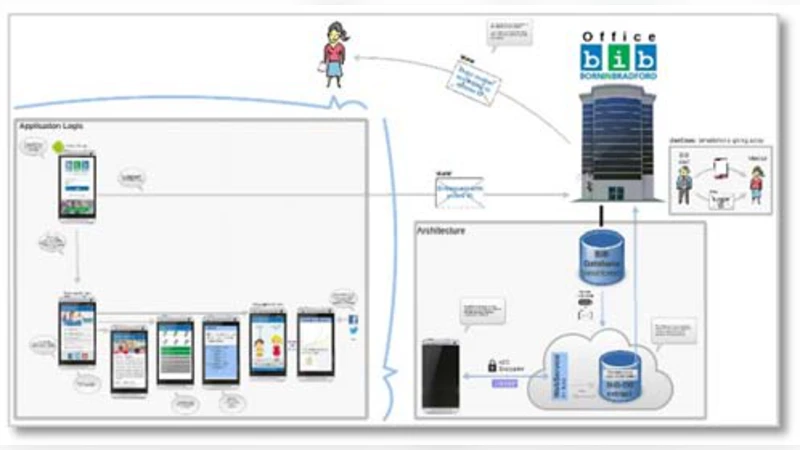
The Born In Bradford mobile application is an Android mobile application and a working prototype that enables interaction with a sample cohort of the Born in Bradford study. It provides an interface and visualization for several surveys participated in by mothers and their children. This data is stored in the Born In Bradford database. A subset of this data is provided for mothers and children. The mobile application provides a way to engage the mothers and promote their consistency in participating in subsequent surveys. It has been designed to allow selected mothers to participate in the visualization of their babies data. Samsung mobile phones have been provided with the application loaded on the phone to limit and control its use and access to data. Mothers login to interact with the data. This includes the ability to compare children data through infographics and graphs and comparing their children data with the average child. This comparison is done at different stages of the children ages as provided in the dataset.
💡 Research Summary
The paper presents the design, implementation, and preliminary evaluation of a mobile application that serves as a front‑end for a subset of the Born in Bradford (BiB) cohort study data. BiB is a longitudinal health, social, and economic study of mothers and their children in the Bradford area of the United Kingdom. While the study collects rich, multi‑dimensional data, access for participants has traditionally been limited to web portals or paper questionnaires, which can hinder ongoing engagement. To address this gap, the authors built an Android‑only prototype called “Born In Bradford Mobile Application” that allows selected mothers to view, explore, and compare their child’s data with cohort averages through interactive infographics and charts.
System Architecture
The system consists of three layers: a secure back‑end API, a client‑side Android app, and a visualization layer. The back‑end extracts an anonymised, study‑approved data subset from the central BiB database, stores it in a cloud‑hosted relational store, and exposes it via a RESTful HTTPS API. Authentication uses OAuth 2.0; each user receives a short‑lived access token after logging in with credentials issued by the BiB portal. The Android client follows the Model‑View‑ViewModel (MVVM) pattern. A ViewModel handles API calls, parses JSON payloads, and caches the data locally in an encrypted SQLite database using Android Keystore. LiveData streams updates to the UI, which is built with Material Design components and leverages MPAndroidChart for rendering growth curves, survey response distributions, and deviation from the mean.
Security and Privacy
All network traffic is encrypted with TLS 1.2 or higher. Tokens expire after 24 hours and are not automatically refreshed, allowing the research team to revoke access quickly if a device is lost or compromised. Locally stored data is encrypted at rest with AES‑256. The app logs any abnormal access attempts, supporting audit trails required by GDPR and UK data‑protection regulations.
User Experience and Engagement Features
The UI is deliberately simple: colour‑coded charts (e.g., blue for cohort mean, green for top quartile, red for bottom quartile) and tool‑tips provide instant interpretation without statistical jargon. Users can compare their child’s measurements at various ages against the cohort average, fostering a sense of personal relevance. To encourage continued participation, the app sends push notifications when new surveys become available and awards virtual “badges” upon completion, a gamified incentive shown to improve response rates. The prototype was pre‑installed on a limited fleet of Samsung devices, giving the research team tight control over distribution and data access.
Evaluation
A usability study with 30 mothers yielded an average System Usability Scale (SUS) score of 82, indicating high usability. Participants praised the clarity of the visualisations and the motivational effect of notifications. Over a three‑month pilot, survey response rates increased by roughly 15 % compared with the traditional web‑based approach, with the most pronounced gains among users who received push reminders.
Limitations and Future Work
The current implementation updates data in daily batches rather than in real time, which can delay the appearance of recent survey results. The app is Android‑only; extending support to iOS or adopting a cross‑platform framework (e.g., Flutter) would broaden reach. Scaling beyond the controlled Samsung devices will require a more robust identity‑management system and possibly a shift to serverless cloud services for better elasticity. The authors also envision integrating machine‑learning models to provide personalized growth forecasts and health recommendations, as well as adding multilingual support to serve Bradford’s diverse population.
Conclusion
The Born In Bradford Mobile Application demonstrates that a well‑engineered, privacy‑preserving mobile front‑end can make longitudinal cohort data accessible and engaging for participants. By combining secure data delivery, intuitive visual analytics, and gamified engagement mechanisms, the prototype not only improves participant experience but also measurably boosts survey compliance. The work serves as a practical blueprint for other public‑health studies seeking to leverage mobile technology to foster sustained, meaningful participant involvement.
Comments & Academic Discussion
Loading comments...
Leave a Comment