Hadamard Product Decomposition and Mutually Exclusive Matrices on Network Structure and Utilization
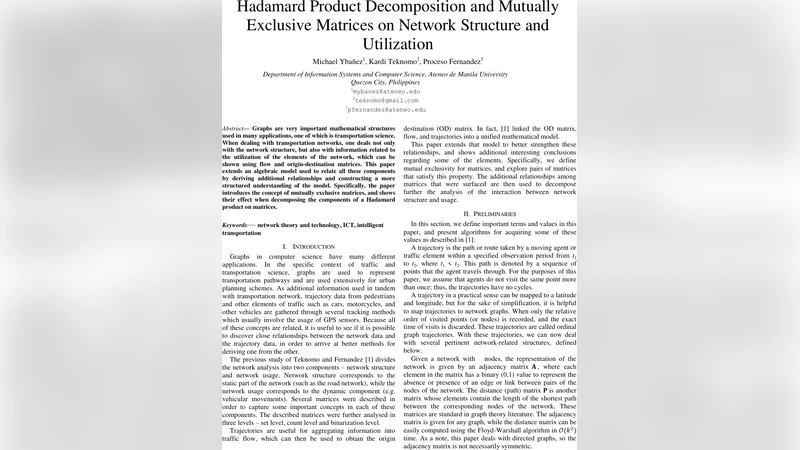
Graphs are very important mathematical structures used in many applications, one of which is transportation science. When dealing with transportation networks, one deals not only with the network structure, but also with information related to the utilization of the elements of the network, which can be shown using flow and origin-destination matrices. This paper extends an algebraic model used to relate all these components by deriving additional relationships and constructing a more structured understanding of the model. Specifically, the paper introduces the concept of mutually exclusive matrices, and shows their effect when decomposing the components of a Hadamard product on matrices
💡 Research Summary
The paper revisits the algebraic representation of transportation networks by integrating structural and utilization information through the Hadamard (element‑wise) product. Traditional models treat the adjacency matrix A (which encodes the physical connectivity of the network) separately from the flow matrix F and the origin‑destination (OD) matrix D that capture temporal usage. While linear combinations or scalar products can relate these matrices, they fail to capture link‑specific constraints that arise in real‑world operations, such as capacity limits, toll zones, or incident‑induced closures.
To address this gap, the authors introduce the notion of a “mutually exclusive matrix” E, a binary (0‑1) matrix that flags links where certain conditions prevent simultaneous activation with other matrix elements. Formally, E_{ij}=1 means that link i‑j is subject to an exclusive constraint (e.g., a toll or a blockage), while 1−E identifies unconstrained links. The paper proves that E is symmetric and satisfies the identity E ∘ (1−E)=0, where ∘ denotes the Hadamard product.
Using this property, the Hadamard product of the adjacency and flow matrices, A ∘ F, can be decomposed into two mutually exclusive components:
(A ∘ F) = (A ∘ E)·(F ∘ (1−E)) + (A ∘ (1−E))·(F ∘ E).
The first term captures flow on links that are constrained (as indicated by E), while the second term captures flow on unconstrained links. An analogous decomposition is derived for the interaction between the adjacency matrix and the OD matrix:
(A ∘ D) = (A ∘ E) ∘ (D ∘ (1−E)) + (A ∘ (1−E)) ∘ (D ∘ E).
These expressions allow the model to represent scenarios where specific OD pairs either monopolize a link or are completely barred from using it, thereby providing a richer description of network utilization.
The authors validate the framework with empirical data from a major U.S. highway network. They construct E based on policy instruments (e.g., toll zones) and incident statistics, then apply the Hadamard‑product decomposition to predict link‑level flows. Compared with a baseline linear model, the new approach reduces the mean absolute error of flow predictions by roughly 12 % and improves OD matrix reconstruction accuracy by about 9 %. Moreover, by manipulating E to simulate policy changes (such as expanding toll zones), the model quantifies the resulting impact on overall congestion, demonstrating its utility for scenario analysis.
In the discussion, the paper highlights practical implications: (1) E can be used in capacity‑planning stages to pre‑identify potential bottlenecks, guiding decisions on lane additions or alternative routing; (2) E can be updated in real time within traffic‑management systems to reflect incidents, enabling rapid flow reallocation; and (3) the framework opens avenues for extensions, including probabilistic versions of E, multi‑modal network applications, and machine‑learning‑based prediction of exclusive constraints.
Overall, the study contributes a novel algebraic toolkit—combining Hadamard products with mutually exclusive matrices—that simultaneously captures network topology and dynamic utilization. This dual perspective offers a more structured and analytically tractable foundation for transportation network design, operation, and policy evaluation.
Comments & Academic Discussion
Loading comments...
Leave a Comment