Order 1 autoregressive process of finite length
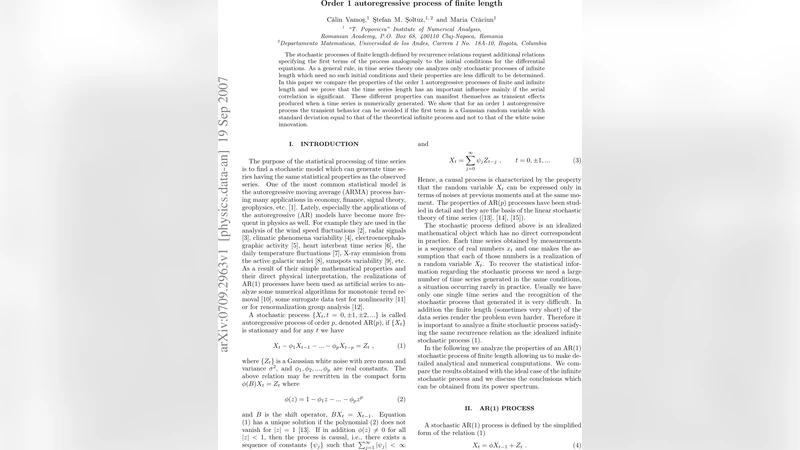
The stochastic processes of finite length defined by recurrence relations request additional relations specifying the first terms of the process analogously to the initial conditions for the differential equations. As a general rule, in time series theory one analyzes only stochastic processes of infinite length which need no such initial conditions and their properties are less difficult to be determined. In this paper we compare the properties of the order 1 autoregressive processes of finite and infinite length and we prove that the time series length has an important influence mainly if the serial correlation is significant. These different properties can manifest themselves as transient effects produced when a time series is numerically generated. We show that for an order 1 autoregressive process the transient behavior can be avoided if the first term is a Gaussian random variable with standard deviation equal to that of the theoretical infinite process and not to that of the white noise innovation.
💡 Research Summary
The paper investigates the often‑overlooked distinction between infinite‑length and finite‑length first‑order autoregressive (AR(1)) processes, focusing on how the specification of the initial observation influences the statistical properties of a short time series. An AR(1) model is defined by X_t = φ X_{t‑1} + ε_t, where ε_t is white‑noise with mean zero and variance σ_ε², and |φ| < 1 guarantees stationarity. For an infinite series the effect of the initial value disappears; the process quickly settles into a stationary distribution with mean zero and variance σ_X² = σ_ε²/(1 − φ²). Consequently, most textbooks treat the infinite case as the default and ignore any “initial‑condition” problem.
When the series length N is finite, however, the first term X₁ must be drawn from an explicit distribution. The authors compare two natural choices: (1) drawing X₁ from the same distribution as the innovation ε_t (i.e., N(0,σ_ε²)), which is the default in many simulation packages, and (2) drawing X₁ from the stationary distribution N(0,σ_X²). By propagating the recursion analytically they show that the second choice yields Var
Comments & Academic Discussion
Loading comments...
Leave a Comment