Monte Carlo Based Toy Model for Fission Process
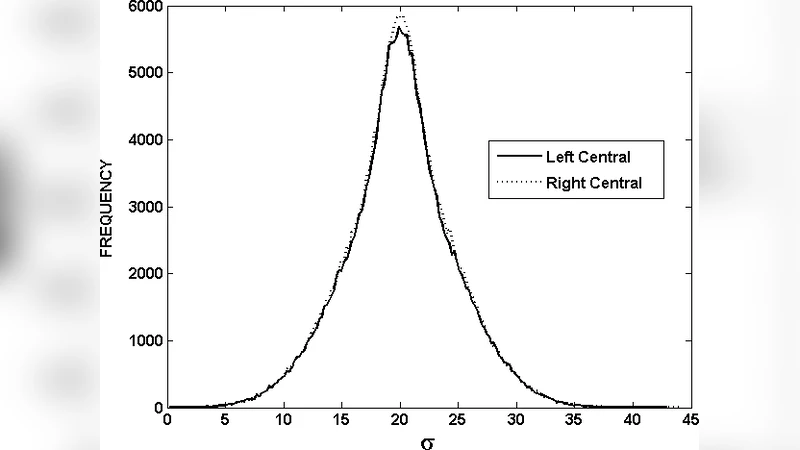
Fission yield has been calculated notoriously by two calculations approach, macroscopic approach and microscopic approach. This work will proposes another calculation approach which the nucleus is treated as a toy model. The toy model of fission yield is a preliminary method that use random number as a backbone of the calculation. Because of nucleus as a toy model hence the fission process does not represent real fission process in nature completely. Fission event is modeled by one random number. The number is assumed as width of distribution probability of nucleon position in compound nuclei when fission process is started. The toy model is formed by Gaussian distribution of random number that randomizes distance like between particle and central point. The scission process is started by smashing compound nucleus central point into two parts that are left central and right central points. These three points have different Gaussian distribution parameters such as mean ({\mu}CN, {\mu}L, {\mu}R), and standard deviation ({\sigma}CN, {\sigma}L ,{\sigma}R). By overlaying of three distributions, the number of particles ( NL, NR) that they are trapped by central points is obtained. This process is iterated until ( NL, NR) become constant numbers. The yield is determined from portion of nuclei distribution which is proportional with portion of mass numbers. Smashing process is repeated by changing {\sigma}L and {\sigma}R randomly
💡 Research Summary
The paper proposes a novel, highly simplified computational framework for estimating fission fragment yields, positioning it as an alternative to the conventional macroscopic (e.g., liquid‑drop) and microscopic (e.g., quantum‑tunnelling) approaches that are both mathematically intensive and computationally demanding. The authors introduce a “toy model” in which the nucleus is represented as a cloud of particles whose spatial distribution is described by a Gaussian probability density. In the initial, pre‑scission state a single Gaussian with mean μCN and standard deviation σCN characterises the whole compound nucleus.
When fission is triggered, the central point of this distribution is “smashed” into two new centers, μL and μR, each associated with its own Gaussian width (σL and σR). The three Gaussians (the original compound‑nucleus distribution and the two nascent fragment distributions) are overlaid, and each particle is assigned to the fragment whose Gaussian is closest to its position. The numbers of particles captured by the left and right fragments, NL and NR, are counted. This assignment procedure is iterated: after each iteration the particle set is redistributed according to the updated Gaussians, and the process continues until NL and NR converge to stable values.
The final fragment mass ratio is taken to be proportional to the particle‑number ratio NL/(NL+NR) for the left fragment and NR/(NL+NR) for the right fragment. By repeating the whole “smashing” operation many times while randomly varying σL and σR, the authors generate a statistical ensemble of fragment mass splits. The ensemble average of the NL/NR ratios is interpreted as the predicted fission yield distribution.
Key methodological points:
- Random‑number backbone – The model hinges on a single random number that determines the width of the Gaussian describing nucleon positions at scission. Subsequent random draws for σL and σR introduce variability that mimics different deformation states.
- Gaussian overlay – The use of three overlapping normal distributions provides a simple geometric rule for particle allocation, avoiding any explicit treatment of nuclear forces, shell effects, or potential‑energy surfaces.
- Iterative convergence – By repeatedly re‑assigning particles until NL and NR stop changing, the algorithm ensures a self‑consistent partition of the particle cloud for each random configuration.
The authors present a few illustrative simulations. When σL and σR differ markedly, the model yields asymmetric fragment yields; when they are comparable, the yields become symmetric. Increasing the absolute values of σL and σR broadens the particle cloud, leading to flatter, less peaked yield curves.
Despite its elegance and computational speed, the model has several serious limitations. First, the assumption that nucleon positions follow a simple Gaussian ignores the known non‑uniform density of real nuclei, which exhibit a central plateau, surface diffuseness, and shell‑induced fluctuations. Second, the “smashing” of the central point into two new points lacks a physical basis: no potential‑energy landscape, surface tension, or Coulomb repulsion is modeled, so energy conservation and barrier penetration are not respected. Third, the random variation of σL and σR is not linked to measurable physical quantities such as excitation energy, temperature, or deformation parameters, making it difficult to interpret the results in a nuclear‑physics context. Fourth, the paper provides no quantitative validation against experimental fission‑yield data or against established macroscopic/microscopic calculations, leaving the predictive power of the toy model untested.
For future development, the authors suggest three avenues: (i) replace the simple Gaussian with a more realistic nuclear density profile (e.g., a two‑parameter Fermi distribution) to capture surface effects; (ii) embed a minimal potential‑energy model that accounts for surface tension, Coulomb repulsion, and shell corrections, thereby giving the “smashing” process a physical driver; (iii) map the random σL/σR values onto physical deformation or temperature variables, enabling a direct comparison with experimental observables. Additionally, systematic benchmarking against measured fragment mass distributions for well‑studied fissile isotopes (U‑235, Pu‑239, Cf‑252, etc.) would be essential to assess whether the toy model can serve as a rapid pre‑screening tool or an educational illustration.
In summary, the paper introduces an innovative Monte‑Carlo‑based toy model that reduces the complex problem of fission‑yield calculation to a tractable statistical exercise. While the approach is conceptually appealing and computationally inexpensive, its current formulation lacks the physical fidelity required for quantitative nuclear‑physics predictions. With the suggested refinements—more realistic density functions, incorporation of nuclear energetics, and rigorous validation—the model could evolve into a useful pedagogical platform or a fast‑approximation scheme for exploratory studies in fission research.