Event-driven agility of interoperability during the Run-time of collaborative processes
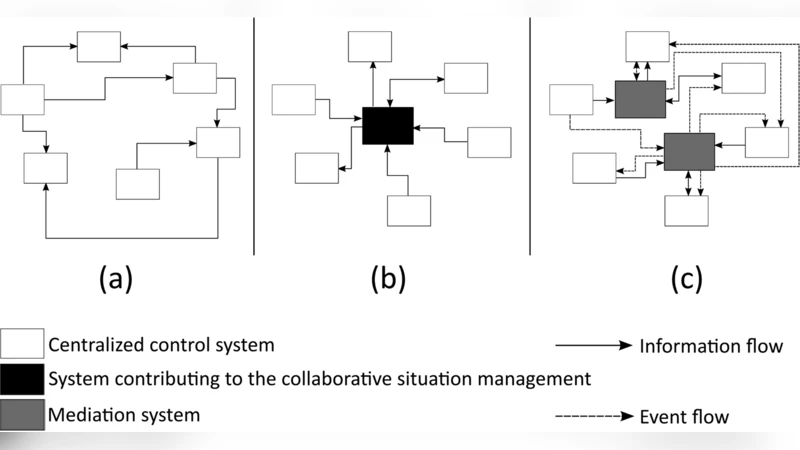
The modern business environment tends to involve a large network of heterogeneous people, devices and organizations that engage in collaborative processes among themselves. Given the nature of this type of collaboration and the high degree of interoperability between partner Information Systems, these processes need to be agile in order to respond to changes in context, which may occur at any time during the collaborative situation.The objective is to build a Mediation Information System (MIS), in support of collaborative situations, whose architecture must be (i) built to be relevant to the collaborative situation under consideration, (ii) more easily integrated into the existing systems, and (iii) sufficiently agile, through its awareness of the environment and of process events, and through the way it reacts to events detected as being relevant.To apply agility mechanisms, it is crucial to detect the significant events that will lead to a subsequent evolution of the situation (detection step). Event-Driven Architecture (EDA) is used to design the structure of the part of the system that is in charge of MIS agility. This architecture takes the events into account, manages them and, if needed, uses them to trigger the adaptation of the MIS.We have defined a means to monitor the evolution of the situation. If relevant changes are detected, and if the situation does not evolve in the expected way, an adaptation is proposed. It is concluded that the principles of detection and adaptation, combined with the responsiveness of the system (provided by the automation of transitions), and based on Event Driven Architecture principles, together provide the agility required for collaborative processes.
💡 Research Summary
The paper addresses the challenge of maintaining agility in collaborative processes that involve heterogeneous participants—people, devices, and organizations—connected through interoperable information systems. To enable real‑time adaptation, the authors propose a Mediation Information System (MIS) whose architecture satisfies three key criteria: relevance to the specific collaborative situation, ease of integration with existing legacy systems, and sufficient agility through environmental awareness and event handling.
Central to the MIS is an Event‑Driven Architecture (EDA) that continuously captures events from diverse sources (sensors, logs, business applications) and feeds them into a complex event processing engine. This engine filters out irrelevant noise and extracts “meaningful” events that indicate a deviation from the expected evolution of the collaborative situation. The detection‑adaptation cycle then triggers an adaptation phase: the situation model—comprising goals, constraints, and participant roles—is updated, and the workflow engine automatically reconfigures process flows or remaps services via a service registry. Policy rules determine whether adaptations are applied automatically or require human approval, thereby providing both speed and governance.
The authors introduce a state model that maintains a meta‑data representation of the current collaborative context. When an event causes a mismatch between the actual and expected state, an adaptation proposal is generated and evaluated by a decision engine. This self‑awareness and self‑adjustment capability allows the MIS to react within seconds, a stark contrast to traditional BPM solutions that may take minutes or longer to respond.
A practical case study in a logistics collaboration demonstrates the approach. Event detection occurs on average within two seconds, and the full adaptation cycle completes in about five seconds, showing a substantial performance gain. Integration with existing ERP and WMS systems required only minimal custom interfaces, and new partners could be onboarded simply by registering their services in the metadata repository.
In conclusion, the paper validates that an event‑driven, model‑based MIS can provide the agility required for dynamic, interoperable collaborative processes. The combination of real‑time event detection, automatic workflow reconfiguration, and policy‑driven governance delivers rapid, context‑aware adaptations. The authors suggest future work on machine‑learning‑enhanced event prediction, cross‑domain interoperability standards, and strengthened security and privacy mechanisms to further extend the framework’s applicability.
Comments & Academic Discussion
Loading comments...
Leave a Comment