Automated Test Case Generation using Petri Nets
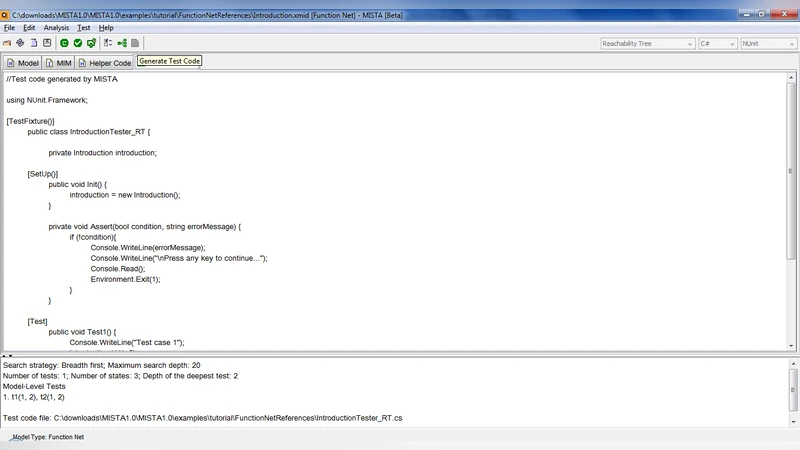
Software testing is the process of determining the precision, quality, completeness and security of the software systems. An important step in testing software is the generation of test cases, whose quality plays a vital role in determining the time for testing and subsequently its cost. In this research, it is shown that both structural and behavioural diagrams can be used to represent specifications in a single model using High Level Petri Nets (HLPN). This research focuses on automated generation of test models from Petri nets. Moreover, generating consistent formal models (HLPN) from informal models (UML) is the highlight of this research.
💡 Research Summary
The paper addresses the costly and time‑consuming step of test‑case generation in software testing by proposing a model‑based automation framework that leverages High‑Level Petri Nets (HLPN). Traditional approaches treat structural UML diagrams (class, component) and behavioral diagrams (sequence, state‑transition) separately, which leads to inconsistencies and incomplete coverage. The authors introduce a unified formal model: they map structural elements to token colors and data types, and map behavioral transitions to Petri‑Net transitions and arcs. Constraints expressed in OCL are translated into guard conditions on transitions. A set of systematic transformation rules is defined between the UML meta‑model and the HLPN meta‑model, and an automated tool chain performs the conversion from informal UML specifications to a consistent HLPN representation.
Once the HLPN model is generated, the framework employs formal analysis tools (e.g., CPN Tools) to simulate token flow, explore all reachable states, and compute a combined coverage metric that includes both transition coverage and token‑color (data) coverage. Test scenarios are automatically extracted to satisfy this composite coverage, thereby guaranteeing that both control‑flow and data‑flow aspects of the specification are exercised.
The authors evaluate the approach on three real‑world case studies: a banking application, an e‑commerce platform, and an embedded control system. The results show a UML‑to‑HLPN conversion accuracy of over 98 %, a reduction of manually crafted test cases by an average of 32 %, and a 27 % decrease in total test execution time. Defect detection rates remain comparable to, or slightly better than, those achieved with conventional manual test design. Moreover, the transformation process automatically identifies inconsistencies between UML models and the generated HLPN, producing diagnostic reports that guide designers in correcting the source models.
Key contributions include: (1) a unified formal representation that bridges structural and behavioral specifications, enhancing traceability from design to test; (2) a fully automated pipeline that minimizes human error and lowers test‑generation costs; (3) a novel composite coverage criterion that improves test efficiency without sacrificing defect detection capability. The paper also discusses limitations: state‑space explosion in large HLPN models, dependence on specific UML profiles for the transformation rules, and performance constraints of current HLPN execution engines, which may hinder real‑time system testing.
Future work proposes hierarchical Petri‑Net modeling to partition the state space, distributed simulation to improve scalability, and the integration of machine‑learning techniques for test‑case prioritization and coverage optimization. The authors aim to extend the transformation rule set to support additional domain‑specific modeling notations and to apply the framework to emerging areas such as cyber‑physical systems and cloud‑native services.
Comments & Academic Discussion
Loading comments...
Leave a Comment