Deep Trans-layer Unsupervised Networks for Representation Learning
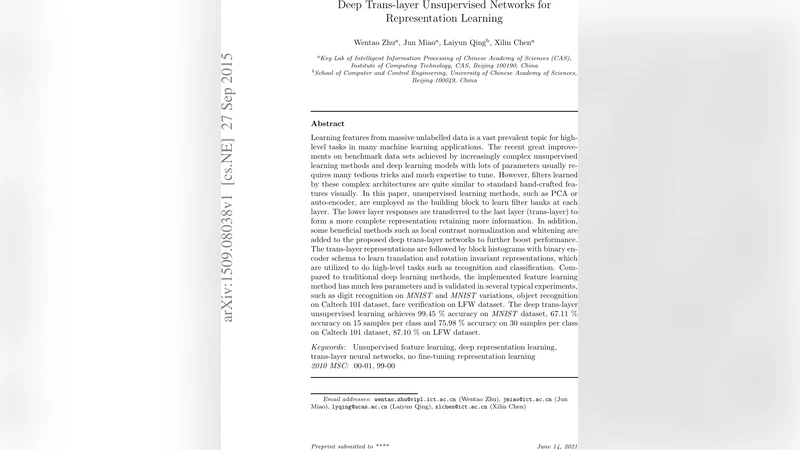
Learning features from massive unlabelled data is a vast prevalent topic for high-level tasks in many machine learning applications. The recent great improvements on benchmark data sets achieved by increasingly complex unsupervised learning methods and deep learning models with lots of parameters usually requires many tedious tricks and much expertise to tune. However, filters learned by these complex architectures are quite similar to standard hand-crafted features visually. In this paper, unsupervised learning methods, such as PCA or auto-encoder, are employed as the building block to learn filter banks at each layer. The lower layer responses are transferred to the last layer (trans-layer) to form a more complete representation retaining more information. In addition, some beneficial methods such as local contrast normalization and whitening are added to the proposed deep trans-layer networks to further boost performance. The trans-layer representations are followed by block histograms with binary encoder schema to learn translation and rotation invariant representations, which are utilized to do high-level tasks such as recognition and classification. Compared to traditional deep learning methods, the implemented feature learning method has much less parameters and is validated in several typical experiments, such as digit recognition on MNIST and MNIST variations, object recognition on Caltech 101 dataset and face verification on LFW dataset. The deep trans-layer unsupervised learning achieves 99.45% accuracy on MNIST dataset, 67.11% accuracy on 15 samples per class and 75.98% accuracy on 30 samples per class on Caltech 101 dataset, 87.10% on LFW dataset.
💡 Research Summary
The paper introduces a novel framework called the Deep Trans‑Layer Unsupervised Network for learning image representations from large amounts of unlabeled data. Traditional deep unsupervised models often rely on complex architectures, a huge number of parameters, and fine‑tuning via back‑propagation, which makes them computationally expensive and difficult to deploy. In contrast, the proposed method builds each layer using classical unsupervised learning techniques—Principal Component Analysis (PCA) or auto‑encoders—without any gradient‑based fine‑tuning.
The architecture consists of three stages: two unsupervised learning layers followed by a trans‑layer aggregation and a final encoding stage. In each of the first two layers, random patches are extracted from the input (or from the feature maps of the previous layer). These patches undergo Local Contrast Normalization (LCN) to remove local mean and normalize contrast, and ZCA whitening to decorrelate the data. After this preprocessing, PCA or an auto‑encoder learns a bank of linear filters. The learned filters are then convolved with the original images (or with the feature maps from the preceding layer) to produce feature maps.
The key innovation is the “trans‑layer” connection: the feature maps from the first layer are concatenated with those from the second layer before the final encoding. This preserves low‑level texture information that would otherwise be lost in a strictly hierarchical cascade (as observed in PCANet). By retaining both low‑ and mid‑level cues, the representation becomes richer and more discriminative.
After the two layers, each feature map is binarized, and the image is divided into spatial blocks. For each block, a histogram of binary codes is computed, yielding a compact descriptor that is invariant to small translations and rotations. The resulting high‑dimensional vector can be fed directly into a linear classifier (e.g., SVM) or reduced further with dimensionality‑reduction techniques.
Experimental evaluation covers four benchmark tasks: handwritten digit classification on MNIST and its variants, object classification on Caltech‑101 with limited training samples (15 and 30 per class), and face verification on Labeled Faces in the Wild (LFW). The method achieves 99.45 % accuracy on MNIST, 67.11 % (15‑sample) and 75.98 % (30‑sample) on Caltech‑101, and 87.10 % verification accuracy on LFW. These results are competitive with state‑of‑the‑art deep supervised models, despite using orders of magnitude fewer parameters (only a few thousand) and no back‑propagation fine‑tuning.
The authors also discuss the role of each component: LCN improves robustness to illumination changes; whitening reduces redundancy and facilitates learning of more informative PCA directions; the trans‑layer connection mitigates information loss across layers; and block‑wise histograms provide translation and rotation invariance.
In summary, the Deep Trans‑Layer Unsupervised Network demonstrates that a carefully designed pipeline—combining simple unsupervised filter learning, effective preprocessing, and a trans‑layer feature aggregation—can produce high‑quality, invariant image representations with minimal computational overhead. The approach offers a practical alternative to heavily parameterized deep networks, especially in scenarios where labeled data are scarce or computational resources are limited. Future work may explore deeper hierarchies, alternative unsupervised learners (e.g., variational auto‑encoders), and applications beyond vision such as audio or text domains.
Comments & Academic Discussion
Loading comments...
Leave a Comment