Fractional Authorship in Nuclear Physics
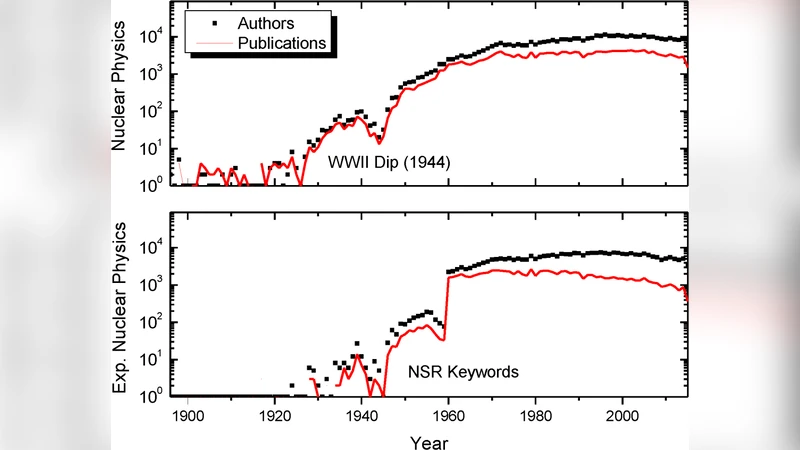
Large, multi-institutional groups or collaborations of scientists are engaged in nuclear physics research projects, and the number of research facilities is dwindling. These collaborations have their own authorship rules, and they produce a large number of highly-cited papers. Multiple authorship of nuclear physics publications creates a problem with the assessment of an individual author’s productivity relative to his/her colleagues and renders ineffective a performance metrics solely based on annual publication and citation counts. Many institutions are increasingly relying on the total number of first-author papers; however, this approach becomes counterproductive for large research collaborations with an alphabetical order of authors. A concept of fractional authorship (the claiming of credit for authorship by more than one individual) helps to clarify this issue by providing a more complete picture of research activities. In the present work, nuclear physics fractional and total authorships have been investigated using nuclear data mining techniques. Historic total and fractional authorship averages have been extracted from the Nuclear Science References (NSR) database, and the current range of fractional contributions has been deduced. The results of this study and their implications are discussed and conclusions presented.
💡 Research Summary
The paper addresses a growing problem in nuclear physics: the proliferation of multi‑author papers produced by large, often international, collaborations. Traditional performance metrics—annual publication counts, total citations, and the number of first‑author papers—were designed for a research environment where a handful of authors contributed to each article and author order reflected contribution. In modern nuclear‑physics collaborations, author lists can run into dozens or even hundreds, and the order is frequently alphabetical or otherwise unrelated to actual work share. Consequently, using raw counts inflates an individual’s apparent productivity and obscures real contributions.
To remedy this, the authors propose a fractional authorship model. Under this scheme each paper’s credit is divided among its authors, either equally (1/N where N is the number of authors) or by a weighted contribution agreed upon by the team. The study extracts bibliographic records from the Nuclear Science References (NSR) database, spanning more than a century of nuclear‑physics literature. By computing yearly averages of total authors per paper and the corresponding fractional credit, the authors reveal a clear historical trend: average author count rose from about three in the 1970s to well over ten today, while the mean fractional contribution fell from roughly 0.33 to below 0.10. Papers linked to major facilities such as CERN, J‑PARC, and GSI frequently list 30–100 authors, underscoring the inadequacy of first‑author metrics in these contexts.
The analysis discusses practical implications. Fractional authorship would allow hiring committees, funding agencies, and institutional review boards to assess researchers on a basis that more accurately reflects their actual input, reducing the bias introduced by sheer volume of co‑authored papers. It also encourages transparent documentation of individual tasks—experiment design, data acquisition, analysis, theoretical modeling—through project‑management tools or contribution logs, thereby mitigating disputes over credit allocation. The authors acknowledge challenges: not all contributions are easily quantifiable, and weighting schemes may introduce subjectivity. Nevertheless, they argue that a community‑wide consensus on fractional credit, supported by clear contribution records, can improve fairness and ethical standards in authorship.
In conclusion, the study demonstrates that the traditional “count‑and‑cite” paradigm is insufficient for evaluating nuclear‑physics researchers in the era of large collaborations. Fractional authorship offers a more nuanced, data‑driven alternative that captures the true distribution of scholarly work. Future work should extend the methodology to other scientific domains, refine weighting algorithms, and develop standardized guidelines for implementing fractional credit across journals and institutions.
Comments & Academic Discussion
Loading comments...
Leave a Comment