Hydrostatic Simulation of Earths Atmospheric Gas Using Multi-particle Collision Dynamics
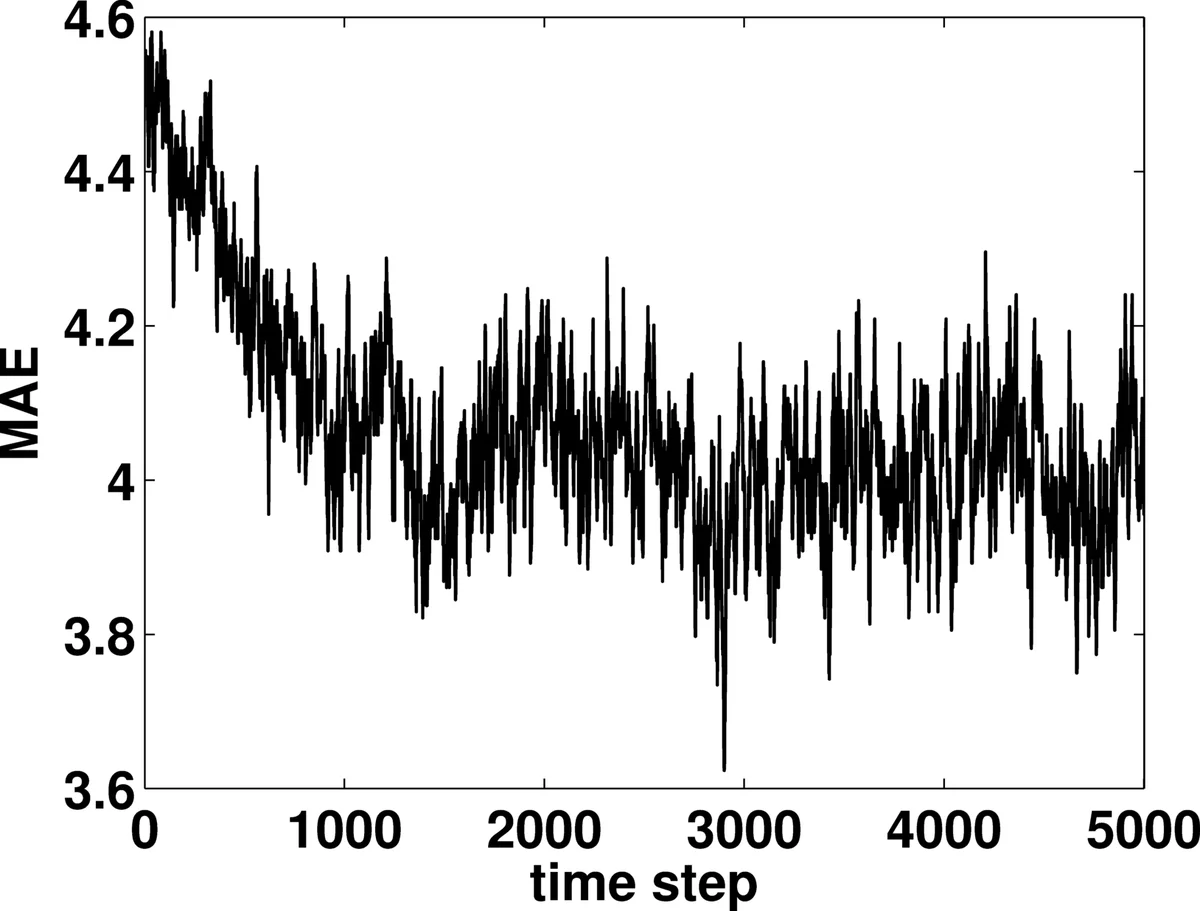
Multi-particle collision dynamics (MPCD) is a mesoscopic simulation method to simulate fluid particle-like flows. MPCD has been widely used to simulate various problems in condensed matter. In this study, hydrostatic behavior of gas in the Earth’s atmospheric layer is simulated by using MPCD method. The simulation is carried out by assuming the system under ideal state and is affected only by gravitational force. Gas particles are homogeneous and placed in 2D box. Interaction of the particles with the box is applied through implementation of boundary conditions (BC). Periodic BC is applied on the left and the right side, specular reflection on the top side, while bounce-back on the bottom side. Simulation program is executed in Arch Linux and running in notebook with processor Intel i5 @2700 MHz with 10 GB DDR3 RAM. The results show behaviors of the particles obey kinetic theory for ideal gas when gravitational acceleration value is proportional to the particle mass. Density distribution as a function of altitude also meets atmosphere’s hydrostatic theory.
💡 Research Summary
This paper presents a novel application of Multi‑Particle Collision Dynamics (MPCD) to simulate the hydrostatic equilibrium of an ideal gas representing Earth’s lower atmosphere. The authors begin by outlining the importance of mesoscopic particle‑based methods for studying complex fluid phenomena in the atmosphere and note that, while MPCD has been widely employed for soft‑matter systems, it has not previously been used for atmospheric hydrostatics.
Using the U.S. Standard Atmosphere 1976 as a reference, the study assumes a dry, homogeneously mixed gas up to 86 km altitude that obeys the ideal‑gas law. With a constant temperature of 288.15 K, the scale height H = RT/g is 8.433 km, leading to the theoretical density profile ρ(z)=ρ₀ exp
Comments & Academic Discussion
Loading comments...
Leave a Comment