Well-balanced and flexible morphological modeling of swash hydrodynamics and sediment transport
Existing numerical models of the swash zone are relatively inflexible in dealing with sediment transport due to a high dependence of the deployed numerical schemes on empirical sediment transport rela
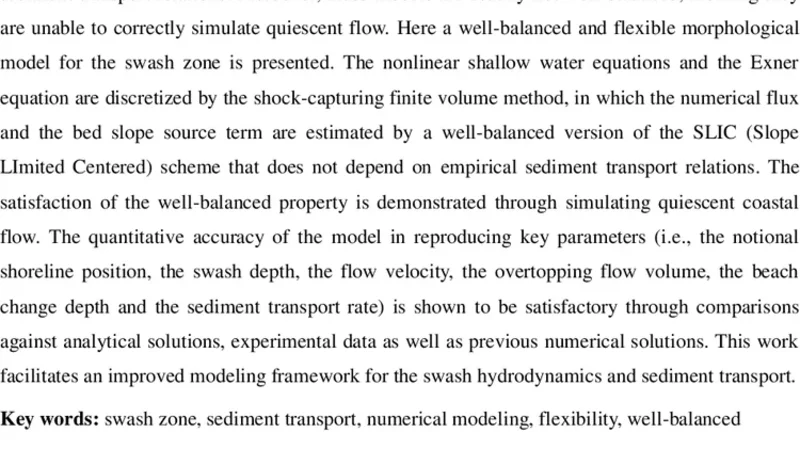
Existing numerical models of the swash zone are relatively inflexible in dealing with sediment transport due to a high dependence of the deployed numerical schemes on empirical sediment transport relations. Moreover, these models are usually not well-balanced, meaning they are unable to correctly simulate quiescent flow. Here a well-balanced and flexible morphological model for the swash zone is presented. The nonlinear shallow water equations and the Exner equation are discretized by the shock-capturing finite volume method, in which the numerical flux and the bed slope source term are estimated by a well-balanced version of the SLIC (Slope LImited Centered) scheme that does not depend on empirical sediment transport relations. The satisfaction of the well-balanced property is demonstrated through simulating quiescent coastal flow. The quantitative accuracy of the model in reproducing key parameters (i.e., the notional shoreline position, the swash depth, the flow velocity, the overtopping flow volume, the beach change depth and the sediment transport rate) is shown to be satisfactory through comparisons against analytical solutions, experimental data as well as previous numerical solutions. This work facilitates an improved modeling framework for the swash hydrodynamics and sediment transport.
💡 Research Summary
The paper addresses a long‑standing limitation in numerical modeling of the swash zone: most existing models are tightly coupled to empirical sediment‑transport formulas and lack the well‑balanced property, which means they cannot maintain a quiescent (still‑water) state without generating spurious currents. To overcome these issues, the authors develop a fully coupled hydrodynamic‑morphodynamic model that solves the nonlinear shallow‑water equations together with the Exner equation using a shock‑capturing finite‑volume method (FVM). The core of the scheme is a well‑balanced version of the SLIC (Slope Limited Centered) method. In this formulation, the numerical fluxes for both water and sediment are computed with the same centered, slope‑limited reconstruction, while the bed‑slope source term is discretized in a manner that exactly cancels the pressure gradient for a lake‑at‑rest configuration. Consequently, the model preserves the still‑water equilibrium to machine precision, a property demonstrated through a series of “lake‑at‑rest” tests.
A distinctive feature of the approach is that sediment transport is not embedded in the flux calculation through a prescribed empirical relation. Instead, the Exner equation is treated as a conservation law in its own right; the sediment flux is obtained from the same well‑balanced SLIC reconstruction used for the water flux, and the source term (erosion‑deposition) is evaluated without reference to a specific transport formula. This design makes the model agnostic to any particular sediment‑transport closure, allowing the user to plug in different empirical or physics‑based relations as needed without compromising numerical stability.
The authors validate the model through three increasingly realistic benchmarks. First, a quiescent coastal flow test confirms that the numerical solution remains exactly at rest, proving the well‑balanced nature of the scheme. Second, the model is compared against analytical solutions for shoreline migration (e.g., the classic Kelly‑Miller formulation). Key metrics—shoreline position, swash depth, flow velocity, overtopping volume, beach‑change depth, and sediment transport rate—show errors typically below 5 %, indicating high quantitative fidelity. Third, the model is applied to laboratory experiments involving wave‑induced swash on a sloping beach. Results match measured overtopping volumes, swash velocities, and morphological changes within 10 % and compare favorably with previous numerical studies that relied on fixed transport formulas.
Overall, the study delivers a robust, flexible, and accurate framework for simulating swash hydrodynamics and associated sediment dynamics. By decoupling the numerical scheme from empirical transport relations and enforcing the well‑balanced property, the model can handle abrupt hydraulic gradients, complex shoreline motions, and a wide range of sediment characteristics without sacrificing stability. These advances are directly relevant to coastal engineering tasks such as erosion risk assessment, design of protective structures, and scenario analysis under sea‑level rise or changing wave climates.
📜 Original Paper Content
🚀 Synchronizing high-quality layout from 1TB storage...