An Automata Theoretic Approach to the Zero-One Law for Regular Languages: Algorithmic and Logical Aspects
A zero-one language L is a regular language whose asymptotic probability converges to either zero or one. In this case, we say that L obeys the zero-one law. We prove that a regular language obeys the zero-one law if and only if its syntactic monoid has a zero element, by means of Eilenberg’s variety theoretic approach. Our proof gives an effective automata characterisation of the zero-one law for regular languages, and it leads to a linear time algorithm for testing whether a given regular language is zero-one. In addition, we discuss the logical aspects of the zero-one law for regular languages.
💡 Research Summary
The paper investigates the “zero‑one law” for regular languages, i.e., the property that the asymptotic probability µ(L)=limₙ|L∩Aⁿ|/|Aⁿ| exists and equals either 0 or 1. The authors establish a precise algebraic‑automata‑logical characterization and derive an optimal linear‑time decision procedure.
Main contributions
-
Equivalence of three viewpoints – The authors prove that for any regular language L the following statements are equivalent:
a) L satisfies the zero‑one law (its asymptotic probability is 0 or 1).
b) The syntactic monoid of L contains a zero element (an element 0 such that 0·m=m·0=0 for all m).
c) The minimal deterministic finite automaton (DFA) of L is a “zero automaton”, i.e., it is synchronising and has a unique trivial strongly‑connected sink component.
Moreover, they introduce “quasi‑zero automata” and show that L is recognised by such an automaton exactly when the above conditions hold. -
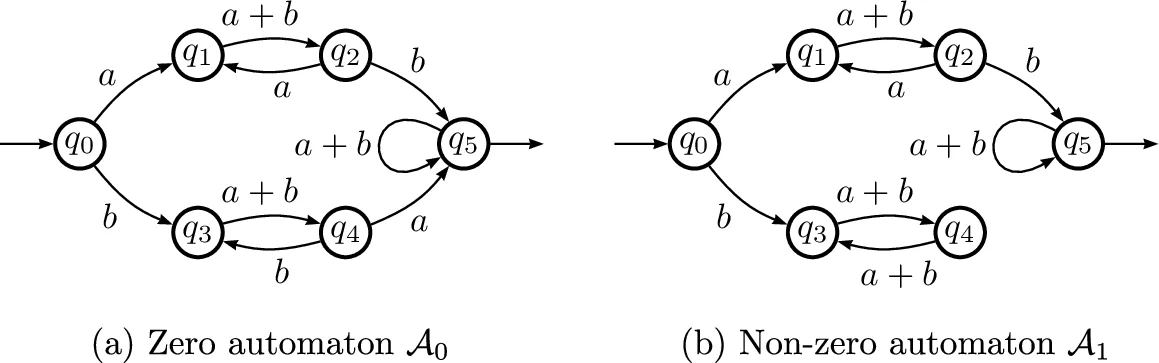
Zero automaton – A zero automaton is defined as a complete DFA that (i) possesses a synchronising word (a word that maps every state to the same state) and (ii) that common state is a sink (all outgoing transitions stay in the state). Lemma 2 shows that this definition is equivalent to the graph‑theoretic condition “the DFA has a unique strongly connected sink component and it consists of a single state”. The paper provides concrete examples (Figure 1) illustrating the difference between a zero automaton and a non‑zero automaton.
-
Closure properties of the zero‑one class (ZO) – Using Lemma 3 (which states that left/right concatenation with a fixed word scales the asymptotic probability by |A|^{-k}) the authors prove that ZO is closed under Boolean operations, left quotients, and right quotients (Proposition 1). This closure is essential for the implication “zero‑one law ⇒ zero automaton”.
-
Technical core (Theorem 1) – The theorem establishes the equivalence of four conditions: (1) minimal DFA is a zero automaton, (2) syntactic monoid has a zero, (3) L obeys the zero‑one law, (4) L is recognised by a quasi‑zero automaton. The proof proceeds as a cycle of implications: (1)⇒(2)⇒(3) is relatively straightforward; the challenging part is (3)⇒(1), which relies on the closure properties of ZO and Lemma 1 (showing that the past of any state can be expressed as a finite Boolean combination of left quotients). Lemma 1 is proved via Myhill‑Nerode arguments and an explicit construction of the required Boolean expression.
-
Linear‑time decision algorithm (Theorem 2) – Because condition (1) can be checked by simple graph analysis of the DFA, the authors design an O(|Q|+|δ|) algorithm: compute the strongly connected components, verify that there is exactly one sink component and that it is a singleton, and then test reachability of that sink from every state (which guarantees the existence of a synchronising word). This yields a linear‑time algorithm for deciding whether a given regular language satisfies the zero‑one law, improving on the previously known cubic‑time methods for computing µ(L).
-
Logical aspects – The paper discusses how zero‑one languages fit into finite model theory. Since the asymptotic probability is extreme (0 or 1), such languages are definable in weak logical fragments such as FO
Comments & Academic Discussion
Loading comments...
Leave a Comment