Design, Modeling and Control of A Novel Amphibious Robot with Dual-swing-legs Propulsion Mechanism
This paper describes a novel amphibious robot, which adopts a dual-swing-legs propulsion mechanism, proposing a new locomotion mode. The robot is called FroBot, since its structure and locomotion are similar to frogs. Our inspiration comes from the frog scooter and breaststroke. Based on its swing leg mechanism, an unusual universal wheel structure is used to generate propulsion on land, while a pair of flexible caudal fins functions like the foot flippers of a frog to generate similar propulsion underwater. On the basis of the prototype design and the dynamic model of the robot, some locomotion control simulations and experiments were conducted for the purpose of adjusting the parameters that affect the propulsion of the robot. Finally, a series of underwater experiments were performed to verify the design feasibility of FroBot and the rationality of the control algorithm.
💡 Research Summary
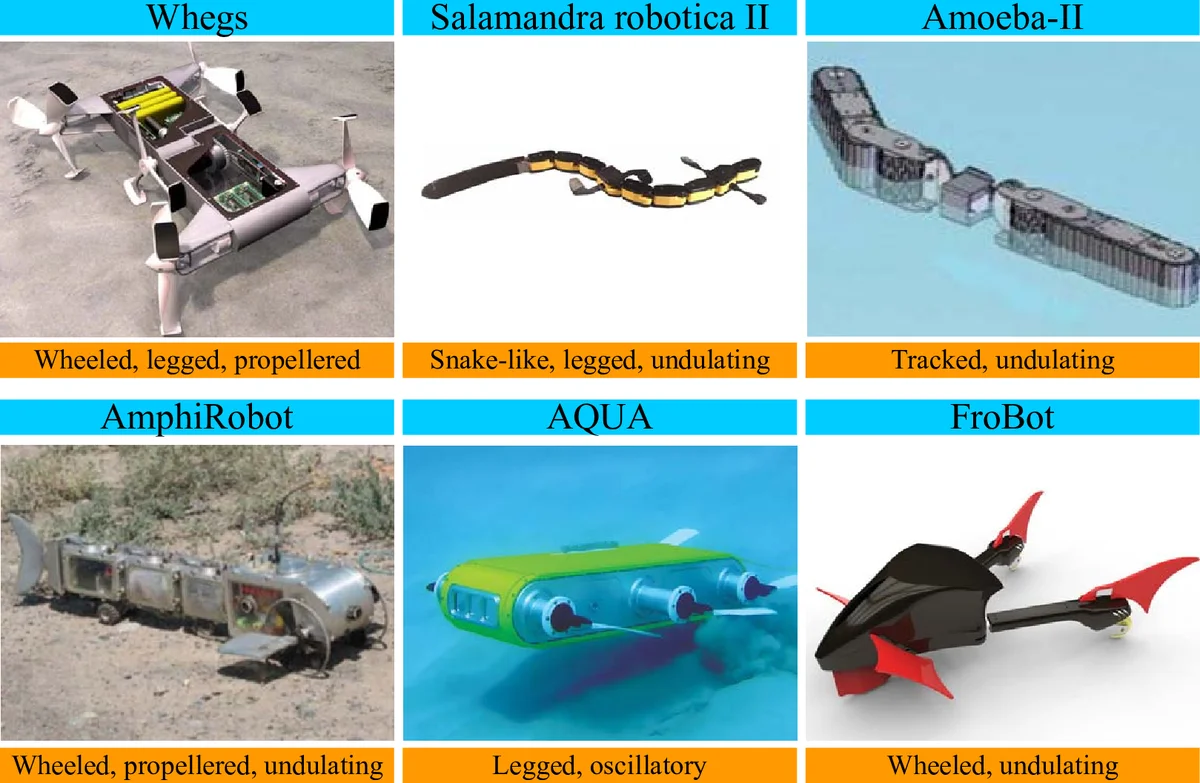
The paper presents “FroBot,” an amphibious robot inspired by the locomotion of a frog, which employs a dual‑swing‑leg propulsion mechanism to achieve both land and underwater movement. Unlike many existing amphibious platforms that combine several distinct locomotion subsystems (wheels, tracks, legs, undulating bodies, propellers, etc.), FroBot relies on a single mechanical principle: the periodic forward and backward swing of two symmetric legs. On land, each leg terminates in a specially designed “anti‑bias wheel.” The wheel is mounted on a tilted axle; when the leg swings, the wheel rolls about this tilted axis, and the friction between the wheel and the ground generates a thrust opposite to the swing direction. The thrust magnitude depends on the wheel’s tilt angle (λ), the instantaneous wheel deflection angle (β), the swing angle of the leg (φ), and the leg’s angular velocity (ω). The authors derive analytical expressions for β as a function of φ and ω (equations 11‑12) and construct a comprehensive resistance model that includes rolling friction, sliding friction, and aerodynamic drag (equations 5‑8). By combining these relationships, they obtain a closed‑form expression for the robot’s longitudinal acceleration as a function of the controllable parameters φ and ω (equation 8). This model enables a straightforward control strategy: adjusting the motor speed that drives the leg swing directly regulates forward velocity.
Underwater, the same leg swing drives a pair of flexible caudal fins attached to the leg ends. The interaction between the moving fin and the surrounding water produces a passive undulating wave that generates thrust, analogous to the body‑and‑caudal‑fin (BCF) propulsion used by many fish. Because the fin deformation is passive, the control complexity is reduced compared with actively actuated fin arrays. Additional degrees of freedom are provided by two pectoral fins and a front rudder mounted on the robot’s head. By varying the attack angles of the pectoral fins, the robot can produce pitch and roll motions; by rotating the rudder, the lateral component of drag creates a yaw moment for heading control.
The paper details three generations of the robot’s mechanical design, culminating in the second‑generation prototype used for experiments. The mechanical architecture includes five DC motors (two for leg swing, one for steering, and two for auxiliary functions), three servo motors (for rudder and pectoral fins), Hall‑effect angle sensors for real‑time swing measurement, and a microcontroller with Bluetooth telemetry. The chassis is fabricated from aluminum alloy and covered with a streamlined waterproof shell to minimize hydrodynamic drag.
A rigorous dynamic model for land locomotion is developed. The authors assume symmetry between the left and right legs, treat normal forces and gravitational forces as acting at the wheel‑ground contact points, and neglect the moment contributions of rolling friction on the front wheel. Using force and moment equilibrium, they derive expressions for the normal force N, the anti‑bias thrust F_forward, and the total resistive force f (including rolling and aerodynamic components). The model predicts that the forward thrust is proportional to 2 N tan λ sin β sin(φ+β), highlighting the critical role of the wheel deflection angle β, which itself varies with the swing speed and robot velocity. The authors also discuss the transition between static and sliding friction regimes, noting that on the tiled test floor the sliding friction coefficient μ_slide was measured as 0.25, leading to a maximum static deflection angle β_max = π/4.
Experimental validation on a flat tiled surface confirms the model’s predictions. Key parameters investigated include the swing amplitude φ (restricted to the range 3π/20 – 11π/40 for stability), the swing angular velocities for inward and outward phases (ω_in and ω_out), and a pause time of approximately 150 ms between swings to smooth the velocity profile. Results show that higher ω yields larger β and thus greater forward thrust, while excessive φ leads to instability. The measured robot accelerations closely match the simulated values derived from the analytical model.
The authors acknowledge limitations: the anti‑bias wheel’s reliance on ground friction restricts performance on low‑traction or highly uneven terrain, and the current two‑leg, single‑degree‑of‑freedom swing limits maneuverability compared with multi‑leg or snake‑like robots. Future work is proposed to increase the number of legs, incorporate additional actuation degrees of freedom, and explore hybrid wheel‑track‑leg configurations to improve terrain adaptability. Enhancements to the flexible caudal fin design and the integration of sensor‑based feedback control are also suggested to boost underwater propulsion efficiency and enable autonomous navigation.
In summary, the paper makes a significant contribution by demonstrating that a simple, symmetric dual‑swing‑leg mechanism can provide effective propulsion for both terrestrial and aquatic environments, supported by a solid physics‑based dynamic model and experimental verification. This approach offers a promising pathway toward lightweight, low‑complexity amphibious robots with respectable speed, payload capacity, and heading stability.
Comments & Academic Discussion
Loading comments...
Leave a Comment