Universality for Barycentric subdivision
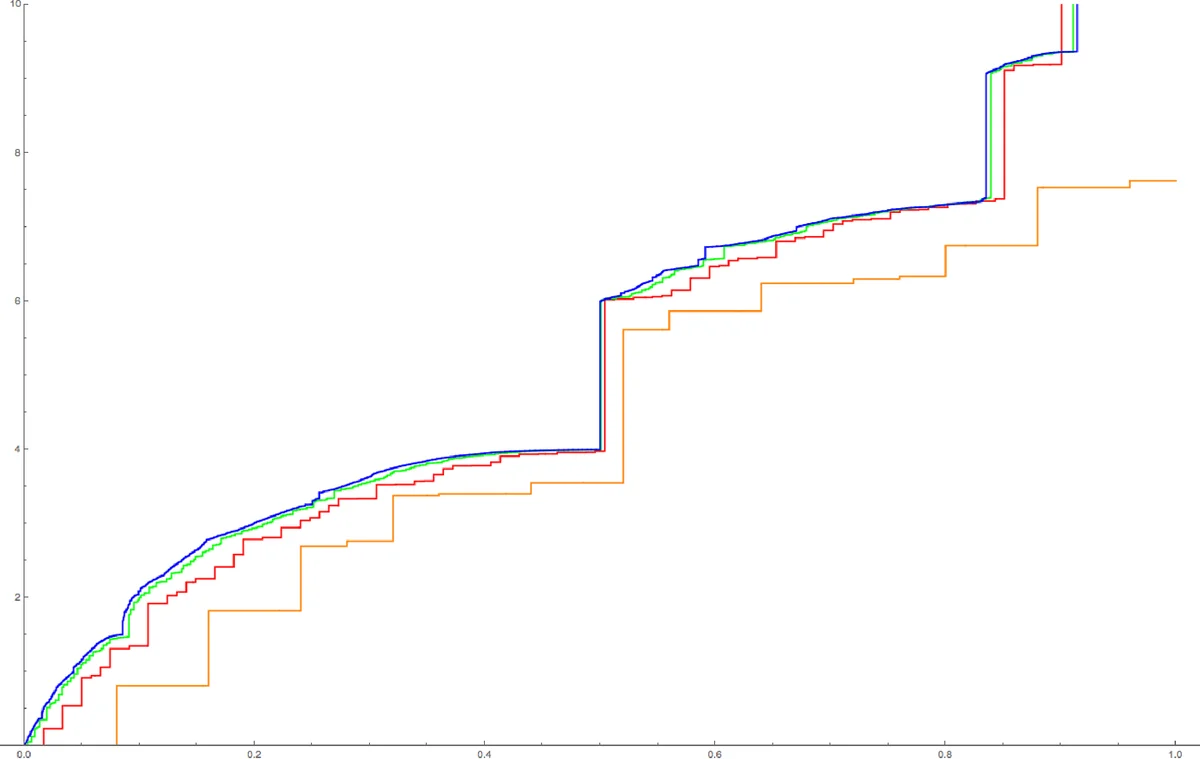
The spectrum of the Laplacian of successive Barycentric subdivisions of a graph converges exponentially fast to a limit which only depends on the clique number of the initial graph and not on the graph itself. The proof uses an explicit linear operator mapping the clique vector of a graph to the clique vector of the Barycentric refinement. The eigenvectors of its transpose produce integral geometric invariants for which Euler characteristic is one example.
💡 Research Summary
The paper investigates the spectral behavior of finite simple graphs under repeated Barycentric subdivision, a process that replaces a graph by the graph whose vertices are all non‑empty complete subgraphs (cliques) of the original and where two vertices are adjacent if one clique is contained in the other. The central result is a universality theorem: for any graph G, the sequence of Laplacian spectral functions F_{G^m}(x) (where F_{G}(x)=λ_{⌊|V|x⌋} and λ_i are the ordered eigenvalues of the Kirchhoff Laplacian L=B−A) converges exponentially fast in the L¹(
Comments & Academic Discussion
Loading comments...
Leave a Comment