Confidence-based Reasoning in Stochastic Constraint Programming
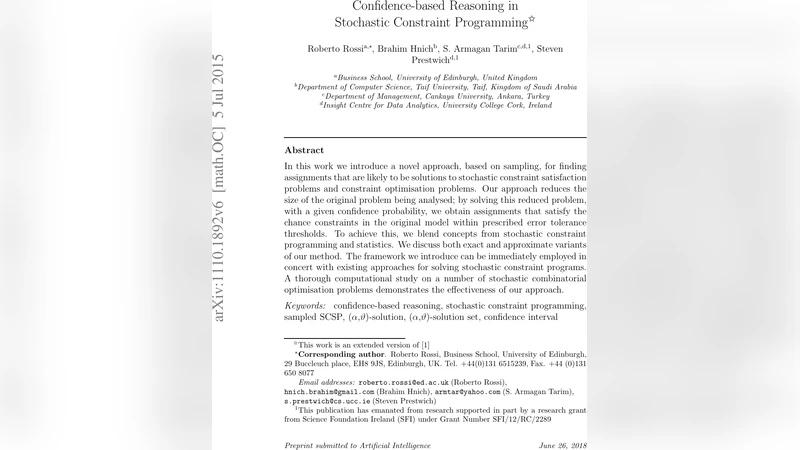
In this work we introduce a novel approach, based on sampling, for finding assignments that are likely to be solutions to stochastic constraint satisfaction problems and constraint optimisation problems. Our approach reduces the size of the original problem being analysed; by solving this reduced problem, with a given confidence probability, we obtain assignments that satisfy the chance constraints in the original model within prescribed error tolerance thresholds. To achieve this, we blend concepts from stochastic constraint programming and statistics. We discuss both exact and approximate variants of our method. The framework we introduce can be immediately employed in concert with existing approaches for solving stochastic constraint programs. A thorough computational study on a number of stochastic combinatorial optimisation problems demonstrates the effectiveness of our approach.
💡 Research Summary
The paper tackles the long‑standing scalability problem of Stochastic Constraint Satisfaction Problems (SCSPs) and Stochastic Constraint Optimisation Problems (SCOPs) by introducing a sampling‑based, confidence‑interval framework. Traditional stochastic constraint programming assumes finite supports for random variables; this restriction makes it infeasible for many real‑world models that involve continuous distributions or an astronomically large number of discrete outcomes. The authors propose to replace the original infinite or large‑scale stochastic model with a “sampled SCSP”, i.e., a reduced instance built from a finite set of independent scenarios drawn from the underlying probability distributions.
Central to the approach is the notion of an ((\alpha,\vartheta))-solution. For a given confidence level (\alpha\in(0,1]) and tolerance (\vartheta>0), a decision assignment is an ((\alpha,\vartheta))-solution if, with probability at least (\alpha), the true satisfaction probability of every chance constraint exceeds its threshold (\beta) by at most (\vartheta). As (\alpha) approaches 1 and (\vartheta) approaches 0, the set of ((\alpha,\vartheta))-solutions converges to the exact solution set (the ((1,0))-solutions). This definition mirrors the statistical concept of a confidence interval: the sampled SCSP provides an empirical estimate of the satisfaction probability, and the confidence interval guarantees that the estimate is within (\vartheta) of the true value with probability (\alpha).
The authors derive a closed‑form expression for the minimal sample size (N) required to achieve a prescribed ((\alpha,\vartheta)) guarantee. The derivation uses the normal approximation to the binomial distribution together with Chebyshev’s inequality, yielding a bound that depends on (\alpha), (\vartheta), the chance‑constraint thresholds (\beta), and the variance of the underlying random variables. This pre‑computation step allows practitioners to decide in advance how many scenarios must be generated to obtain statistically sound results.
Two algorithmic families are presented. The first family solves the sampled SCSP exactly by exhaustive enumeration of policy trees, leveraging existing CSP propagation techniques on each sampled scenario. The second family provides approximate solutions using branch‑and‑bound, heuristic search, or any off‑the‑shelf stochastic CSP solver, but now applied to a dramatically smaller instance. In both cases, after a candidate policy is found, the algorithm checks whether the empirical satisfaction frequencies of the chance constraints lie within the pre‑computed confidence interval; if they do, the policy is declared an ((\alpha,\vartheta))-solution for the original problem.
A thorough experimental evaluation is conducted on three benchmark stochastic combinatorial problems: (1) a two‑stage inventory control model with service‑level chance constraints, (2) a stochastic job‑shop scheduling problem where due‑date violations are bounded probabilistically, and (3) a network design problem with reliability constraints. For each benchmark the authors vary (\alpha) (0.90, 0.95, 0.99) and (\vartheta) (0.01, 0.05, 0.10) and compare the quality of the obtained solutions against those from state‑of‑the‑art exact SCSP solvers. Results show that even with modest confidence levels (e.g., (\alpha=0.95, \vartheta=0.05)) the sampled approach yields solutions whose objective values are within 1–3 % of the exact optimum, while runtime is reduced by an order of magnitude or more. Moreover, the method successfully handles continuous distributions (e.g., normal demand) by sampling, something traditional exact methods cannot do without discretisation.
The paper’s contributions can be summarised as follows:
- Introduction of “sampled SCSP”, a principled reduction of infinite or large‑scale stochastic models via random sampling.
- Definition of ((\alpha,\vartheta))-solutions and ((\alpha,\vartheta))-solution sets, providing a statistical guarantee on constraint satisfaction.
- Derivation of a priori sample‑size bounds that ensure the desired confidence/precision.
- Integration of the framework with existing CSP/SCSP solvers, offering both exact and heuristic solution strategies.
- Empirical validation on diverse stochastic optimisation problems, demonstrating scalability, efficiency, and robustness.
In conclusion, the work bridges stochastic constraint programming and statistical confidence‑interval analysis, offering a practical pathway to solve large‑scale or continuous‑distribution stochastic models. By allowing decision makers to specify how much risk they are willing to tolerate (through (\alpha) and (\vartheta)), the approach delivers solutions that are both computationally tractable and statistically reliable, opening new avenues for applying stochastic constraint programming in real‑world decision‑making environments.
Comments & Academic Discussion
Loading comments...
Leave a Comment