Solar Lab Notebook (SLN): An Ultra-Portable Web-Based System for Heliophysics and High-Security Labs
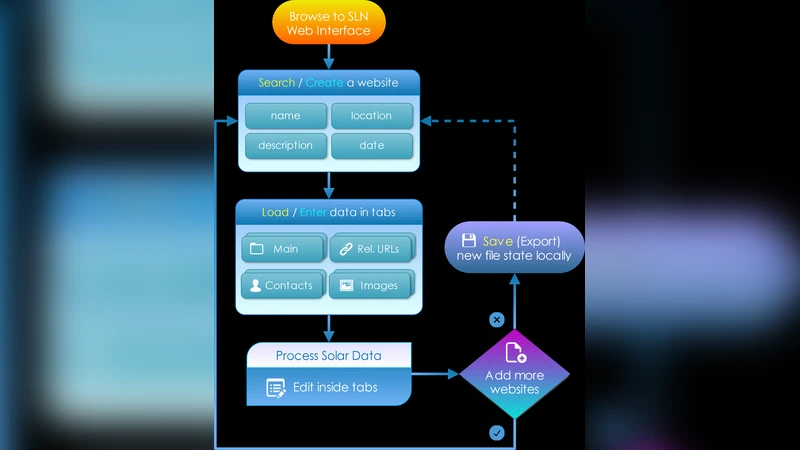
This paper introduces the Solar Lab Notebook (SLN), an electronic lab notebook for improving the process of recording and sharing solar related digital information in an organized manner. SLN is a pure web-based application (available online: http://umbra.nascom.nasa.gov/sln) that runs client-side only, employing a clean and very friendly graphical user interface design, and thus providing a true cross-platform user experience. Furthermore, SLN leverages unique technologies offered by modern web browsers, such as the FileReader API, the Blob interface and Local Storage mechanism; it is coded entirely using HTML5, CSS3, and JavaScript, and powered by the extremely well documented XML file format. For high-security labs, it can be utilized as an ultra-portable and secure digital notebook solution, since it is functionally self-contained, and does not require any server-side process running on either the local or a remote system. Finally, the W3C XML Schema language is used to define a list of rules, namely a data standard, that an SLN file must conform to in order to be valid. In this way, developers are able to implement their own validation functions in their projects, or use one of the freely available tools to check if a data file is properly structured. Similarly, scientific groups at different labs can easily share information, being confident about the integrity of the exchanged data.
💡 Research Summary
The paper presents Solar Lab Notebook (SLN), a lightweight, purely client‑side electronic lab notebook designed specifically for heliophysics research. Implemented with standard web technologies—HTML5, CSS3, and JavaScript—SLN runs entirely in the browser, requiring no server component, installation, or network connectivity. This “zero‑server” architecture makes the tool ideal for high‑security, air‑gapped laboratories where installing or running unauthorized services is prohibited.
Data are stored in a single UTF‑8 encoded XML file. Multimedia assets such as images and videos are embedded directly using Base64 encoding, allowing a complete research record to be packaged in one portable text file. The XML structure is rigorously defined by a W3C XML Schema (XSD), which specifies required elements (e.g., website URL, visit date, notes) and optional elements (e.g., image, video, metadata). The schema enables automatic validation, ensures long‑term data integrity, and facilitates interoperability with external tools that can parse any XML‑compatible language.
SLN leverages modern browser APIs: the FileReader API loads local XML files asynchronously; the Blob interface creates downloadable files on demand; and LocalStorage provides temporary client‑side caching. The user interface follows a single‑page application model built on the Bootstrap framework. The main view organizes “website” groups—representing data sources such as SDO, NOAA, or LMSAL—while sub‑tabs display associated images, notes, and links in searchable tables. Real‑time search is powered by an in‑memory index that updates results with each keystroke, offering rapid retrieval even for large datasets.
Cross‑platform compatibility is a core design goal. The application runs unchanged on any operating system that supports a modern browser (Windows, macOS, Linux, *BSD, etc.). At the time of writing, full functionality has been verified in Google Chrome and Chromium, with other browsers slated for support. Because all processing occurs locally, there is no exposure to man‑in‑the‑middle attacks, ARP poisoning, or other network‑based threats, making SLN suitable for isolated environments.
Key differentiators from commercial ELNs include: (1) complete client‑side operation eliminating installation and update burdens; (2) an open, XML‑based data standard that encourages community‑driven extensions; (3) the ability to embed multimedia directly in the notebook file, simplifying backup and sharing; and (4) a minimalistic, intuitive UI that can be mastered within minutes. The authors also discuss future enhancements such as collaborative real‑time syncing, plugin‑based analysis modules, and fine‑grained access control.
In summary, SLN provides a secure, portable, and extensible solution for recording, organizing, and sharing solar‑related digital data, addressing the specific workflow needs of heliophysics researchers while complying with stringent laboratory security policies.
Comments & Academic Discussion
Loading comments...
Leave a Comment