Fast Rendezvous on a Cycle by Agents with Different Speeds
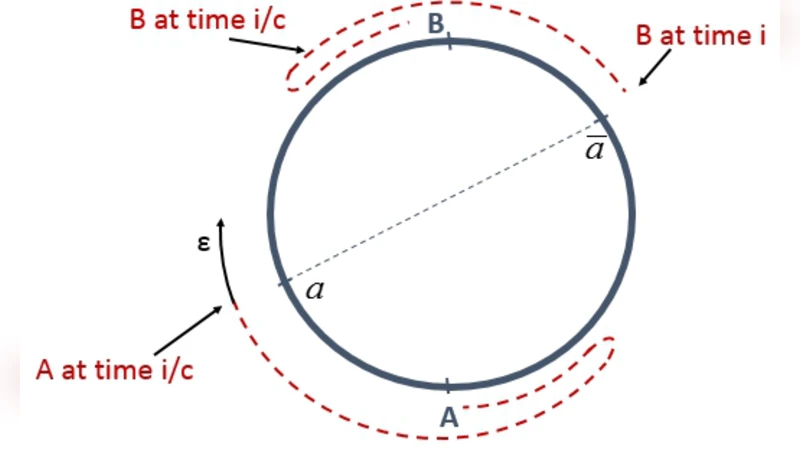
The difference between the speed of the actions of different processes is typically considered as an obstacle that makes the achievement of cooperative goals more difficult. In this work, we aim to highlight potential benefits of such asynchrony phenomena to tasks involving symmetry breaking. Specifically, in this paper, identical (except for their speeds) mobile agents are placed at arbitrary locations on a cycle of length $n$ and use their speed difference in order to rendezvous fast. We normalize the speed of the slower agent to be 1, and fix the speed of the faster agent to be some $c>1$. (An agent does not know whether it is the slower agent or the faster one.) The straightforward distributed-race DR algorithm is the one in which both agents simply start walking until rendezvous is achieved. It is easy to show that, in the worst case, the rendezvous time of DR is $n/(c-1)$. Note that in the interesting case, where $c$ is very close to 1 this bound becomes huge. Our first result is a lower bound showing that, up to a multiplicative factor of 2, this bound is unavoidable, even in a model that allows agents to leave arbitrary marks, even assuming sense of direction, and even assuming $n$ and $c$ are known to agents. That is, we show that under such assumptions, the rendezvous time of any algorithm is at least $\frac{n}{2(c-1)}$ if $c\leq 3$ and slightly larger if $c>3$. We then construct an algorithm that precisely matches the lower bound for the case $c\leq 2$, and almost matches it when $c>2$. Moreover, our algorithm performs under weaker assumptions than those stated above, as it does not assume sense of direction, and it allows agents to leave only a single mark (a pebble) and only at the place where they start the execution. Finally, we investigate the setting in which no marks can be used at all, and show tight bounds for $c\leq 2$, and almost tight bounds for $c>2$.
💡 Research Summary
The paper investigates the rendezvous problem on a cycle of length n when two identical mobile agents have different speeds. The slower agent’s speed is normalized to 1, while the faster agent moves at speed c (> 1). Crucially, each agent does not know whether it is the slower or the faster one, so any algorithm must rely solely on the speed ratio c. The most straightforward approach, called Distributed‑Race (DR), has both agents walk in the same direction until they meet. Because the relative speed is c – 1, the worst‑case meeting time of DR is n / (c – 1). When c is close to 1, this bound becomes prohibitively large.
The authors first establish a lower bound that is essentially tight. By constructing an adversarial initial placement where the agents start opposite each other and exploiting the fact that agents cannot distinguish their own speed, they prove that any algorithm— even one that allows unlimited marking, a common sense of direction, or knowledge of n and c—must take at least n /
Comments & Academic Discussion
Loading comments...
Leave a Comment