Modeling Quantum Optical Components, Pulses and Fiber Channels Using OMNeT++
Quantum Key Distribution (QKD) is an innovative technology which exploits the laws of quantum mechanics to generate and distribute unconditionally secure cryptographic keys. While QKD offers the promi
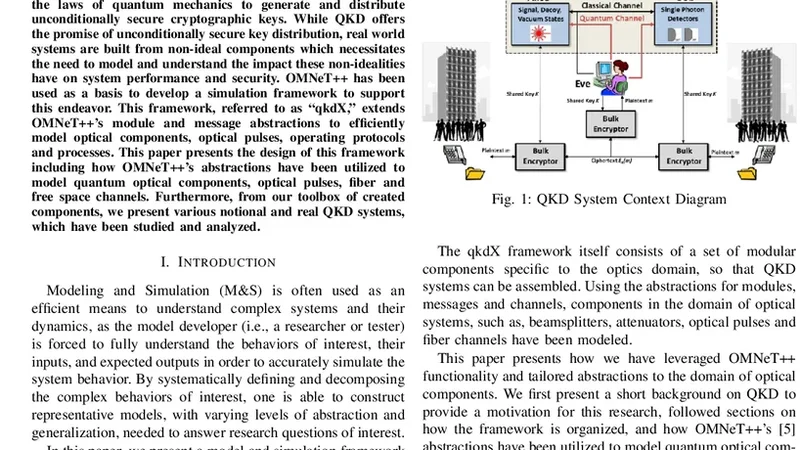
Quantum Key Distribution (QKD) is an innovative technology which exploits the laws of quantum mechanics to generate and distribute unconditionally secure cryptographic keys. While QKD offers the promise of unconditionally secure key distribution, real world systems are built from non-ideal components which necessitates the need to model and understand the impact these non-idealities have on system performance and security. OMNeT++ has been used as a basis to develop a simulation framework to support this endeavor. This framework, referred to as “qkdX” extends OMNeT++’s module and message abstractions to efficiently model optical components, optical pulses, operating protocols and processes. This paper presents the design of this framework including how OMNeT++’s abstractions have been utilized to model quantum optical components, optical pulses, fiber and free space channels. Furthermore, from our toolbox of created components, we present various notional and real QKD systems, which have been studied and analyzed.
💡 Research Summary
This paper presents qkdX, a simulation framework built on the OMNeT++ discrete‑event platform, specifically designed to model quantum key distribution (QKD) systems with realistic, non‑ideal optical components and transmission channels. The authors first extend OMNeT++’s module and message abstractions to create reusable classes for optical components (e.g., beamsplitters, detectors, modulators), each parameterized by loss, phase noise, polarization dependence, and nonlinear effects. These parameters are treated probabilistically, allowing the framework to capture manufacturing tolerances and environmental fluctuations. Optical pulses are represented as “Pulse” objects carrying complex amplitudes, photon‑number statistics, spectral width, and phase jitter; quantum measurement and wave‑function collapse are implemented as stochastic events triggered during message passing, thereby reproducing post‑selection and error‑rate phenomena observed in laboratory experiments.
Two channel models are provided. The “FiberChannel” class incorporates attenuation (α), chromatic dispersion (β₂), and Kerr‑nonlinearities (SPM, XPM) with distance‑ and temperature‑dependent dynamics. The “FreeSpaceChannel” accounts for atmospheric absorption, turbulence‑induced phase distortion, and beam spreading. Both channels discretize continuous propagation into OMNeT++ events, enabling seamless integration with the existing scheduler and visualization tools.
On the protocol side, the QKD stack is modularized into preparation, transmission, basis reconciliation, error correction, and privacy amplification stages. Users can plug in standard protocols such as BB84, E91, or continuous‑variable QKD (CV‑QKD) without rewriting low‑level physics code. A hybrid module handles both classical and quantum messages, allowing simultaneous tracking of security metrics (QBER, secret‑key rate) and physical metrics (photon flux, loss).
The framework’s capabilities are demonstrated through two case studies. In the first, a BB84 system employing non‑ideal detectors and an asymmetric beamsplitter is examined via parameter sweeps. Results show that insertion loss beyond 3 dB or phase imbalance above 0.05 rad leads to a steep increase in QBER and a >30 % reduction in secret‑key rate, highlighting tight tolerances required for component selection. In the second study, a long‑distance (>200 km) CV‑QKD link is simulated; chromatic dispersion and self‑phase modulation are found to degrade the signal‑to‑noise ratio, establishing an effective distance limit that depends on launch power and fiber temperature. Optimizing launch power extends viable key generation to roughly 250 km.
The authors discuss strengths—modular reuse, OMNeT++’s robust event engine, and straightforward incorporation of stochastic non‑idealities—and limitations, notably the difficulty of fully capturing global quantum correlations without a density‑matrix engine. Future work will integrate GPU‑accelerated quantum state propagation and data‑driven parameter extraction from experimental measurements.
In conclusion, qkdX provides a comprehensive, physics‑aware simulation environment that bridges the gap between idealized QKD theory and the messy reality of hardware imperfections. By enabling systematic exploration of component tolerances, channel impairments, and protocol choices, it offers researchers and system engineers a powerful tool for designing, optimizing, and validating secure quantum communication networks.
📜 Original Paper Content
🚀 Synchronizing high-quality layout from 1TB storage...