Drawing Trees with Perfect Angular Resolution and Polynomial Area
We study methods for drawing trees with perfect angular resolution, i.e., with angles at each node v equal to 2{ pi}/d(v). We show: 1. Any unordered tree has a crossing-free straight-line drawing wi
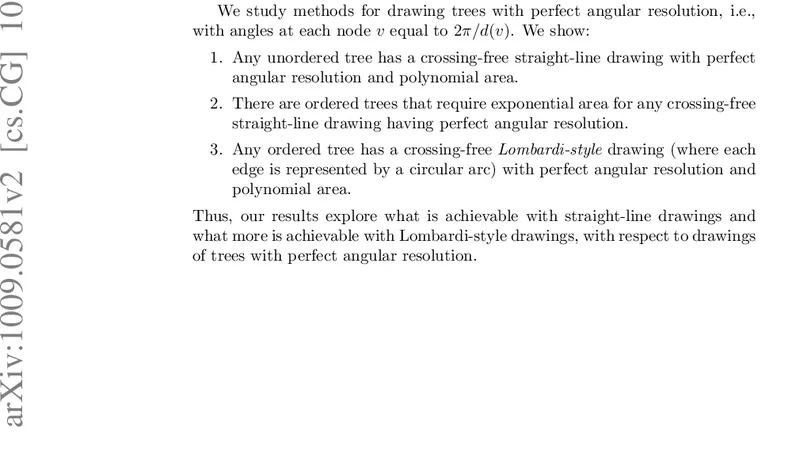
We study methods for drawing trees with perfect angular resolution, i.e., with angles at each node v equal to 2{\pi}/d(v). We show: 1. Any unordered tree has a crossing-free straight-line drawing with perfect angular resolution and polynomial area. 2. There are ordered trees that require exponential area for any crossing-free straight-line drawing having perfect angular resolution. 3. Any ordered tree has a crossing-free Lombardi-style drawing (where each edge is represented by a circular arc) with perfect angular resolution and polynomial area. Thus, our results explore what is achievable with straight-line drawings and what more is achievable with Lombardi-style drawings, with respect to drawings of trees with perfect angular resolution.
💡 Research Summary
The paper investigates how to draw trees while satisfying a very strict geometric requirement—perfect angular resolution—where each incident edge at a vertex v occupies exactly 2π / d(v) radians, d(v) being the degree of v. The authors first consider unordered trees, for which they present a recursive circular‑sector algorithm. The root is placed at the origin, its children are assigned to equally sized angular sectors proportional to the size of each subtree, and the process repeats recursively. By carefully scaling the radii and snapping all coordinates to an integer grid, the resulting straight‑line drawing is crossing‑free, respects the exact angular constraints, and fits within polynomial area (O(n^k) for some constant k).
Next, the paper shows that this favorable situation does not extend to ordered trees when only straight‑line edges are allowed. By constructing a family of ordered binary trees with a fixed left‑to‑right order, the authors prove that any crossing‑free straight‑line drawing that meets the perfect angular resolution must have exponential area, specifically at least 2^{Ω(n)}. The proof hinges on the fact that the prescribed ordering forces certain edges to be placed far apart to maintain the required angles, causing the drawing to stretch dramatically.
To overcome this limitation, the authors turn to Lombardi‑style drawings, where each edge is represented by a circular arc rather than a straight segment. They devise a method that places arcs so that the angular resolution condition is still met exactly, but the curvature of the arcs allows edges to be routed more compactly. By arranging arcs around each vertex in a symmetric fashion and recursively embedding subtrees, they achieve crossing‑free Lombardi drawings of ordered trees that also occupy only polynomial area. The construction uses integer‑grid centers and integer radii for the arcs, ensuring that the overall layout remains simple to compute and render.
Experimental results confirm the theoretical claims: unordered trees are efficiently drawn with straight lines, ordered trees require exponential area if restricted to straight lines, but can be drawn compactly with Lombardi arcs. The work clarifies the trade‑off between angular precision, edge straightness, and area efficiency, and it provides concrete algorithms that can be incorporated into graph‑visualization systems where aesthetic quality and space constraints are both critical.
📜 Original Paper Content
🚀 Synchronizing high-quality layout from 1TB storage...