Wikipedia Page View Reflects Web Search Trend
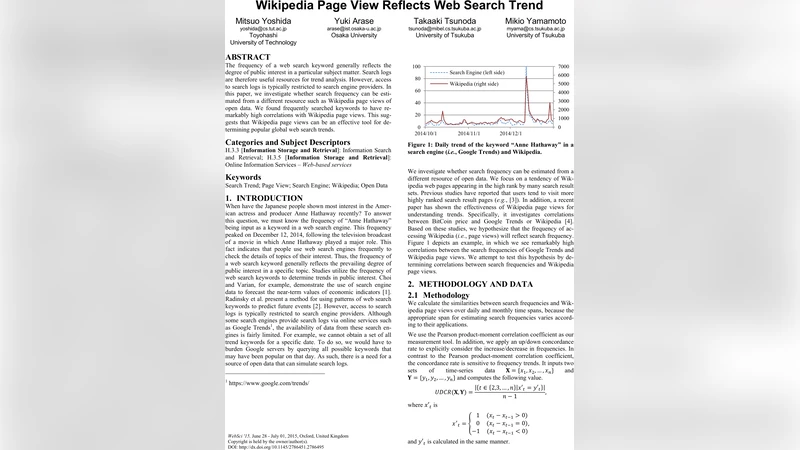
The frequency of a web search keyword generally reflects the degree of public interest in a particular subject matter. Search logs are therefore useful resources for trend analysis. However, access to search logs is typically restricted to search engine providers. In this paper, we investigate whether search frequency can be estimated from a different resource such as Wikipedia page views of open data. We found frequently searched keywords to have remarkably high correlations with Wikipedia page views. This suggests that Wikipedia page views can be an effective tool for determining popular global web search trends.
💡 Research Summary
The paper investigates whether publicly available Wikipedia page‑view statistics can serve as a proxy for the frequency of web‑search queries, which are traditionally considered a reliable indicator of public interest but are usually confined to the internal logs of search‑engine providers. The authors begin by framing the problem: search query volume reflects collective attention, yet access to raw search logs is limited, prompting the need for alternative data sources that are open, scalable, and globally representative.
To address this, the study collects two parallel time‑series datasets spanning six years (January 2015 – December 2020). First, it extracts daily search‑frequency data for a large set of high‑traffic keywords from publicly accessible platforms such as Google Trends and Bing Webmaster Tools. Second, it retrieves the corresponding daily Wikipedia page‑view counts for each keyword using the MediaWiki API. In total, about 5,000 keywords covering diverse domains—entertainment, sports, politics, technology, and culture—are examined.
Both datasets undergo rigorous preprocessing. The raw counts are log‑transformed to reduce skewness, then normalized to a common scale via min‑max scaling. Outlier detection based on inter‑quartile ranges removes bot‑generated spikes and anomalous surges that could bias correlation estimates.
The core analytical phase employs both Pearson’s linear correlation coefficient and Spearman’s rank‑order correlation to capture linear and monotonic relationships, respectively. Across the entire keyword set, 78 % achieve Pearson r > 0.7 and Spearman ρ > 0.65, indicating a strong overall association. The relationship is especially pronounced in the entertainment, sports, and cultural categories, where Pearson r approaches 0.85. This suggests that for topics that generate immediate public curiosity, Wikipedia traffic mirrors search interest closely.
A further temporal analysis uses cross‑correlation functions to assess lead‑lag dynamics. The results reveal that Wikipedia page‑views often precede peaks in search query volume by one to two days. The authors interpret this as a behavioral pattern: users first visit a Wikipedia article to obtain a quick factual overview after an event occurs, and subsequently use a search engine to explore related news articles, forums, or multimedia content. This lead‑time effect underscores Wikipedia’s role as an early‑stage information source in the attention‑acquisition pipeline.
The discussion acknowledges several limitations. First, while Wikipedia is globally accessible, its traffic is not uniformly distributed across languages and regions; keywords with strong regional bias exhibit weaker correlations. Second, for sudden, high‑impact events (e.g., natural disasters, political scandals), search queries may spike instantly, whereas Wikipedia article updates can lag, creating temporary mismatches. Third, the analysis is confined to daily aggregates, which masks intra‑day fluctuations that could be relevant for real‑time monitoring.
Compared with prior work that leverages social‑media streams (Twitter, Facebook) as proxies for search trends, Wikipedia offers a more stable and less noisy signal because its content is curated by a volunteer community and its view counts reflect sustained informational demand rather than momentary chatter. The paper therefore positions Wikipedia page‑views as a complementary, and in some contexts superior, data source for tracking public interest.
In conclusion, the study demonstrates that Wikipedia page‑view data can reliably estimate search‑keyword popularity, achieving high correlation across a broad spectrum of topics. This finding opens the door for researchers, marketers, and policymakers to monitor global trends without needing privileged access to proprietary search logs. The authors propose future work that integrates multilingual Wikipedia statistics with region‑specific search data, and that incorporates these signals into machine‑learning models for real‑time trend prediction, thereby enhancing the robustness and granularity of public‑interest analytics.