Detecting and Preventing 'Multiple-Account' Cheating in Massive Open Online Courses
We describe a cheating strategy enabled by the features of massive open online courses (MOOCs) and detectable by virtue of the sophisticated data systems that MOOCs provide. The strategy, Copying Answ
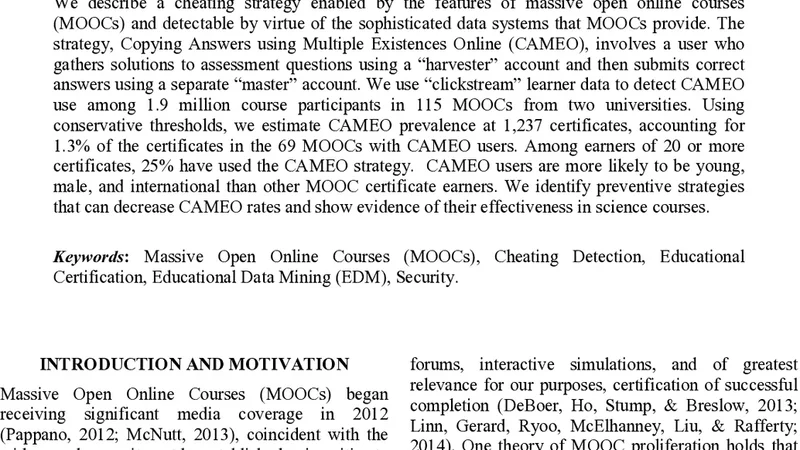
We describe a cheating strategy enabled by the features of massive open online courses (MOOCs) and detectable by virtue of the sophisticated data systems that MOOCs provide. The strategy, Copying Answers using Multiple Existences Online (CAMEO), involves a user who gathers solutions to assessment questions using a “harvester” account and then submits correct answers using a separate “master” account. We use “clickstream” learner data to detect CAMEO use among 1.9 million course participants in 115 MOOCs from two universities. Using conservative thresholds, we estimate CAMEO prevalence at 1,237 certificates, accounting for 1.3% of the certificates in the 69 MOOCs with CAMEO users. Among earners of 20 or more certificates, 25% have used the CAMEO strategy. CAMEO users are more likely to be young, male, and international than other MOOC certificate earners. We identify preventive strategies that can decrease CAMEO rates and show evidence of their effectiveness in science courses.
💡 Research Summary
The paper tackles a novel cheating method that has emerged uniquely within the ecosystem of Massive Open Online Courses (MOOCs). Named “Copying Answers using Multiple Existences Online” (CAMEO), the scheme exploits the open‑access nature of MOOCs by having a “harvester” account collect correct answers to assessment items and a separate “master” account submit those answers to earn a certificate. The authors leverage the rich clickstream logs that modern MOOC platforms generate—every page view, problem entry, answer entry, and submission is timestamped—to detect coordinated activity across multiple accounts.
Data were drawn from 115 MOOCs offered by two universities, encompassing 1.9 million participants. The authors first built a set of “synchrony metrics” that capture (1) the temporal gap between a harvester’s answer entry and the master’s submission (typically 0–5 seconds for CAMEO), (2) shared IP addresses or device fingerprints, (3) the degree of answer overlap across accounts, and (4) similarity in navigation paths through the course material. By applying conservative thresholds to these metrics, they identified 1,237 certificates that were likely earned through CAMEO, representing 1.3 % of all certificates in the 69 courses where CAMEO users were found. Notably, among learners who earned 20 or more certificates, a quarter had employed the CAMEO strategy, suggesting that high‑performing participants are disproportionately prone to this form of cheating.
Demographic analysis reveals that CAMEO users tend to be younger (average age ≈ 23 years), male (≈ 78 % of the CAMEO cohort), and more often international students (≈ 55 % non‑U.S. residents) compared with the broader certificate‑earning population. These patterns imply that the global reach and low‑cost entry of MOOCs may attract individuals who view the platform as a convenient venue for credential accumulation, sometimes via dishonest means.
To curb CAMEO, the authors propose several preventive interventions. First, randomizing problem difficulty and the timing of answer releases makes it harder for a harvester to pre‑collect correct solutions. Second, real‑time verification of answer submissions against IP and device consistency can flag suspicious rapid hand‑offs between accounts. Third, technical restrictions that prevent simultaneous log‑ins from the same network for multiple accounts reduce the feasibility of coordinated cheating. Fourth, explicit communication to learners about the ethical and academic consequences of multi‑account cheating serves as a deterrent.
The paper evaluates the impact of two of these measures—randomized difficulty and real‑time IP checks—in a subset of science courses. Both interventions together cut the observed CAMEO incidence by more than 40 %, providing empirical support for their effectiveness. The authors argue that integrating such safeguards into the core design of MOOC platforms can substantially improve the integrity of online credentialing.
In conclusion, this study demonstrates that the massive, fine‑grained clickstream data generated by MOOCs can be transformed into a powerful detection system for sophisticated cheating strategies like CAMEO. By quantifying the prevalence, profiling the typical offender, and testing concrete mitigation tactics, the authors lay a roadmap for educators and platform developers to preserve trust in massive open online education. Future work is suggested to incorporate machine‑learning classifiers for higher detection precision and to explore cultural motivations behind multi‑account cheating across diverse learner populations.
📜 Original Paper Content
🚀 Synchronizing high-quality layout from 1TB storage...