On Hardness of the Joint Crossing Number
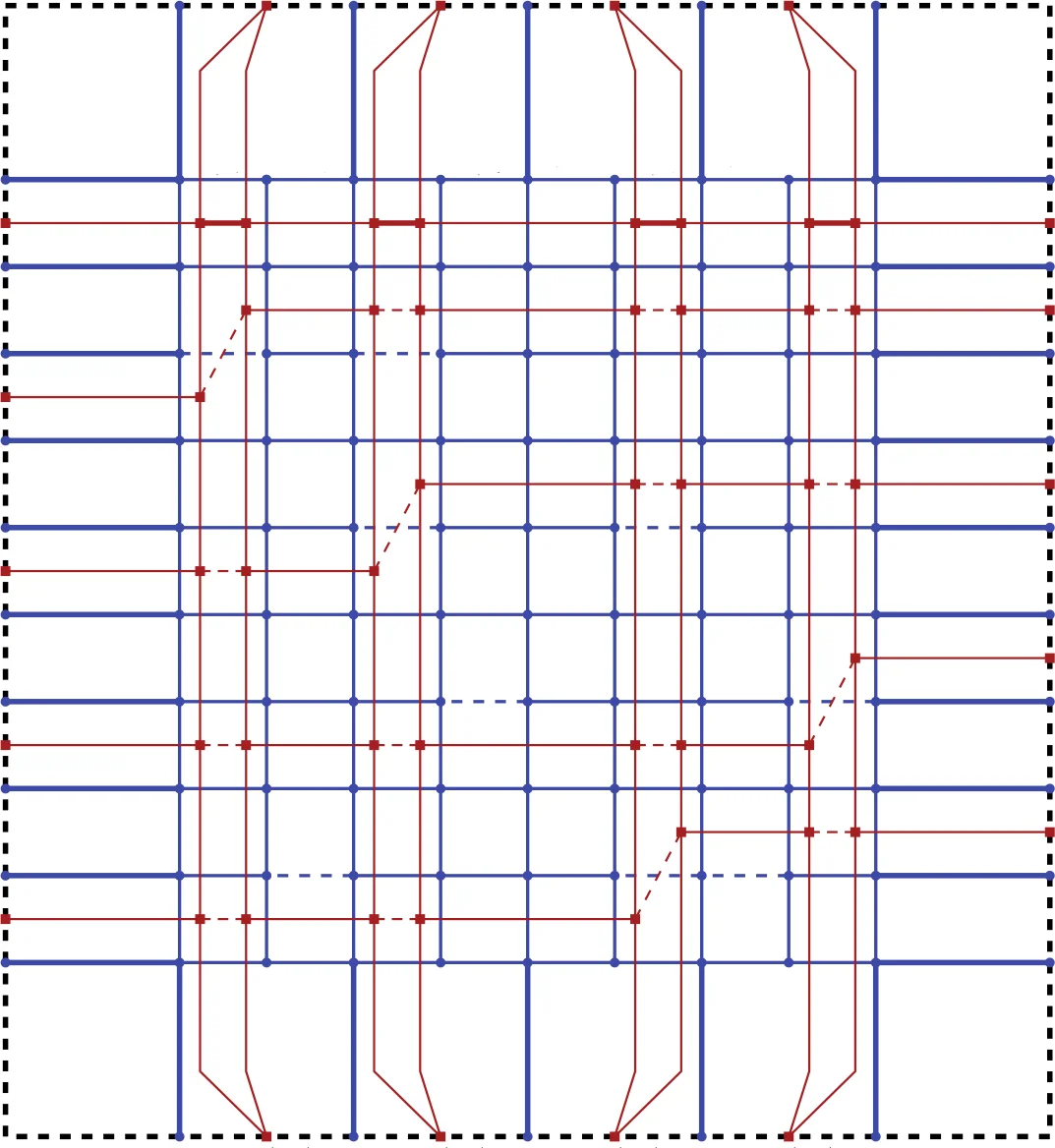
The Joint Crossing Number problem asks for a simultaneous embedding of two disjoint graphs into one surface such that the number of edge crossings (between the two graphs) is minimized. It was introduced by Negami in 2001 in connection with diagonal flips in triangulations of surfaces, and subsequently investigated in a general form for small-genus surfaces. We prove that all of the commonly considered variants of this problem are NP-hard already in the orientable surface of genus 6, by a reduction from a special variant of the anchored crossing number problem of Cabello and Mohar.
💡 Research Summary
The paper investigates the computational complexity of the Joint Crossing Number problem and its two natural variants—Joint Homeomorphic Crossing Number and Joint OP‑Homeomorphic Crossing Number—where two disjoint graphs must be simultaneously embedded on the same surface and only edges belonging to different graphs are allowed to cross. While the original concept, introduced by Negami in 2001, allowed the two graphs to share vertices and edges (the so‑called diagonal crossing number), later work focused on the disjoint case and on orientable surfaces. The three variants differ in the amount of freedom given to the embedding: the first allows any embedding of each graph, the second requires the embedding of each graph to be homeomorphic to a prescribed one, and the third adds the additional constraint that the homeomorphism must preserve orientation.
The main contribution is a proof that all three problems are NP‑hard already on orientable surfaces of genus six or higher, even when the input graphs are simple and 3‑connected. The hardness proof proceeds via a chain of reductions from a special version of the Anchored Crossing Number problem introduced by Cabello and Mohar. In the anchored version, certain vertices of one graph must be placed inside prescribed faces of the other graph’s embedding. The authors formalize this as a “face‑anchored joint embedding” and define the corresponding decision problem k‑FA Joint Planar Crossing Number.
Key technical steps include:
-
Weighted to Unweighted Reduction (Proposition 2.4). Edge weights are encoded by replacing each edge with a bundle of parallel unit‑weight edges. This transformation preserves NP‑hardness, 3‑connectivity, and simplicity while allowing the use of weighted crossing numbers in subsequent constructions.
-
Construction of Face‑Anchored Gadgets. For each anchor pair (C_i, a_i), the cycle C_i in G₁ is duplicated to C′_i and linked to form a rigid “frame” that forces any optimal embedding to keep a_i inside the face bounded by C_i. This ensures that the anchoring condition is respected without explicitly enforcing it.
-
Insertion of Toroidal Grids (Theorem 3.1). For each anchor, a toroidal grid T_i is attached to the framed cycle. The grid consists of a torus‑like handle with a carefully chosen pattern of heavy (weight p) and light (weight 1) edges. Adding T_i raises the genus of the surface by one and forces any optimal solution to use the new handle for the corresponding anchor, because crossing a heavy edge would incur a penalty larger than any possible savings elsewhere.
-
K₃,₃ Gadgets L_i. In the second graph G₂, a copy of K₃,₃ is added for each anchor, with seven of its edges given very large weights t_i that decrease with i. The decreasing sequence guarantees that each L_i must occupy a distinct toroidal handle; otherwise the total crossing cost would exceed the optimum. Consequently, the anchor vertex a_i is forced into the face α_i bounded by C_i.
-
Crossing‑Number Lower Bound (Lemma 2.5). By arranging the heavy and light weights as two monotone sequences a_i and b_i, the authors show that any non‑identity permutation of the pairings yields a crossing cost at least the minimum difference |a_i – a_j|, establishing a quantitative gap between correct and incorrect placements.
Through these constructions, the authors define a polynomial‑time mapping from an instance of the anchored planar crossing problem with value s to an instance (H₁, H₂) on the surface S_h such that the optimal joint crossing number of (H₁, H₂) is at most f(s) = p·s + O(1). Conversely, any solution for (H₁, H₂) with crossing number ≤ f(s) yields a solution for the original anchored problem with value ≤ s. Since the anchored crossing number problem is known to be NP‑hard, the reduction establishes NP‑hardness for all three joint crossing number variants on any orientable surface of genus at least six.
The paper also emphasizes that the hardness holds even when the input graphs are restricted to simple, 3‑connected graphs, showing that the difficulty does not stem from pathological graph structures. In the concluding section the authors slightly strengthen Cabello‑Mohar’s original result and discuss possible extensions, such as determining the exact threshold genus for hardness, exploring approximation algorithms, or investigating the problem on non‑orientable surfaces.
Overall, the work provides a comprehensive and technically sophisticated proof that joint crossing number problems, despite their seemingly modest formulation, are computationally intractable on moderately complex surfaces. The blend of weighted reductions, face‑anchored constructions, and toroidal gadgets offers a powerful toolkit that may be applicable to other embedding‑related hardness proofs.
Comments & Academic Discussion
Loading comments...
Leave a Comment