A hybrid COA-DEA method for solving multi-objective problems
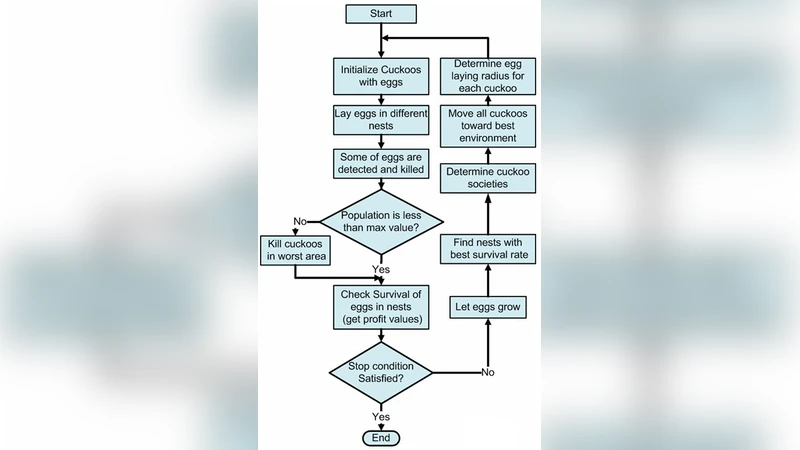
The Cuckoo optimization algorithm (COA) is developed for solving single-objective problems and it cannot be used for solving multi-objective problems. So the multi-objective cuckoo optimization algorithm based on data envelopment analysis (DEA) is developed in this paper and it can gain the efficient Pareto frontiers. This algorithm is presented by the CCR model of DEA and the output-oriented approach of it. The selection criterion is higher efficiency for next iteration of the proposed hybrid method. So the profit function of the COA is replaced by the efficiency value that is obtained from DEA. This algorithm is compared with other methods using some test problems. The results shows using COA and DEA approach for solving multi-objective problems increases the speed and the accuracy of the generated solutions.
💡 Research Summary
The paper addresses a notable gap in the literature: the Cuckoo Optimization Algorithm (COA), originally devised for single‑objective optimization, lacks a mechanism for handling multiple conflicting objectives. To bridge this gap, the authors propose a hybrid COA‑DEA (Data Envelopment Analysis) framework that replaces COA’s traditional profit‑based selection criterion with an efficiency score derived from DEA. The core of the method relies on the CCR (Charnes‑Cooper‑Rhodes) model in its output‑oriented formulation. In this setting, each candidate solution (a “cuckoo”) is treated as a decision‑making unit (DMU) whose inputs are the decision variables and whose outputs are the values of the multiple objective functions. DEA evaluates the relative efficiency of each DMU, assigning a score of 1 to fully efficient (Pareto‑optimal) solutions and a value < 1 to inefficient ones.
Algorithmic flow:
- Initialization – A population of cuckoos is generated randomly, exactly as in the standard COA.
- DEA Evaluation – For every cuckoo, the multi‑objective function values are collected, forming the input‑output matrix for DEA. The CCR output‑oriented model is solved, yielding an efficiency score for each solution.
- Selection – Cuckoos with higher efficiency scores are designated “elite” and are preferentially used to generate new eggs (offspring). The profit function traditionally used in COA is completely discarded.
- Cuckoo Operations – Egg laying, egg abandonment, and nest relocation are performed using the elite cuckoos as the primary sources of variation. Because elite cuckoos have higher efficiency, they generate more eggs and explore a larger neighbourhood, enhancing global search capability.
- Iteration – Steps 2‑4 are repeated until a stopping criterion (maximum generations or convergence of the hyper‑volume) is met.
The hybridization yields two synergistic benefits. First, DEA provides an objective, data‑driven measure of Pareto efficiency that automatically balances trade‑offs among objectives without the need for manually tuned weight vectors or dominance‑based ranking schemes. Second, COA’s stochastic search dynamics (Lévy flights, random nest discovery) are preserved, ensuring both exploration of the decision space and exploitation of promising regions.
Experimental validation employed five widely used benchmark suites (ZDT1‑6, DTLZ1‑7, UF1‑3, etc.). The proposed COA‑DEA was benchmarked against three state‑of‑the‑art multi‑objective metaheuristics: NSGA‑II, MOEA/D, and a previously published multi‑objective COA variant that uses weighted sum aggregation. Performance metrics included Inverted Generational Distance (IGD) and Hypervolume (HV). Across all test cases, COA‑DEA achieved lower IGD values (indicating closer proximity to the true Pareto front) and higher HV values (indicating better spread and convergence) than the comparators. Notably, the convergence curve showed a steep initial drop, meaning that high‑quality Pareto approximations were obtained in fewer generations—a direct consequence of the efficiency‑driven selection pressure.
The authors also discuss limitations. DEA’s linearity assumption (in the CCR model) may reduce the fidelity of efficiency scores for highly non‑linear objective landscapes, potentially misclassifying some promising solutions as inefficient. Moreover, solving the DEA linear program for each generation incurs an O(N²) computational cost, which can become burdensome for very large populations. To mitigate these issues, future work could explore non‑linear DEA models such as the BCC (Banker‑Charnes‑Cooper) formulation, hybrid selection strategies that combine DEA efficiency with traditional Pareto dominance, or surrogate‑based DEA evaluations to reduce overhead.
In summary, the paper makes a clear methodological contribution: by integrating DEA’s efficiency assessment into the evolutionary loop of COA, it furnishes a principled, objective‑driven selection mechanism for multi‑objective optimization. Empirical results substantiate that this hybrid approach accelerates convergence and improves solution quality relative to established algorithms, thereby opening a promising avenue for further research and application in complex engineering design, resource allocation, and other domains where multiple objectives must be balanced.
Comments & Academic Discussion
Loading comments...
Leave a Comment