Contact patterns in a high school: a comparison between data collected using wearable sensors, contact diaries and friendship surveys
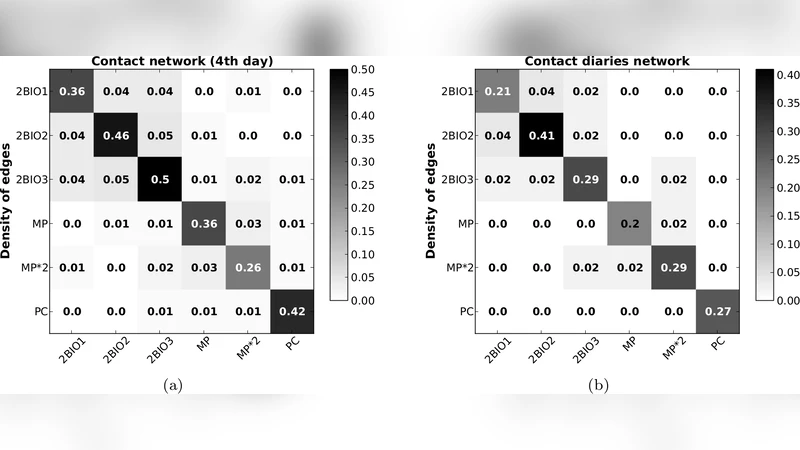
Given their importance in shaping social networks and determining how information or diseases propagate in a population, human interactions are the subject of many data collection efforts. To this aim, different methods are commonly used, from diaries and surveys to wearable sensors. These methods show advantages and limitations but are rarely compared in a given setting. As surveys targeting friendship relations might suffer less from memory biases than contact diaries, it is also interesting to explore how daily contact patterns compare with friendship relations and with online social links. Here we make progresses in these directions by leveraging data from a French high school: face-to-face contacts measured by two concurrent methods, sensors and diaries; self-reported friendship surveys; Facebook links. We compare the data sets and find that most short contacts are not reported in diaries while long contacts have larger reporting probability, with a general tendency to overestimate durations. Measured contacts corresponding to reported friendship can have durations of any length but all long contacts correspond to reported friendships. Online links not associated to reported friendships correspond to short face-to-face contacts, highlighting the different nature of reported friendships and online links. Diaries and surveys suffer from a low sampling rate, showing the higher acceptability of sensor-based platform. Despite the biases, we found that the overall structure of the contact network, i.e., the mixing patterns between classes, is correctly captured by both self-reported contacts and friendships networks. Overall, diaries and surveys tend to yield a correct picture of the structural organization of the contact network, albeit with much less links, and give access to a sort of backbone of the contact network corresponding to the strongest links in terms of cumulative durations.
💡 Research Summary
This paper presents a comprehensive comparison of four data‑collection methods for face‑to‑face interactions among high‑school students in Marseille, France. Over one week in December 2013, 327 students from nine specialized classes participated in a SocioPatterns wearable‑sensor deployment, a paper‑based contact diary, a friendship nomination survey, and a Facebook friendship extraction using Netvizz. The sensor system recorded proximity events every 20 seconds with a detection range of 1–1.5 m, achieving an 86 % participation rate and capturing more than one million contact events. In contrast, only 120 students (≈37 %) completed the diary and 135 students (≈41 %) answered the friendship survey; 17 students provided Facebook data, yielding a few hundred online links.
The analysis proceeds in three parts. First, the authors compare sensor data with diary reports. Short contacts (≤5 min) are rarely reported (≈20 % reporting probability), whereas contacts lasting longer than one hour are reported with >85 % probability. Reported durations are systematically over‑estimated, on average by a factor of 1.5, reflecting cognitive biases in time perception. Second, the overlap between sensor contacts and friendship nominations is examined. While friendships span the full range of contact durations, the longest sensor‑detected contacts (>1 h) are exclusively found among nominated friends, indicating that strong social ties correspond to prolonged face‑to‑face interaction. Conversely, many brief contacts are captured only by sensors and do not appear in the friendship network. Third, Facebook friendships are compared with both sensors and the friendship survey. Online links overlap only partially with survey‑based friendships (≈30 % overlap) and are predominantly associated with short sensor contacts, suggesting that online ties represent a distinct social dimension not directly tied to intensive physical interaction.
Structural analyses focus on class‑level mixing matrices. Sensor‑derived matrices show high intra‑class link density (≈0.45) and lower inter‑class density (≈0.12). When the same matrices are built from diary and friendship data—after symmetrising directed reports—the relative pattern of intra‑ versus inter‑class mixing is preserved, despite the absolute number of links being 5–10 times smaller. This indicates that, for purposes such as epidemic modeling where the coarse‑grained mixing structure is crucial, low‑cost survey methods can reliably reproduce the essential topology.
The discussion highlights complementary strengths and weaknesses. Sensors provide complete, objective, temporally resolved contact data but require hardware, infrastructure, and suffer from non‑participation of a subset of the population. Surveys and diaries are inexpensive and capture social relationship information (friendship, online ties) that sensors miss, yet they are subject to recall bias, duration over‑estimation, and low response rates. The authors argue that the choice of method should be driven by research goals: detailed transmission dynamics demand sensor data, whereas studies focused on social structure or coarse‑grained mixing can rely on surveys.
In conclusion, the study demonstrates that short, incidental contacts are largely invisible to self‑reports, while long, meaningful interactions are well captured by both sensors and friendship nominations. Online friendships occupy a separate layer, mostly linked to brief physical encounters. By integrating multiple data sources, researchers can obtain a richer, multi‑layered view of human contact patterns, improving the fidelity of models in epidemiology, sociology, and related fields.
Comments & Academic Discussion
Loading comments...
Leave a Comment