Cohomology of real Grassmann manifold and KP flow
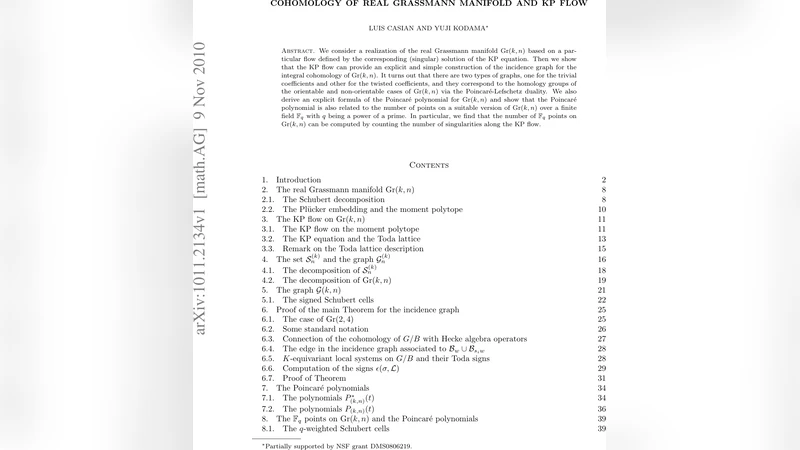
We consider a realization of the real Grassmann manifold Gr(k,n) based on a particular flow defined by the corresponding (singular) solution of the KP equation. Then we show that the KP flow can provide an explicit and simple construction of the incidence graph for the integral cohomology of Gr(k,n). It turns out that there are two types of graphs, one for the trivial coefficients and other for the twisted coefficients, and they correspond to the homology groups of the orientable and non-orientable cases of Gr(k,n) via the Poincare-Lefschetz duality. We also derive an explicit formula of the Poincare polynomial for Gr(k,n) and show that the Poincare polynomial is also related to the number of points on a suitable version of Gr(k,n) over a finite field $\F_q$ with q being a power of a prime. In particular, we find that the number of $\F_q$ points on Gr(k,n) can be computed by counting the number of singularities along the KP flow.
💡 Research Summary
The paper presents a novel approach to computing the integral cohomology of the real Grassmann manifold Gr(k,n) by exploiting a particular flow generated by a singular solution of the Kadomtsev‑Petviashvili (KP) equation. Traditionally, the cohomology of Gr(k,n) has been obtained through Schubert cell decompositions and cellular chain complexes, which involve intricate boundary calculations. The authors instead start from the τ‑function representation of a KP solution, choosing initial data that correspond to a specific Schubert cell. As the KP flow evolves in time, the τ‑function continuously deforms, sweeping across the entire Grassmannian and encoding precisely when one cell is attached to another.
From this dynamical picture they construct an incidence graph whose vertices are the Schubert cells and whose directed edges represent inclusion relations dictated by the KP flow. Two distinct families of graphs arise depending on the coefficient system used for the cellular boundary operator. The first family employs ordinary integer coefficients ℤ; the resulting graph reproduces the usual cellular boundary map and computes the cohomology groups H⁎(Gr(k,n);ℤ). This case corresponds to the orientable situation, i.e., when the product k·(n‑k) is even. The second family uses a twisted local system ℤ̃, introducing an extra sign change on each boundary. This twisted graph captures the cohomology with local coefficients H⁎(Gr(k,n);ℤ̃) and is appropriate for the non‑orientable case (k·(n‑k) odd). By Poincaré‑Lefschetz duality the two graphs are dual to each other, reflecting the relationship between ordinary cohomology and compact‑support cohomology with twisted coefficients.
The incidence graph enables a direct enumeration of cells in each dimension, leading to an explicit formula for the Poincaré polynomial
\
Comments & Academic Discussion
Loading comments...
Leave a Comment