Weak Alfven-Wave Turbulence Revisited
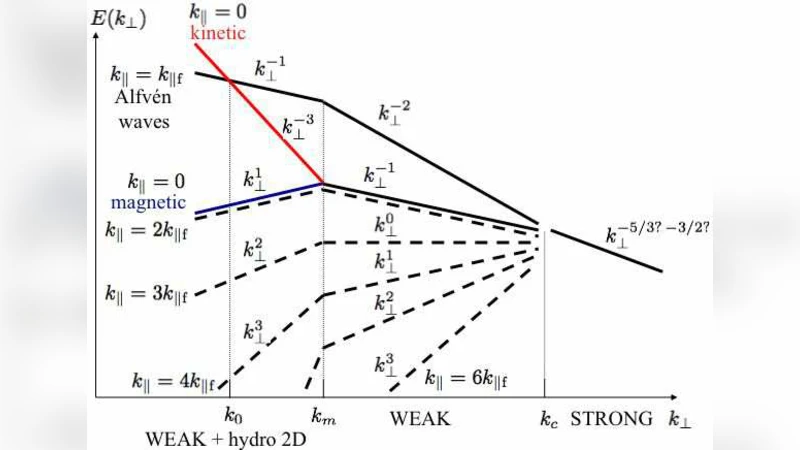
Weak Alfvenic turbulence in a periodic domain is considered as a mixed state of Alfven waves interacting with the two-dimensional (2D) condensate. Unlike in standard treatments, no spectral continuity between the two is assumed and indeed none is found. If the 2D modes are not directly forced, k^{-2} and k^{-1} spectra are found for the Alfven waves and the 2D modes, respectively, with the latter less energetic than the former. The wave number at which their energies become comparable marks the transition to strong turbulence. For imbalanced energy injection, the spectra are similar and the Elsasser ratio scales as the ratio of the energy fluxes in the counterpropagting Alfven waves. If the 2D modes are forced, a 2D inverse cascade dominates the dynamics at the largest scales, but at small enough scales, the same weak and then strong regimes as described above are achieved.
💡 Research Summary
The paper revisits weak Alfvén‑wave turbulence in a periodic box by treating the system as a mixture of propagating Alfvén waves (with non‑zero parallel wavenumber k∥) and a two‑dimensional (2D) condensate (k∥ = 0). Unlike the standard weak‑turbulence approach, which assumes a continuous spectrum across k∥ = 0, the authors deliberately break this continuity and analyse the two components separately. Starting from reduced magnetohydrodynamics (RMHD) written in terms of Elsasser potentials ζ±, they Fourier‑transform in the parallel direction and separate the evolution equations for k∥ ≠ 0 waves and k∥ = 0 modes.
When the 2D modes are not directly forced, their only source of energy is the oscillatory nonlinear coupling to the Alfvén waves. By averaging out the rapidly oscillating factors, the authors estimate the amplitude of the k∥ = 0 modes as proportional to the product of the two counter‑propagating wave amplitudes divided by the Alfvén frequency ωA = k∥ vA. Balancing the injected power ε with the nonlinear transfer yields the familiar k⊥⁻² spectrum for the Alfvén waves (E¹(k⊥) ∝ k⊥⁻²) and a shallower k⊥⁻¹ spectrum for the 2D condensate (E⁰(k⊥) ∝ k⊥⁻¹). The two spectra intersect at a critical perpendicular wavenumber
k_c ≈ (ω_A³/ε)¹/²,
where the Alfvén time τ_A = 1/ω_A becomes comparable to the nonlinear time τ_nl. This marks the transition from weak turbulence to a critically balanced, strong regime that is expected to develop a Kolmogorov‑like k⊥⁻⁵/³ (or possibly k⊥⁻³/²) spectrum.
The authors then consider imbalanced forcing, i.e., ε⁺ ≠ ε⁻. The same scaling arguments give ζ± ∝ ε±³/⁸ ε∓¹/⁸ ω_A¹/⁴ k⊥⁻³/², leading to identical k⊥⁻² wave spectra for both Elsasser fields but with amplitudes that reflect the ratio of the injected fluxes. Consequently, the Elsasser energy ratio scales as (ε⁺/ε⁻)¹/², a result that standard weak‑turbulence theory could not obtain without solving the full kinetic equation.
A third regime is explored where the k∥ = 0 modes are directly forced (hydrodynamically). In this case the 2D condensate decouples from the waves and obeys the 2D Euler equation, producing an inverse energy cascade to the largest scales and a direct enstrophy cascade to smaller scales. The kinetic‑energy spectrum of the condensate follows the classic k⊥⁻³ law, while the forced Alfvén waves are passively advected by this flow, acquiring a k⊥⁻¹ spectrum. The magnetic component of the condensate behaves as a passive scalar, yielding a k⊥² spectrum for magnetic fluctuations. The intersection of the condensate and wave spectra occurs near the forcing scale if the power injected into the 2D flow and the waves is comparable.
The paper also discusses higher‑order parallel harmonics (k∥ = n k∥ f) generated by the oscillatory terms, showing that their amplitudes grow with k⊥ and become comparable to the primary forced mode at the same critical wavenumber k_c, reinforcing the picture of a cascade that eventually reaches the strong‑turbulence regime.
Overall, the study provides a coherent phenomenological framework that separates the dynamics of Alfvén waves and the 2D condensate, predicts distinct spectral slopes for each, and identifies the precise scale at which weak turbulence breaks down. By abandoning the artificial continuity across k∥ = 0, the authors resolve several inconsistencies of earlier weak‑turbulence theories and offer explanations for spectral features observed in numerical simulations and astrophysical plasmas, such as the presence of a “slaved” 2D component and the non‑universal slopes in strongly imbalanced turbulence. The work thus bridges the gap between idealized infinite‑domain theories and the finite‑box settings commonly used in simulations, highlighting the importance of the 2D condensate in shaping the overall turbulent cascade.
Comments & Academic Discussion
Loading comments...
Leave a Comment