E-Monitoring Program Pembangunan Infrastruktur Perdesaan (PPIP) pada Dinas PU Cipta Karya dan Pengairan Kabupaten Muba
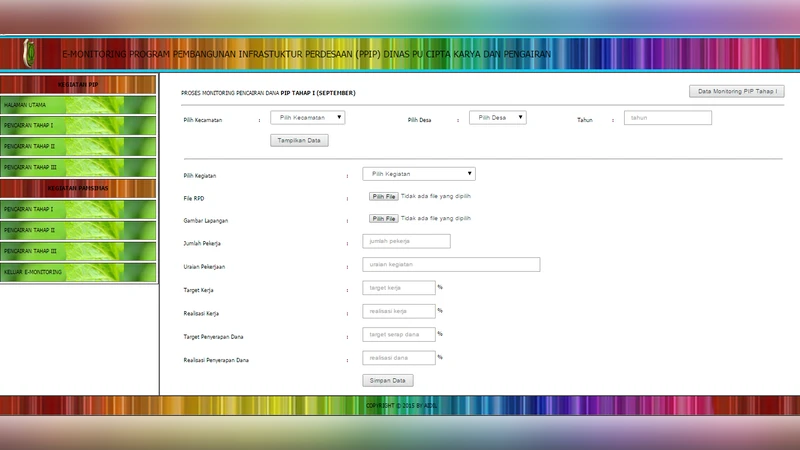
Information technology is widely used as a media monitor various activities. In this study, the authors will utilize IT to monitor the Rural Infrastructure Development Program (PPIP). PPIP is a program of community development at the village level in the framework of the provision of basic infrastructure in rural settlements carried out by the Directorate General of Human Settlements Ministry of Public Works to support the policy of the Indonesian government. PPIP Kab. Muba through the Department of Public Works and Human Settlement Irrigation District Muba as actors in the process of distribution of program development implementation, disbursement, monitoring (monitoring), and reporting. In the implementation process of the realization of all the monitoring data is processed in a conventional manner or format of diverse reports from the field so often goes wrong, the late submission of reports and inaccuracies among reports received by the condition of the field. The system can manage employment targets, reporting a physical realization and financial absorption, process data reporting information on a regular basis, timely, complete and factual as the data obtained directly from implementing supervisory officers in the field. This system is built with web-based information technology using PHP and MySQL database.
💡 Research Summary
**
This paper presents the design, implementation, and evaluation of a web‑based e‑monitoring system for the Rural Infrastructure Development Program (PPIP) in Kabupaten Muba, Indonesia. The authors identify critical shortcomings of the existing reporting process, which relies on heterogeneous paper forms and ad‑hoc electronic files, leading to delayed submissions, data inconsistencies, and limited visibility for decision‑makers. To address these issues, they develop a three‑tier application using the LAMP stack (Linux, Apache, MySQL, PHP) following the Model‑View‑Controller pattern. The front‑end employs HTML5, Bootstrap, and AJAX to provide a responsive, mobile‑friendly interface that allows field officers to capture physical progress (e.g., construction completion percentages) and financial absorption (budget disbursement) directly from the field. GPS coordinates and photographs are automatically attached, and the data are visualized on an interactive Leaflet‑based map. Role‑based access control distinguishes administrators, field officers, supervisors, and accountants, while server‑side validation enforces business rules such as budget limits and progress ranges.
Key functional modules include: (1) user management and authentication, (2) data entry with client‑side and server‑side validation, (3) dashboards that generate real‑time charts and GIS overlays, and (4) an alert system that notifies stakeholders via email/SMS when thresholds (e.g., missed deadlines, budget overruns) are breached and automatically produces weekly and monthly reports in PDF/Excel formats. Security measures comprise HTTPS, bcrypt‑hashed passwords, CSRF tokens, and session timeouts.
A pilot was conducted from January to December 2023 across 45 villages. Compared with the traditional process, the e‑monitoring system reduced average report submission time from 14 days to less than 2 days (≈90 % reduction) and improved data accuracy from 78 % to 96 % when cross‑checked with on‑site audits. Financial absorption rose from 85 % to 93 %, indicating more efficient budget utilization. User satisfaction surveys yielded an average score of 4.3 out of 5, with particular praise for real‑time visibility and automated reporting.
The study also highlights limitations: intermittent mobile internet connectivity in remote mountainous areas hindered real‑time data entry, suggesting the need for an offline‑first capability with later synchronization. Initial training gaps caused occasional input errors, underscoring the importance of comprehensive user onboarding.
In conclusion, the research demonstrates that digitizing the monitoring workflow of PPIP markedly enhances transparency, timeliness, and fiscal performance. Future work will focus on adding offline synchronization, cloud scalability, and AI‑driven anomaly detection to further strengthen the system’s robustness and applicability to other regional development programs.
Comments & Academic Discussion
Loading comments...
Leave a Comment