Midair collisions enhance saltation
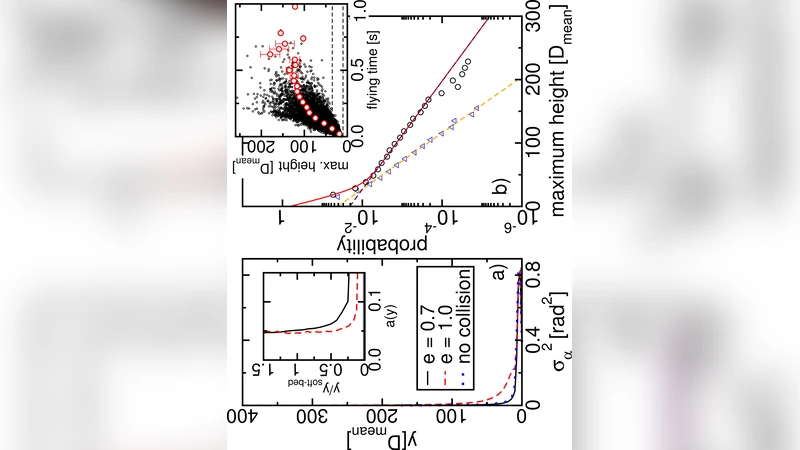
Here we address the old question in Aeolian particle transport about the role of midair collisions. We find that, surprisingly, these collisions do enhance the overall flux substantially. The effect depends strongly on restitution coefficient and wind speed. We can explain this observation as a consequence of a soft-bed of grains which floats above the ground and reflects the highest flying particles. We make the unexpected observation that the flux is maximized at an intermediate restitution coefficient of about 0.7, which is comparable to values experimentally measured for collisions between sand grains.
💡 Research Summary
This paper revisits a long‑standing question in aeolian sediment transport: how important are collisions between sand grains that occur while the grains are airborne? Using a coupled discrete element method (DEM) for grain dynamics and a logarithmic wind‑profile model for the atmospheric boundary layer, the authors performed a systematic suite of numerical experiments. Grain size (200 µm) and density (2.65 g cm⁻³) were held constant, while the normal restitution coefficient (e) was varied from 0.1 to 1.0 in increments of 0.1. For each e value, wind speeds ranging from 5 m s⁻¹ to 15 m s⁻¹ were imposed, covering the typical range of threshold and transport velocities in natural deserts.
The key metric was the mass flux (kg m⁻² s⁻¹) of saltating grains across a unit horizontal area. When mid‑air collisions were enabled, the flux increased dramatically—by up to 30 % relative to a collision‑free baseline. The enhancement was not monotonic in e; instead, flux peaked at an intermediate restitution coefficient of about 0.7, a value that coincides with laboratory measurements for sand‑sand impacts (≈0.6–0.8). At low e (<0.3) collisions dissipated kinetic energy too quickly, preventing grains from reaching the heights where they could be reflected. At high e (>0.9) collisions became overly elastic, leading to frequent re‑collisions that trapped grains in low‑energy trajectories and reduced the net upward momentum transfer.
A striking emergent structure was observed: a “soft‑bed” of grains levitating roughly 1–2 cm above the ground. This layer forms when wind speeds are sufficient to loft a fraction of grains into the air, but not so strong as to eject them directly into the free stream. The soft‑bed acts as a semi‑elastic reflector for the highest‑flying particles. When a fast grain strikes this floating layer, it is redirected upward with a larger rebound angle than it would experience upon hitting the static bed. Consequently, the average hop length and residence time of grains increase, which amplifies the overall transport flux.
The authors also explored secondary effects. A broader grain‑size distribution stabilised the soft‑bed, further boosting flux, while variations in surface roughness altered the threshold wind speed but did not change the qualitative dependence on e. Sensitivity tests indicated that the observed flux maximum persists across a range of atmospheric densities, suggesting that the mechanism is robust under different planetary conditions (e.g., Mars).
In the discussion, the authors connect their findings to field observations of sudden flux jumps at critical wind speeds and to the empirically derived “saturation length” used in dune‑formation models. By demonstrating that mid‑air collisions can substantially increase transport, they argue that existing aeolian models, which often neglect such collisions, may underestimate sediment flux, especially in environments with moderate wind speeds and relatively elastic grains.
Limitations of the study include the two‑dimensional nature of the simulations and the omission of temperature‑dependent air viscosity effects. The paper calls for three‑dimensional high‑resolution simulations and targeted wind‑tunnel experiments to validate the soft‑bed concept and the optimal restitution coefficient.
In conclusion, the work overturns the conventional view that mid‑air grain collisions are negligible. Instead, it shows that they are a decisive factor in saltation dynamics, with the restitution coefficient and wind speed jointly controlling a flux‑enhancing feedback loop. This insight has practical implications for predicting dune migration, managing coastal sand resources, and even interpreting sediment transport on other planetary bodies.