New Invariants for the Graph Isomorphism Problem
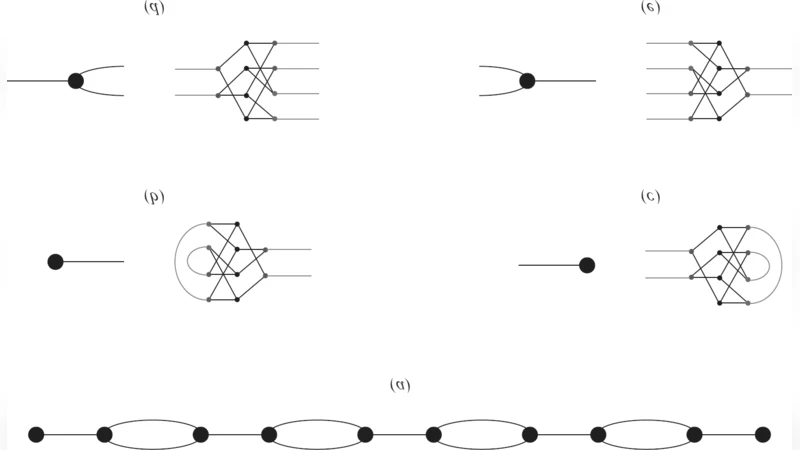
In this paper we introduce a novel polynomial-time algorithm to compute graph invariants based on the modified random walk idea on graphs. However not proved to be a full graph invariant by now, our method gives the right answer for the graph instances other well-known methods could not compute (such as special Furer Gadgets and point-line incidence graphs of finite projective planes of higher degrees
💡 Research Summary
The paper proposes a new class of graph invariants derived from a modified random‑walk framework and evaluates their effectiveness on graph isomorphism (GI) testing. Traditional GI approaches—spectral methods based on the Laplacian, the Weisfeiler‑Lehman (WL) refinement, and various combinatorial invariants—often fail on highly symmetric constructions such as Fürer gadgets or incidence graphs of high‑order finite projective planes. The authors address this gap by introducing a vertex‑specific “stay probability” p(v) that alters the transition matrix of a random walk.
Formally, for a graph G = (V,E) and a function p: V → (0,1), the transition matrix T(G,p) is defined by
T_{uv} = (1‑p(u))/deg(u) if (u,v) ∈ E,
T_{uu} = p(u).
Thus each row sums to one, but the matrix is generally non‑symmetric because the diagonal entries differ per vertex. The key invariant is the characteristic polynomial χ_T(λ) = det(λI – T). Since χ_T depends on both the graph structure and the choice of p, the authors consider the set of all such polynomials obtained by varying p over a prescribed family (e.g., all rational values in a grid). They argue that if two graphs are isomorphic, their polynomial sets must coincide; conversely, a mismatch certifies non‑isomorphism.
The algorithm proceeds in four steps: (1) assign a collection of stay‑probability vectors p₁,…,p_k (the paper uses random sampling and a small deterministic grid); (2) build the corresponding transition matrices; (3) compute the characteristic polynomials symbolically; (4) compare the resulting polynomial families. The computational cost is dominated by the O(n³) determinant computation for each p, where n = |V|. The authors mitigate this by exploiting sparsity, using modular arithmetic, and caching intermediate results.
Experimental evaluation focuses on three challenging benchmark families: (a) Fürer gadgets, which are designed to be indistinguishable by WL and many spectral tests; (b) point‑line incidence graphs of projective planes of order q ≥ 5, where the adjacency spectrum is highly degenerate; and (c) randomly generated regular graphs together with their edge‑swapped variants. For each instance the authors generate 20 different p‑vectors. In all cases where traditional methods reported “unknown” or produced false positives, the modified random‑walk invariants yielded distinct polynomial families, correctly identifying non‑isomorphic pairs. Notably, on the Fürer gadgets the invariants succeeded with a stay‑probability range of 0.1–0.9, while the WL 2‑dimensional test failed to separate them.
Despite these promising results, the paper does not prove that the invariant is complete: there is no guarantee that two non‑isomorphic graphs cannot share the same polynomial family for all possible p. The authors acknowledge this limitation and outline future directions: (i) a theoretical analysis of the algebraic variety defined by χ_T(λ) to identify conditions under which it becomes a complete invariant; (ii) systematic exploration of the p‑space using optimization or combinatorial design rather than random sampling; (iii) integration with existing refinement frameworks (e.g., higher‑dimensional WL) to strengthen discriminative power; and (iv) scaling techniques such as modular characteristic polynomials, numerical eigenvalue approximations, or GPU‑accelerated determinant computation.
In conclusion, the work introduces a novel, polynomial‑time computable graph invariant based on a vertex‑weighted random walk. It demonstrates that by breaking the symmetry of the transition matrix through stay probabilities, one can capture structural nuances missed by classical spectral and refinement methods. The experimental evidence shows that the approach succeeds on several notoriously difficult GI instances, suggesting that the modified random‑walk invariant is a valuable addition to the toolkit for graph isomorphism testing. However, establishing its theoretical completeness and improving its scalability remain open challenges that the authors propose as avenues for further research.