Arrow type impossibility theorems over median algebras
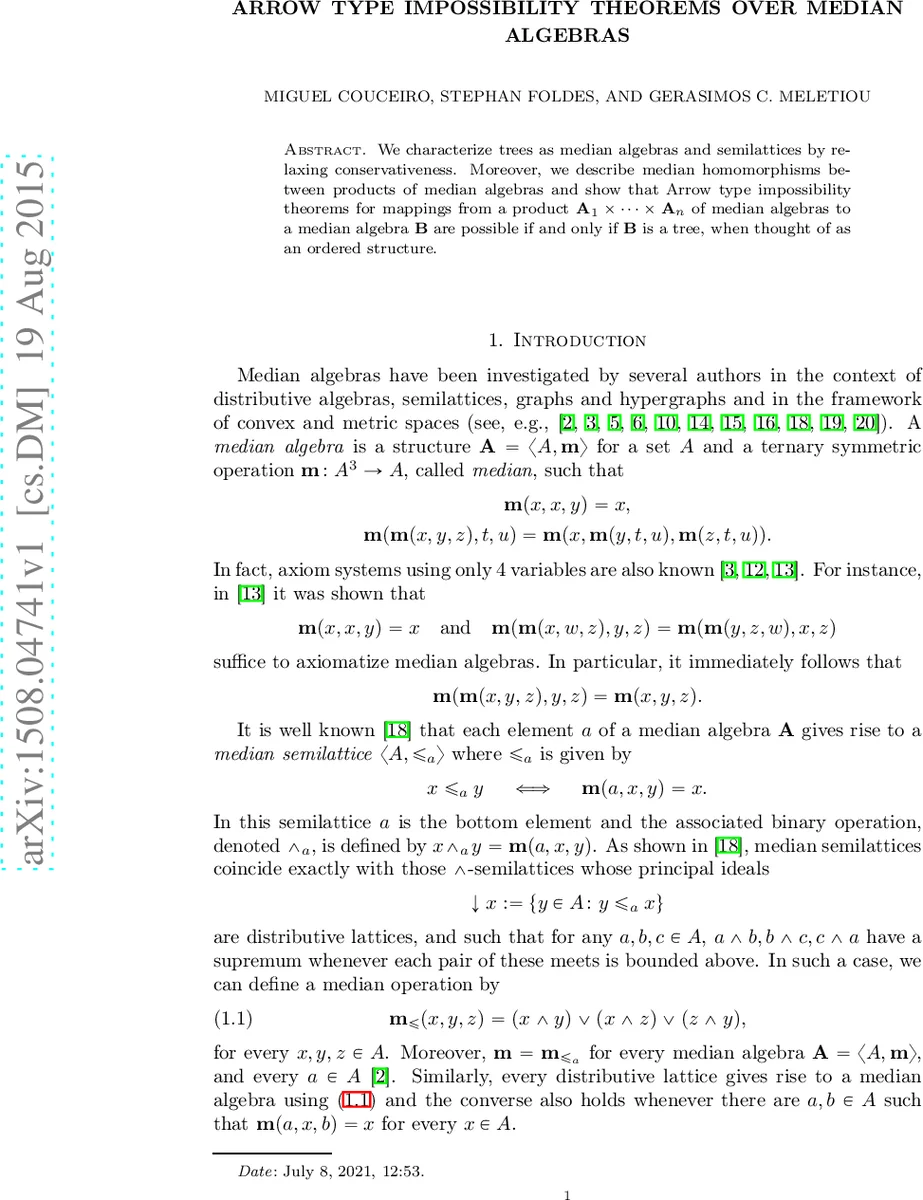
We characterize trees as median algebras and semilattices by relaxing conservativeness. Moreover, we describe median homomorphisms between products of median algebras and show that Arrow type impossibility theorems for mappings from a product $\mathbf{A}_1\times \cdots \times \mathbf{A}_n$ of median algebras to a median algebra $\mathbf{B}$ are possible if and only if $\mathbf{B}$ is a tree, when thought of as an ordered structure.
💡 Research Summary
The paper investigates median algebras—structures equipped with a symmetric ternary operation m that satisfies the usual median identities—and their relationship with semilattices and tree‑like ordered sets. After recalling the classical correspondence between a median algebra (A,m) and the family of binary operations ∧ₐ defined by x∧ₐy = m(a,x,y), the authors turn to the well‑studied class of conservative median algebras, where m(x,y,z) always belongs to {x,y,z}. Conservative median algebras are known to be representable as two lower‑bounded chains glued at their minima, i.e., essentially linear orders.
The authors introduce a weaker condition, called a p₂:₃‑median semilattice. For every triple x,y,z∈A they require
m(x,y,z) ∈ { x∧y, x∧z, y∧z } ⊆ { x∧y, y∧z, z∧x }.
This relaxation still forces a strong comparability property: if two elements are incomparable, they cannot share a common upper bound unless one of them already dominates the other. The central Theorem 3.2 proves that the following statements are equivalent: (i) there exists a distinguished element p such that (A,∧ₚ) satisfies the p₂:₃ condition; (ii) the condition holds for every p; (iii) there exists p such that (A,∧ₚ) is a tree (an acyclic undirected graph when viewed as a poset); (iv) the same holds for every p; (v) every interval
Comments & Academic Discussion
Loading comments...
Leave a Comment