Jump at the onset of saltation
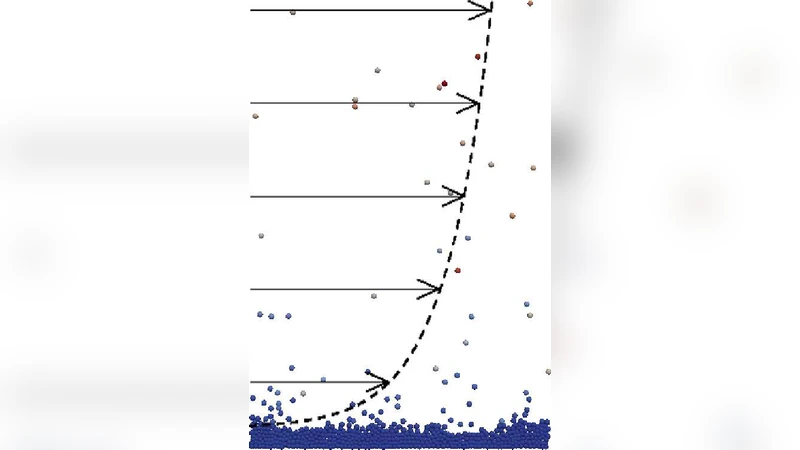
We reveal a discontinuous transition in the saturated flux for aeolian saltation by simulating explicitly particle motion in turbulent flow. The discontinuity is followed by a coexistence interval with two metastable solutions. The modification of the wind profile due to momentum exchange exhibits a second maximum at high shear strength. The saturated flux depends on the strength of the wind as $q_s=q_0+A(u_-u_t)(u_^2+u_t^2)$.
💡 Research Summary
The paper presents a novel, fully particle‑resolved numerical study of aeolian saltation that uncovers a discontinuous transition in the saturated sediment flux at the onset of transport. Unlike earlier work that relied on Bagnold’s empirical cubic law or on pre‑specified splash functions, the authors simulate the motion of individual grains in a turbulent wind field using a discrete element method (DEM) coupled with a height‑dependent logarithmic wind profile. Each grain experiences gravity, a drag force whose coefficient follows Cheng’s formulation (accounting for a wide range of Reynolds numbers), and a lift force proportional to the local shear‑induced pressure gradient. Grain‑grain collisions are modeled with a spring‑dashpot contact law, and the equations of motion are integrated with a Velocity‑Verlet scheme.
The wind profile is initially the classic logarithmic law (u(y)=u_* \kappa \ln(y/y_0)). As grains accelerate, they extract momentum from the flow; the authors compute the grain‑induced stress (\tau_g(y)) by integrating drag forces over height, then iteratively solve a modified differential form of the log‑law to obtain a self‑consistent wind profile that accounts for this feedback. This procedure reproduces the well‑known “Bagnold focus” where modified velocity profiles intersect at a characteristic height above the bed.
Simulations are performed in a two‑dimensional domain populated with 500 spherical particles whose diameters follow a narrow Gaussian distribution around a mean value (D_{\text{mean}}). The bed roughness is set to (y_0 = D_{\text{mean}}/30). Periodic lateral boundaries and a reflective top are used; the lower boundary is heavily damped to prevent rebound‑induced spurious ejections.
The key results are expressed in terms of the Shields number (\theta = u_*^2 (s-1) g D_{\text{mean}} / \nu^2). Two critical Shields numbers are identified: a lower threshold (\theta_t \approx 0.037) below which no grain is lifted, and an upper critical value (\theta_c \approx 0.048) that separates a metastable regime from a fully developed saltation regime. For (\theta_t < \theta < \theta_c) the system exhibits bistability: depending on initial conditions or external perturbations (e.g., occasional random lifts of surface grains with probability (c=0.2) or a prescribed lift force), the flow either dies out or settles into a sustained transport state. This metastable region is characterized by strong sensitivity to perturbations, highlighting the importance of turbulent lift in real environments.
At (\theta = \theta_c) the saturated, dimensionless flux (\tilde q = q \rho_s /
Comments & Academic Discussion
Loading comments...
Leave a Comment