Studying the Affecting Factors on Trust in Social Commerce
Recently, e-commerce has enjoyed the appearance of many novel opportunities created as a result of the increasing growth of social networks. Social commerce (s-commerce), an offspring of e-commerce, i
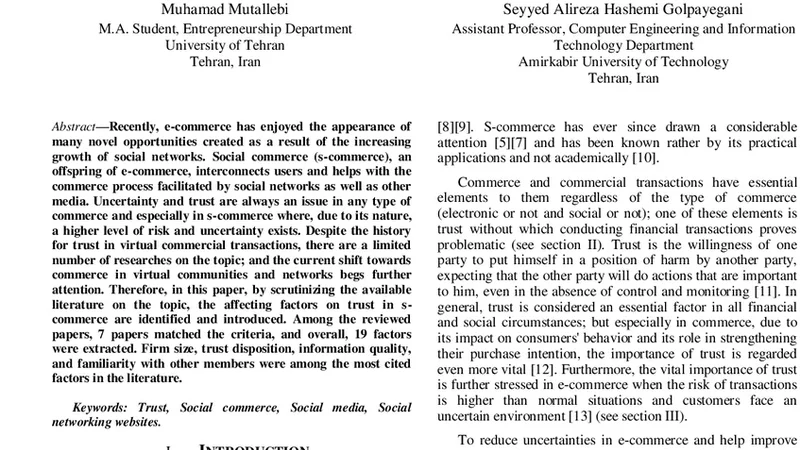
Recently, e-commerce has enjoyed the appearance of many novel opportunities created as a result of the increasing growth of social networks. Social commerce (s-commerce), an offspring of e-commerce, interconnects users and helps with the commerce process facilitated by social networks as well as other media. Uncertainty and trust are always an issue in any type of commerce and especially in s-commerce where, due to its nature, a higher level of risk and uncertainty exists. Despite the history for trust in virtual commercial transactions, there are a limited number of researches on the topic; and the current shift towards commerce in virtual communities and networks begs further attention. Therefore, in this paper, by scrutinizing the available literature on the topic, the affecting factors on trust in scommerce are identified and introduced. Among the reviewed papers, 7 papers matched the criteria, and overall, 19 factors were extracted. Firm size, trust disposition, information quality, and familiarity with other members were among the most cited factors in the literature.
💡 Research Summary
Social commerce (s‑commerce) merges the transactional functions of traditional e‑commerce with the interactive, community‑driven features of social networking platforms. While this integration creates new marketing opportunities, it also amplifies perceived risk and uncertainty because purchase decisions are influenced not only by the seller but also by peer‑generated content, recommendations, and social cues. Consequently, trust becomes a pivotal determinant of consumer intention in s‑commerce, yet the existing trust literature has largely focused on conventional online retail settings and has paid limited attention to the unique dynamics of socially mediated commerce.
This paper addresses that gap by conducting a systematic literature review (SLR) to identify and synthesize the factors that affect trust in social commerce. The authors searched major academic databases (Scopus, Web of Science, Google Scholar) using keywords such as “social commerce,” “trust,” and “online trust factors.” The search window covered publications from 2010 onward. Inclusion criteria required that a study (1) explicitly examine a social commerce context (e.g., Facebook Shops, Instagram Shopping), (2) treat trust as either an independent or dependent construct, and (3) propose or test specific antecedents of trust. After screening titles, abstracts, and full texts, only seven peer‑reviewed articles satisfied all criteria.
From these seven studies the authors extracted a total of 19 distinct trust‑influencing variables. For analytical clarity, the variables were grouped into four overarching categories:
-
Individual/Psychological Factors – Trust disposition (a general propensity to trust), risk‑aversion tendency, prior online purchase experience, and privacy sensitivity. These variables capture the consumer’s internal attitudes and risk perceptions that shape how they evaluate social commerce offers.
-
Firm/Platform Characteristics – Firm size, brand reputation, and overall service quality (including delivery speed, return policies, and customer support). Larger firms tend to be perceived as more stable and financially secure, which bolsters trust, while strong brand equity can compensate for other perceived deficiencies.
-
Information/Technology Factors – Information quality (accuracy, completeness, timeliness), security mechanisms (SSL, two‑factor authentication), and transparency of privacy policies. High‑quality product information reduces ambiguity, and visible security cues lower perceived transaction risk.
-
Social/Relational Factors – Familiarity with other members, social presence (e.g., real‑time chat, profile pictures), word‑of‑mouth (user reviews and recommendations), and overall community activity level. These elements reflect the social fabric of the platform; trust can be transferred from known peers to the transaction environment.
Among the 19 variables, four emerged as the most frequently cited across the reviewed literature: firm size, trust disposition, information quality, and familiarity with other members. This convergence suggests that trust in s‑commerce is simultaneously shaped by structural (firm‑level), cognitive (individual disposition), informational (content quality), and relational (social network) dimensions.
The authors also discuss interaction effects. For instance, high information quality can mitigate the negative impact of a consumer’s low trust disposition, while strong community familiarity can offset the disadvantage of a small firm size. Such synergistic relationships imply that a simple additive model of trust determinants may be insufficient; future research should explore multiplicative or moderated frameworks.
Practical implications are drawn for platform operators and marketers. First, investing in robust, accurate product descriptions and visual media is essential to enhance perceived information quality. Second, designing features that increase user familiarity—such as friend‑following mechanisms, community forums, and reputation scores—can amplify social trust. Third, smaller merchants should leverage storytelling, transparent policies, and consistent service delivery to compensate for limited brand size. Fourth, explicit security badges and clear privacy statements should be prominently displayed to lower perceived risk.
Limitations of the study include the small sample of only seven papers, which may not capture the full diversity of s‑commerce contexts (e.g., cultural variations, niche platforms). Moreover, most included studies rely on cross‑sectional surveys, limiting causal inference between identified factors and actual purchase behavior.
Future research directions proposed are: (1) expanding the SLR to incorporate a broader set of disciplines and languages, thereby increasing the generalizability of findings; (2) investigating affective variables such as enjoyment, satisfaction, and emotional attachment, which may interact with cognitive trust constructs; (3) examining the role of AI‑driven recommendation engines and algorithmic transparency on trust formation; and (4) employing longitudinal or experimental designs that track real‑time trust dynamics using social media analytics and transaction data.
In summary, this paper systematically maps the multidimensional antecedents of trust in social commerce, highlighting the interplay between firm attributes, consumer psychology, information quality, and social relationships. By consolidating existing evidence and identifying research gaps, it provides a foundation for both scholars and practitioners aiming to build more trustworthy, lower‑risk s‑commerce ecosystems.
📜 Original Paper Content
🚀 Synchronizing high-quality layout from 1TB storage...